.webp)
Technical interview scorecard examples by role
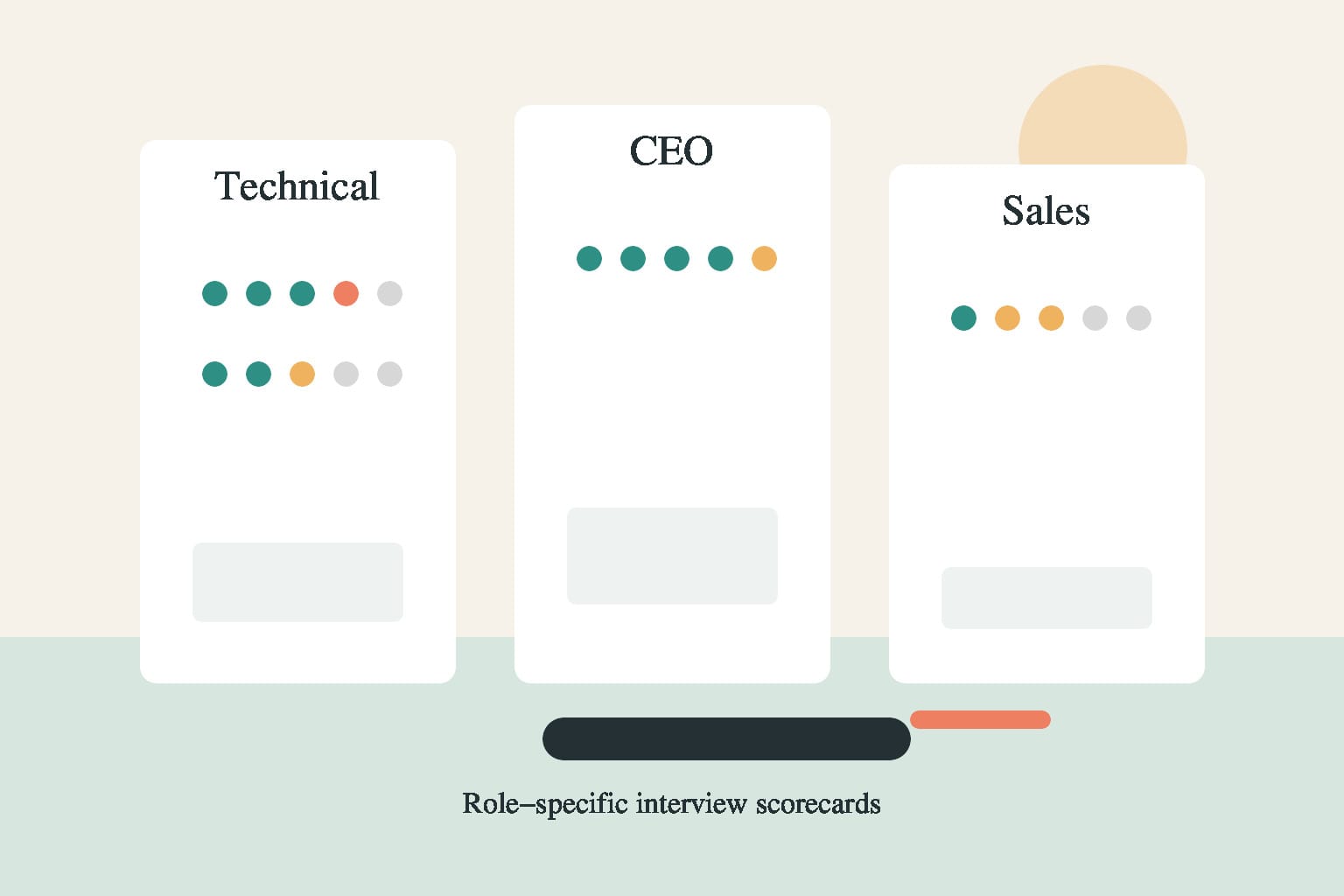
Role-specific scorecard examples for technical, CEO and sales interviews, with 1-5 rating anchors and evidence notes.
Why role-specific scorecards matter
A technical interview scorecard is not a generic interview form with "technical skills" typed into the first row. The point of an interview scorecard is to turn the job into observable evidence, so interviewers are comparing candidates on the same work-relevant signals rather than on charm, fluency or who happened to be asked the kindest follow-up question.
That is why role-specific scorecards matter. A CEO, a senior engineer and a sales lead all need judgement, communication and resilience, but they do not demonstrate those things in the same way. For a technical hire, useful evidence might be the trade-offs in a system design answer. For a CEO, it might be how they explain a painful strategic choice to a board. For sales, it might be whether they can diagnose a buyer's problem before pitching. Generic scorecards are better than nothing, but only if you treat them as scaffolding rather than scripture.
The research base is unusually consistent for a hiring topic. Campion, Palmer and Campion (1997) argue that interview structure improves reliability and validity because it standardises both what is asked and how answers are evaluated. Dana, Dawes and Peterson (2012) explain the other half of the problem: unstructured interviews encourage sensemaking, where interviewers create a neat story from noisy evidence. Later work on overconfidence shows that unstructured interview information can make people more confident and less accurate.
The examples below use the same underlying mechanics: role-specific criteria, a defined 1-5 scale, evidence notes and independent scoring before the debrief. The content changes by role. The discipline does not.
The common structure every scorecard needs
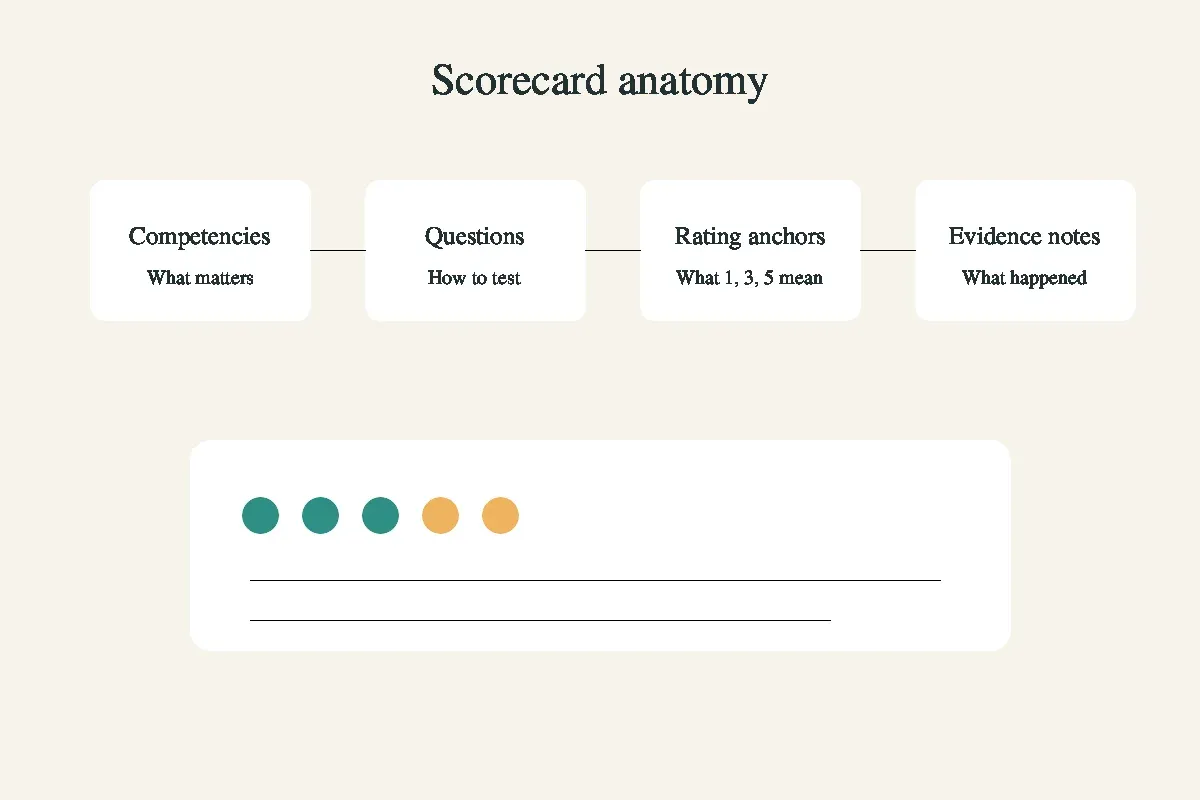
Every useful scorecard has five parts. First, it names the competencies that matter for the role. Second, it gives interviewers questions or work samples that elicit evidence for those competencies. Third, it uses a simple 1-5 rating scale with behavioural anchors. Fourth, it requires notes that justify each rating. Fifth, it asks for an overall recommendation only after the evidence has been scored.
The rating scale is where many teams quietly lose the plot. "Rate communication from 1 to 5" sounds tidy, but it is just vibes with arithmetic. A stronger scale defines the anchor. A 1 means the candidate did not demonstrate the capability or showed evidence against it. A 3 means they met the role bar with credible, specific examples. A 5 means unusually strong evidence for the level, with examples that would raise expectations for the hire.
Campion, Palmer and Campion (1997) place anchored rating scales, rating each answer, detailed notes and interviewer training among the components of structure. Levashina, Hartwell, Morgeson and Campion (2013) later describe structure as standardisation of questions and response scoring. In plainer English: ask comparable questions, evaluate comparable evidence, and stop pretending that a lively debrief is the same as measurement.
Weighting can help, but only after the criteria are sound. A senior backend role might weight system design and debugging more heavily than presentation polish. A first sales hire might weight discovery and qualification more heavily than CRM tidiness. Keep the weights simple enough that interviewers will use them during a normal hiring week, not only during the workshop where everyone solemnly nodded at the spreadsheet.
Technical interview scorecard example
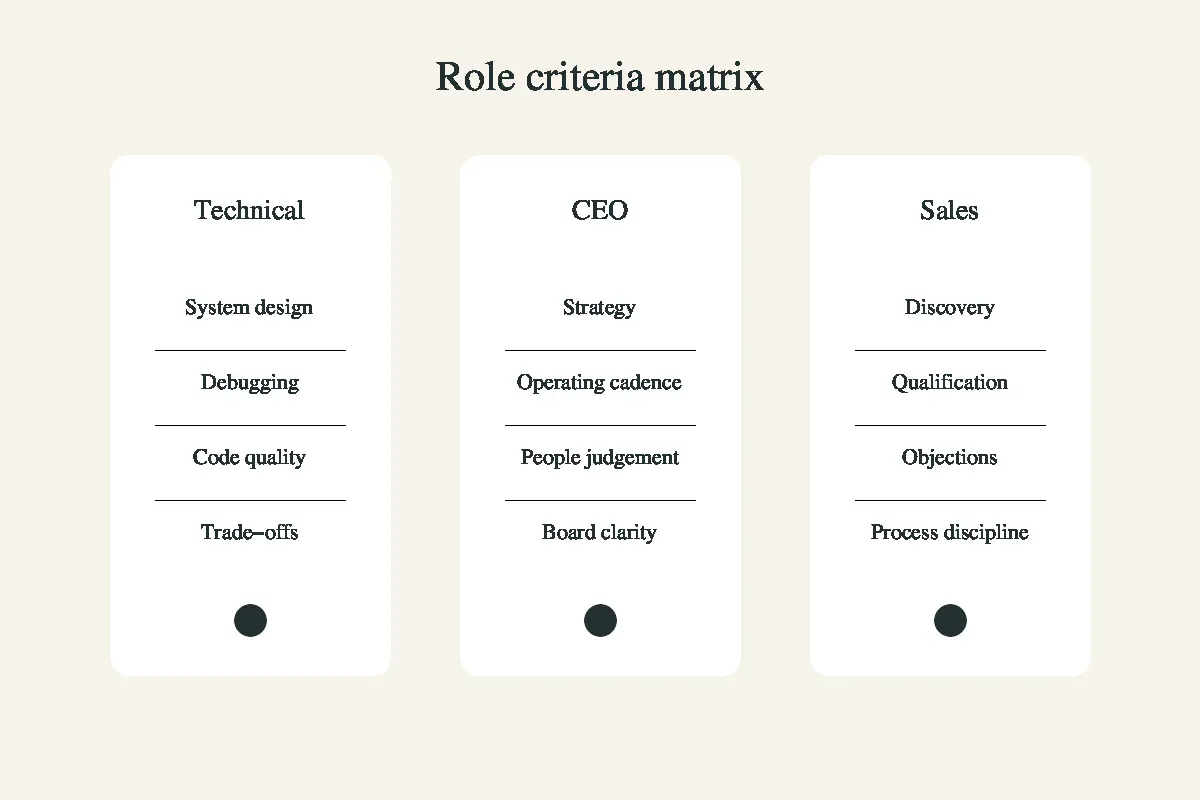
A technical interview scorecard should measure how the candidate works through technical problems, not whether they can perform confidence under fluorescent lighting. A practical set of criteria for a software engineering role might include system design, problem decomposition, code quality, debugging, technical communication and collaboration. For some roles, security judgement, data modelling or product sense will replace one of those. The scorecard should follow the job, not a template's mood.
A compact system-design row might look like this:
- 1: Gives high-level architecture without meaningful trade-offs, failure modes or scaling assumptions.
- 3: Proposes a coherent design, names key components, explains at least two trade-offs and responds sensibly to constraints.
- 5: Frames the problem clearly, quantifies constraints, anticipates bottlenecks and adjusts the design when new evidence appears.
That is a better test than asking a clever-sounding puzzle and then rewarding the candidate who has seen it before. The technical scorecards need job-specific criteria and evidence fields principle matters because technical interviews can otherwise confuse speed with skill. A candidate who pauses to test an assumption may be showing better engineering judgement than one who sprints to the first plausible answer.
McDaniel, Whetzel, Schmidt and Maurer (1994) found that interview validity depends partly on content and conduct, with structured formats outperforming unstructured ones. Levashina et al. (2013) also stress that structured interviews can be designed to measure different constructs. For technical hiring, that means deciding what technical judgement really looks like in your environment, then asking interviewers to capture evidence rather than impressions.
The notes field is not decoration. "Strong backend engineer" is not evidence. "Explained why a write-heavy system would need asynchronous processing, named the consistency risk, and changed approach when latency requirements changed" is evidence. It gives the debrief something firmer than personality weather.
CEO interview scorecard example
A CEO interview scorecard needs more care because executive interviews are storytelling machines. Senior candidates are usually articulate, practised and comfortable with ambiguity. That is not a criticism. It is the job. The risk is that interviewers mistake polish for evidence and leave the room with a heroic narrative rather than a decision record.
Useful CEO criteria normally include strategic judgement, operating cadence, capital allocation, people judgement, board communication and values under pressure. The questions should force concrete episodes. "Tell us about your strategy" invites a keynote. "Talk us through a strategic bet you reversed, what evidence changed your mind, and what you told the team" gives the panel something to score.
The anchor design should reflect the level. For strategic judgement, a 1 might be a candidate who talks in slogans, cannot name trade-offs, or externalises every poor outcome. A 3 might describe a plausible strategy, the constraints around it and the operating changes that followed. A 5 should show unusually clear diagnosis, explicit trade-offs, learning from contrary evidence and the ability to align people without pretending the decision was painless.
This is where Dana, Dawes and Peterson (2012) are particularly useful. Their work explains why unstructured interviews feel so convincing: people make sense of almost anything once they are in conversation. A board interview should therefore ask candidates the same questions and score them against the same criteria, even if the conversation around those questions is appropriately senior.
For CEO hiring, the scorecard should not flatten judgement into pretend precision. It should make the evidence visible enough that the panel can distinguish disagreement about standards from disagreement about what actually happened.
Sales interview scorecard example and how to install it
A sales interview scorecard should not reward the person who sells themselves most loudly in the interview. It should test whether they can understand a buyer, qualify honestly, handle objections, manage a process and learn from feedback. Common criteria include discovery, qualification, objection handling, commercial judgement, coachability, written follow-up and CRM discipline. The exact list should depend on your sales motion. Enterprise sales, founder-led sales and high-volume transactional sales are not the same sport.
For discovery, the anchors might be simple. A 1 means the candidate pitches before diagnosing, asks generic questions and misses the buyer's business context. A 3 means they ask sensible questions, identify a problem and connect it to a plausible next step. A 5 means they uncover urgency, decision process, constraints and risk without making the conversation feel like an interrogation conducted by a spreadsheet. That last part matters. Structure should improve judgement, not remove all signs of human life.
The practical literature is aligned here: sales scorecards commonly focus on discovery, objection handling and process discipline. The same logic applies to templates. An interview scorecard template Excel file or Interview Scoring Sheet PDF is useful if it helps the team ask better questions and capture evidence. It is weak if it becomes a static attachment nobody calibrates.
This is the bridge to implementation. Most hiring teams do not fail because they dislike evidence. They fail because every role is rebuilt from scratch under time pressure, every interviewer has a private definition of "good", and the debrief rewards the most fluent opinion. HireSchool's Structured Hiring Method is built for that problem: a self-guided digital programme that helps small businesses and scale-ups install a consistent structured hiring process across interview flow, capabilities, candidate assessment and decision mechanics.
It is not a consultancy parade, and nobody needs six weeks of discovery calls to learn that "good communicator" is too vague. The programme gives teams the structure to decide what they are testing, build the scorecard, run interviews consistently and make decisions from evidence. For a small business hiring technical, CEO-level or sales roles, that is the difference between a template that looks professional and a process that actually changes the decision.
The minimum viable installation is straightforward. Define the role outcomes first. Pick five to seven criteria. Write anchors for 1, 3 and 5. Give each interviewer a defined area to test. Require independent scorecards before discussion. In the debrief, start with evidence, not recommendations. If the notes cannot support the score, the score is not ready yet.
How to use the examples without turning them into theatre
The obvious danger is that structure becomes theatre. The team asks the same questions, fills in the same boxes, and still hires the person everyone liked after three minutes. The form did its paperwork. The judgement did not move.
That critique is real. There is a fair concern that the critique that structure can become box-ticking applies when scorecards reward expected phrases rather than useful evidence. A candidate can learn to say "I collaborate cross-functionally" on command. Your scorecard should ask for the situation, the constraint, the action, the result and the trade-off they would now handle differently.
Use the examples in this article as working patterns, not finished doctrine. For each role, define the outcomes, choose the criteria, write behavioural anchors, calibrate interviewers on a sample answer, score independently and review the scorecard after a few hires. Levashina et al. (2013) make clear that structure is about standardising questions and scoring. Dana, Dawes and Peterson (2012) remind us why this matters: unstructured conversation feels more diagnostic than it is.
The best scorecard is a decision instrument. It helps a team slow down just enough to notice what evidence they have, what evidence they lack and where confidence has arrived ahead of proof. That is not bureaucracy. That is hiring with a memory longer than the last persuasive anecdote.