.webp)
Consistent hiring process: fair interviews across teams
How to keep interviews fair across teams with structured questions, scorecards, calibration, and evidence-led hiring decisions.

Why consistency fails when teams start hiring
A consistent hiring process is rarely destroyed by bad intentions. It is usually chipped away by sensible people making local decisions. A founder wants to test urgency. A sales leader wants "presence". A product manager wants sharp trade-off thinking. Each interview feels reasonable on its own, but the process no longer collects the same evidence from each candidate.
That is where interview consistency breaks. Candidates are compared as if they sat the same assessment, when in practice they met different interviewers, answered different questions and were judged against different private standards. SHL's interview research describes high variability across interviewers, even for a single profile. In one reported analysis, only 40% of interviewers followed the prescribed questions.
The psychology is not flattering, but it is useful. Dana, Dawes and Peterson (2012) show that unstructured interviews create sensemaking: interviewers feel they have uncovered something meaningful, even when the information is noisy. Bohnet (2016) makes the management version of the same point: hiring managers often trust unstructured conversations because they feel human and expert-led. They also conflate liking someone with predicting performance.
The result is a debrief full of confident fragments. One person saw spark. Another saw risk. Nobody can quite say whether those judgements came from job evidence or from the interviewer taking a scenic route through their own preferences.
What a consistent hiring process actually means
Consistency does not mean every role gets the same interview, or that hiring becomes a script read with the warmth of a parking fine. It means every candidate for the same role is assessed against the same job-relevant capabilities, through planned questions and exercises, scored with the same rules.
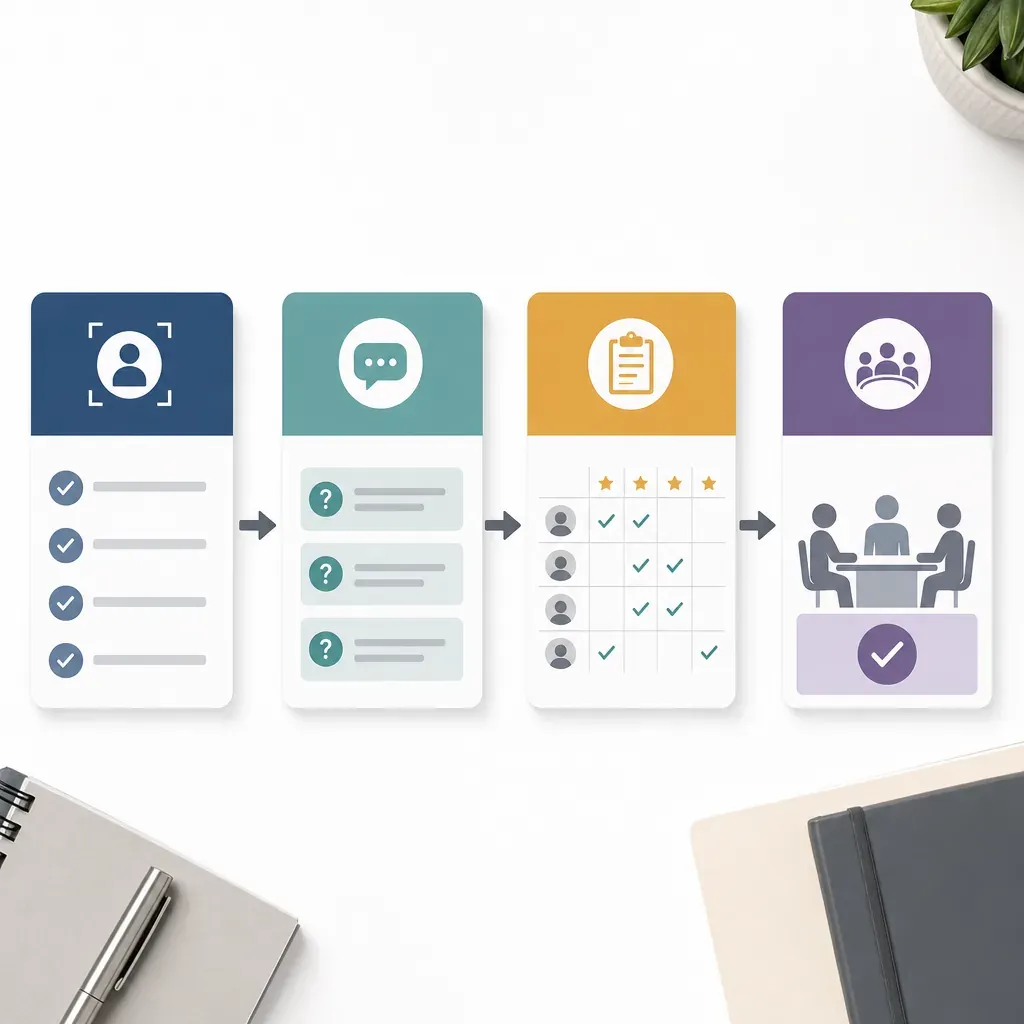
A structured interview is the interview format that supports that discipline. OPM's practical guide defines the core mechanics as same questions and common rating scale, with interviewers agreeing in advance what good answers look like. That is not bureaucracy for its own sake. It is how you make candidate evidence comparable.
Campion, Palmer and Campion (1997) go further. Their review breaks interview structure into 15 components, including job analysis, same questions, limited prompting, anchored rating scales, detailed notes, interviewer training and rules about discussion. Levashina et al. (2013) later summarise structure as predetermined rules for questions, observations and evaluations.
In plain English, a consistent hiring process has four linked parts. First, define the capabilities the job needs. Second, choose the interview questions or work samples that reveal those capabilities. Third, score the evidence on a shared scorecard. Fourth, make decisions after independent ratings, not during the warm glow of a persuasive anecdote.
The evidence: structure beats interview theatre
The research case for structure is not new, which is slightly awkward given how many hiring processes still run on charm, memory and a heroic belief in "good judgement". Wiesner and Cronshaw (1988) found that structured interviews produced mean validity coefficients about twice as high as unstructured interviews. Their meta-analysis also linked stronger validity to reliability and formal job-analytic information.
McDaniel, Whetzel, Schmidt and Maurer (1994) reached a similar conclusion in a larger meta-analysis based on 245 coefficients from 86,311 individuals. Structured interviews had higher validity than unstructured interviews, and job-related or situational content performed better than interview content drifting into vague psychological impressions.
The mechanism is not mysterious. Structure reduces random variation in what each interviewer asks, how much prompting they give, what they write down and how they translate an answer into a score. Levashina et al. (2013) found strong evidence across multiple meta-analyses that structured interviews are more reliable and valid than unstructured interviews.
The red flag in a job interview, from the employer's side, is not a candidate needing a moment to think. It is a process where nobody can trace a hiring judgement back to job evidence. "Strong communicator" is not evidence. "Explained how she diagnosed a late-stage implementation risk, named the trade-offs and set a recovery plan" is evidence.
There is one caveat worth taking seriously. A fixed question list can create rigidity without the consistency benefits if the team skips job analysis, role-specific criteria, anchored scoring and calibration. Structure is not the template. Structure is the operating discipline behind the template.
Build the scorecard before anyone interviews
The scorecard is where a consistent hiring process becomes concrete. Without it, interviewers carry the criteria in their heads, where they can quietly mutate. With it, the team has a shared answer to three questions: what capability are we testing, what evidence would show it and how strong was that evidence?
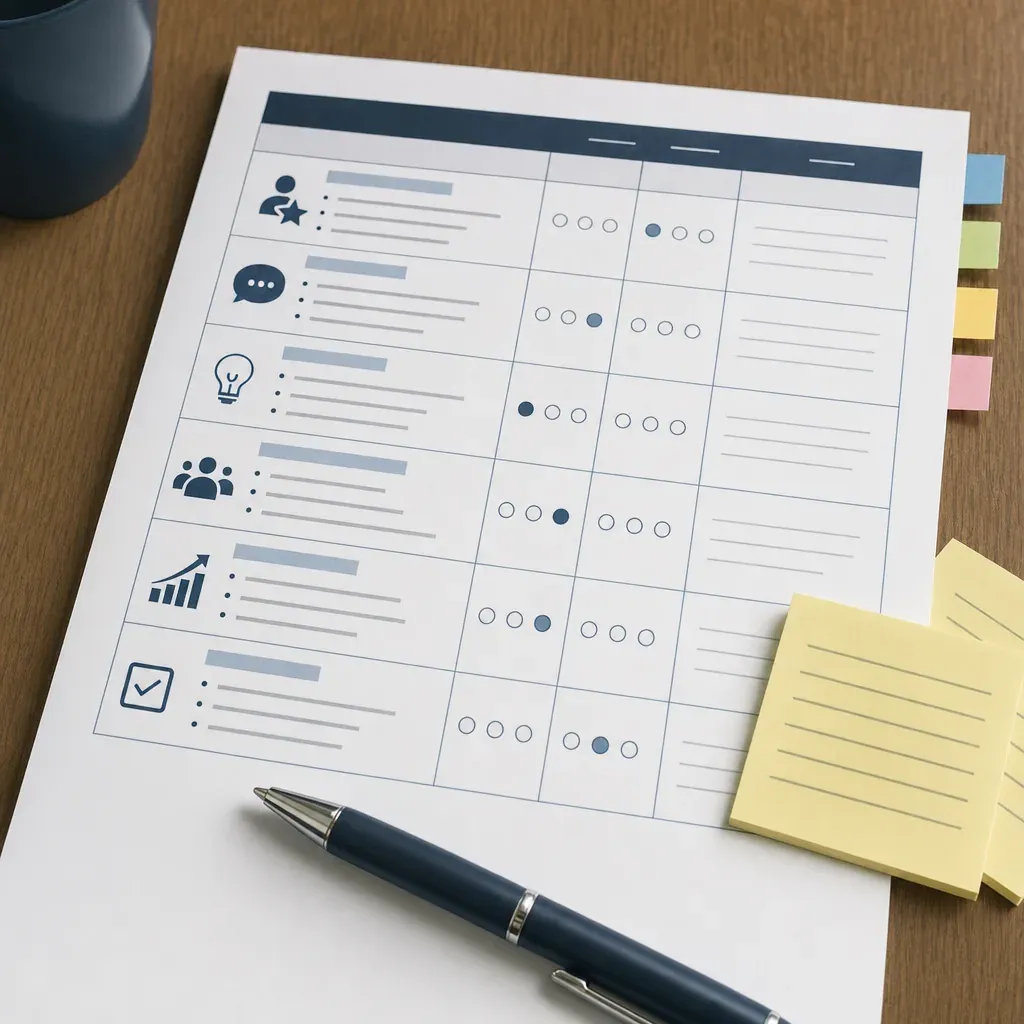
A useful scorecard is not complicated. For each capability, include a short definition, the question or task used to test it, an anchored rating scale, space for evidence notes and any decision weight. Anchored matters. "3 = meets the bar" is weaker than "3 = identifies the main risks, explains trade-offs and proposes a workable next step without prompting".
Campion, Palmer and Campion (1997) include anchored rating scales, detailed notes and rating each answer among the components that improve interview structure. Bohnet (2016) adds a practical behavioural rule: score each answer immediately, before memory and halo effects start tidying the candidate into a story.
The scorecard should also protect the debrief from performance art. A recommendation without evidence is only a mood wearing a blazer. The strongest rule is simple: no rating should exist without supporting evidence. If an interviewer cannot write down what they observed, the team should be cautious about giving that judgement weight.
A hiring process flowchart teams can actually follow
The usual five stages of the hiring process are attraction, screening, interviewing, selection and offer. That is fine as a map of movement. It is not enough as a control system. For interview consistency across teams, use a more operational flowchart: define the role, design the assessment, train the interviewers, run the interviews, then decide and review.
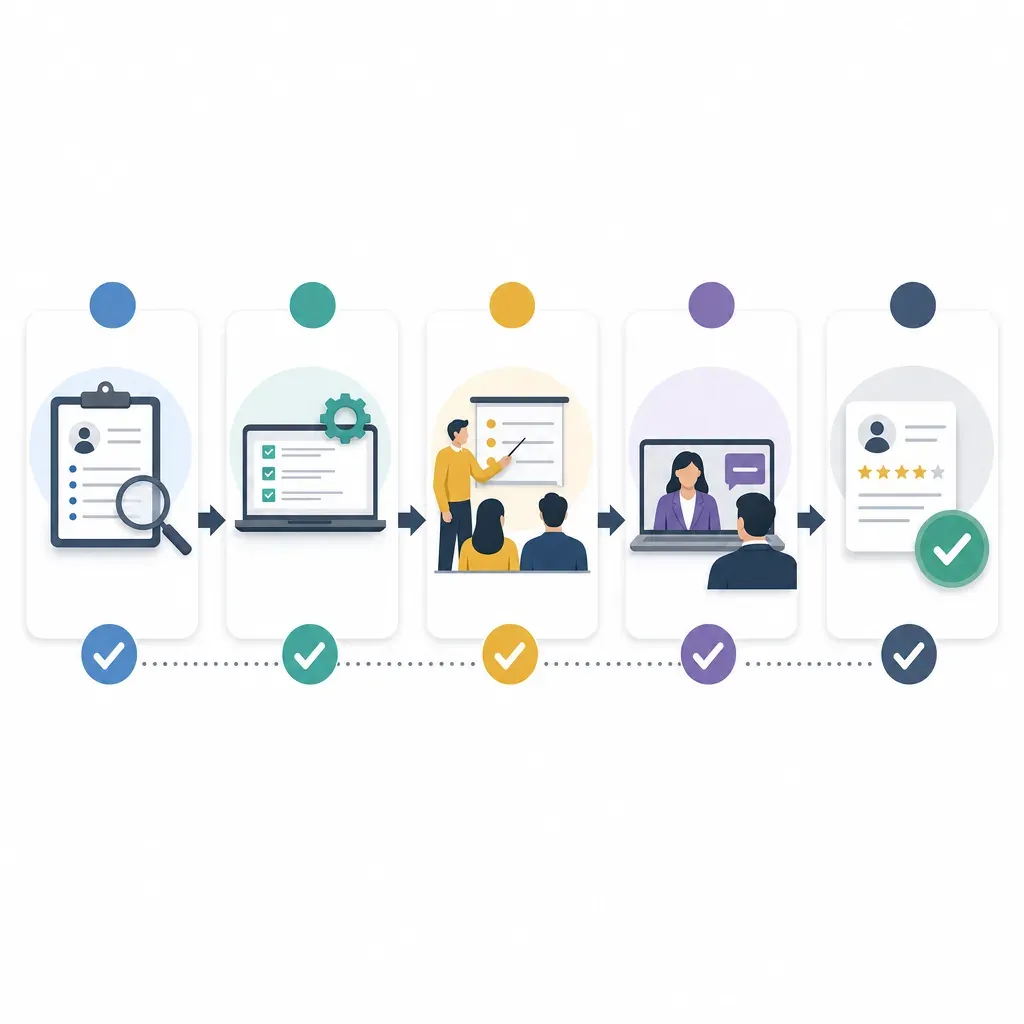
First, define the role in terms of outcomes and capabilities, not a wishlist of flattering adjectives. Second, design each hiring step so it tests something specific. Screening might test baseline requirements. A work sample might test task skill. A structured interview might test judgement, collaboration or problem solving.
Third, train interviewers on the question set, scorecard and what good evidence looks like. This is where many teams go oddly shy. They will spend hours debating the candidate pipeline, then give interviewers a calendar invite and hope standards arrive by osmosis. They do not.
Fourth, run the interviews consistently. OPM's hiring-manager guidance recommends that interviewers ask all candidates the same questions and give them the same amount of time. A useful version of the 70/30 rule in hiring is to let roughly 70% of interview time produce candidate evidence and keep roughly 30% for context, follow-up and candidate questions. It is not a law of physics. It is a guardrail against interviewers doing most of the talking.
Fifth, decide after independent scoring. Levashina et al. (2013) describe structure as predetermined rules for evaluation as well as questioning. That means the decision meeting should compare evidence, resolve genuine disagreement and record why the final choice follows from the criteria.
How to install consistency without becoming a consultancy project
Most small businesses and scale-ups do not reject structured hiring because they have carefully considered the evidence and found it wanting. They reject it because it feels like a project that will require consultants, workshops, software procurement, stakeholder alignment sessions and other phrases that make calendars lose the will to live.
The more practical route is to codify the process once, teach the people who use it and keep the system simple enough that busy managers actually follow it. That is the work of HireSchool's Structured Hiring Method: a self-guided digital programme that helps a business install a shared hiring process across interview flow, capabilities tested, candidate assessment and decision mechanics.
The point is not to turn founders or managers into occupational psychologists. It is to give them a usable method. The programme is delivered through video content and a learning management system, so teams can learn the same approach without bringing in consultants or waiting for a perfect HR function to appear. For a company where hiring is spread across founders, functional leads and first-time managers, that shared language matters.
This is also where a consistent hiring process becomes commercial rather than theoretical. If one team interviews for pace, another for polish and another for personal chemistry, the business is not scaling judgement. It is scaling preference. A shared method helps each team test the role properly while still leaving room for human judgement where it belongs: interpreting evidence, not inventing criteria mid-conversation.
It is not a generic question bank. It is not a software-first fix that assumes the process becomes rigorous because the buttons are prettier. And it is not a consultant-led transformation with a 64-slide deck and a suspiciously abstract maturity model. Teams can explore the Structured Hiring Method programme when they want the hiring standard written down, taught and used consistently across the people making the decisions.
Keep the system honest after the first hire
A consistent hiring process is not finished when the first scorecard is designed. It stays useful only if someone checks whether teams are following it. The SHL finding that only 40% of interviewers follow the prescribed questions is a good reminder: launch documents do not interview candidates. People do.
Keep the audit light, but real. Once a month, review a sample of interviews for question adherence, missing evidence, score spread, late changes to criteria, candidate feedback and post-hire signal. If every candidate gets the same middle score, the anchors are too soft. If one interviewer is consistently harsher, calibrate. If managers keep asking pet questions, decide whether the question belongs in the process or out of the room.
The 80% rule in hiring is useful if it stops teams chasing mythical perfection. A candidate can meet the job bar without satisfying every private preference. The 5 Cs or three Cs of hiring can be handy memory aids, but they should not replace role-specific criteria. "Culture", especially, is a word that needs adult supervision.
Fairness is not making every interviewer sound identical. It is giving candidates a comparable chance to show job-relevant evidence, then making teams explain their decisions against that evidence. That is quieter than gut feel. It is also better management.