.webp)
Interview scorecard templates: examples that beat gut-feel hiring
A working interview scorecard, fully rendered, plus the validity research behind it - and the failure modes that quietly undo most rollouts.
Why most interviews still run on instinct
Most hiring panels run on instinct, snacks, and the calendar of whoever booked the room. The interviewer asks a few questions, follows whichever answers seem interesting, and emerges sure they "know one when they see one". That confidence is real. The problem is that it has very little to do with whether the candidate will actually do the job.
The unstructured-interview literature is, by quiet consensus, embarrassing. Dana, Dawes and Peterson (2012) ran a study in which interviewees secretly answered questions according to a random system. The interviewers did not notice. Their predictions about the candidates were no worse, and no better, than they had been with sensible answers. People are extraordinarily good at making sense of nonsense and extraordinarily bad at noticing they are doing it. Bohnet (2016), reviewing the same territory in HBR, points to the University of Texas medical school natural experiment: when the legislature forced the school to admit 50 previously rejected applicants, those students performed indistinguishably from the original cohort. Roughly three-quarters of the gap between accepted and rejected candidates came from interviewer perception in unstructured interviews, not from grades.
The fix is not better instincts. It is an interview scorecard: a written rubric that turns the interview from a vibe into a measurement. A real structured interview hangs off one. The rest of this article makes the case from the validity research, renders an actual scorecard you can copy, and then names the failure modes that quietly undo most rollouts after a cycle or two.
What an interview scorecard actually is
An interview scorecard is a one-page scoring rubric. A small set of capabilities the role actually demands, a fixed numeric scale, behavioural anchors so two interviewers reading the same answer arrive at similar scores, a notes column for the evidence, and a final recommendation. That is the whole instrument. A scorecard is, in plain terms, the form your panel evaluates the candidate on while they are still in the room.
It is worth saying what a scorecard is not. A 14-tab spreadsheet handed to interviewers an hour before the interview is not a rubric; it is a compliance artefact. A list of forty competencies copied from a vendor template is not a rubric; it is a wish list. A rubric is something the panel can hold in working memory while listening, score against in real time, and explain to a candidate without flinching. If your scorecard cannot be printed on a single side of A4, it has stopped being a scorecard.
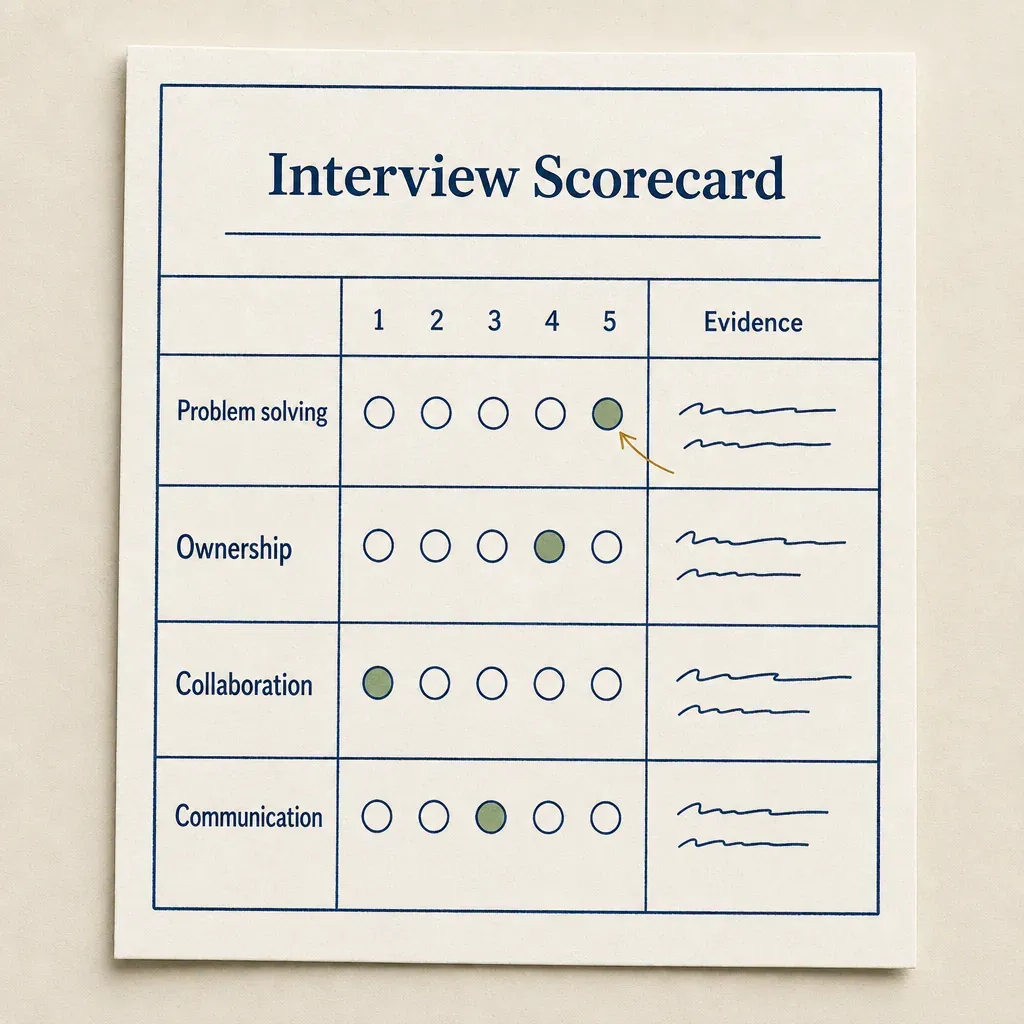
The research is unusually clear on which features matter. Campion, Palmer and Campion (1997), in their foundational review, identify anchored rating scales as the ninth of fifteen components of interview structure - and report that anchored scales achieve higher inter-rater reliability than unanchored ones. Levashina et al. (2013), updating the literature fifteen years on, put a number on it: with anchored rating scales, inter-rater reliability rose to r = 0.77, against r = 0.26 without. Two interviewers scoring the same candidate without anchors are doing roughly different jobs. With anchors, they are doing nearly the same one.
The anchors are the work. Everything else - the columns, the page layout, the choice of five points or ten - is housekeeping.
The evidence: predictive validity, in numbers
The argument for the scorecard is not aesthetic. It is the predictive validity figures, which have barely shifted in three decades.
McDaniel, Whetzel, Schmidt and Maurer (1994) ran the comprehensive meta-analysis: 245 validity coefficients across 86,311 individuals. Job-related structured interviews reached a mean validity of 0.51 against job-performance criteria. Unstructured interviews reached 0.39. Situational interviews - a structured format - landed at 0.50. Psychological interviews trailed at 0.29. The pattern is consistent across criteria and across formats: how you ask and score predicts performance better than what you ask. Wiesner and Cronshaw (1988) had reached the same conclusion six years earlier from a different angle, finding that structured interviews outperform unstructured ones by roughly a factor of two in mean criterion validity.
The picture has not softened. More recent re-analyses push the gap further, with structured interviews around 0.42 and unstructured around 0.19 - the headline conclusion is unchanged: structured interviewing is roughly twice as good at predicting who will do the job. None of this is a new finding waiting for a defining trial. It is a settled question that the field has been pretending was open for forty years.
Inter-rater reliability tells a parallel story. Levashina et al. (2013) report r = 0.77 with anchored rating scales versus r = 0.26 without. The caveat is that the underlying study count is small and the figure is striking; the direction of the effect is robust, the precise magnitude less so. But even at half the headline gap, anchored scales transform a panel from four people guessing to four people measuring.
The point worth carrying out of this section: the validity premium does not come from clever questions. It comes from the rating apparatus. The scorecard is the structure. Without it, the rest is theatre.
A concrete interview scorecard, fully rendered
Below is a working interview scorecard template for a mid-level individual contributor. Five capabilities, a five-point scale, behavioural anchors at three of the five points so the panel can interpolate, an evidence column, and weights. Treat it as the starting position; the capabilities and anchors should be rewritten against the actual role before anyone interviews against it.
| Capability | Score (1-5) | Evidence captured | Weight |
|---|---|---|---|
| Role-relevant problem solving | 1-5 | Specific situation, action taken, outcome. | 25 % |
| Ownership and accountability | 1-5 | What they did when nobody asked them to. | 20 % |
| Collaboration and influence | 1-5 | How they moved a peer or stakeholder, not just got along. | 20 % |
| Communication clarity | 1-5 | Whether the panel could follow the story without help. | 15 % |
| Learning agility | 1-5 | What they did with feedback or a setback. | 20 % |
The five-point scale uses the most widely-used five-point anchor language: 1 is wholly inadequate, 2 is poor or incomplete, 3 is basically adequate, 4 is strong and exceeds the basics, 5 is excellent and aligned with the ideal response. That is the scaffolding. The behavioural anchors do the actual work.
Below is the same scorecard with one capability fully anchored, so you can see what a usable rubric looks like. The skipped levels (1 and 4) interpolate between the rows above and below.
| Score | Role-relevant problem solving: what this looks like |
|---|---|
| 2 | Describes a problem in vague terms. Cannot say what they tried first, what they ruled out, or how they knew the fix worked. Outcome is "we sorted it". |
| 3 | Describes a real problem with a clear sequence: diagnosis, action, outcome. Reasoning is sound but conventional. Could be repeated by anyone with the same training. |
| 5 | Describes a non-obvious problem. Names a hypothesis they tested and one they discarded with evidence. Outcome is measurable. Volunteers what they would do differently. |

The shape repeats for each capability. Three behavioural anchors per row is usually enough; five is better if you have the time. The point is that two interviewers reading the same answer should arrive at the same score, and the anchors are what gets them there. A rubric without anchors is a number line with opinions on it.
How to build your own scorecard from scratch
Templates only travel so far. The best scorecard is the one you have built against the actual role, in your own language, with anchors drawn from the work your team actually does. The build itself is not complicated. It is just disciplined.
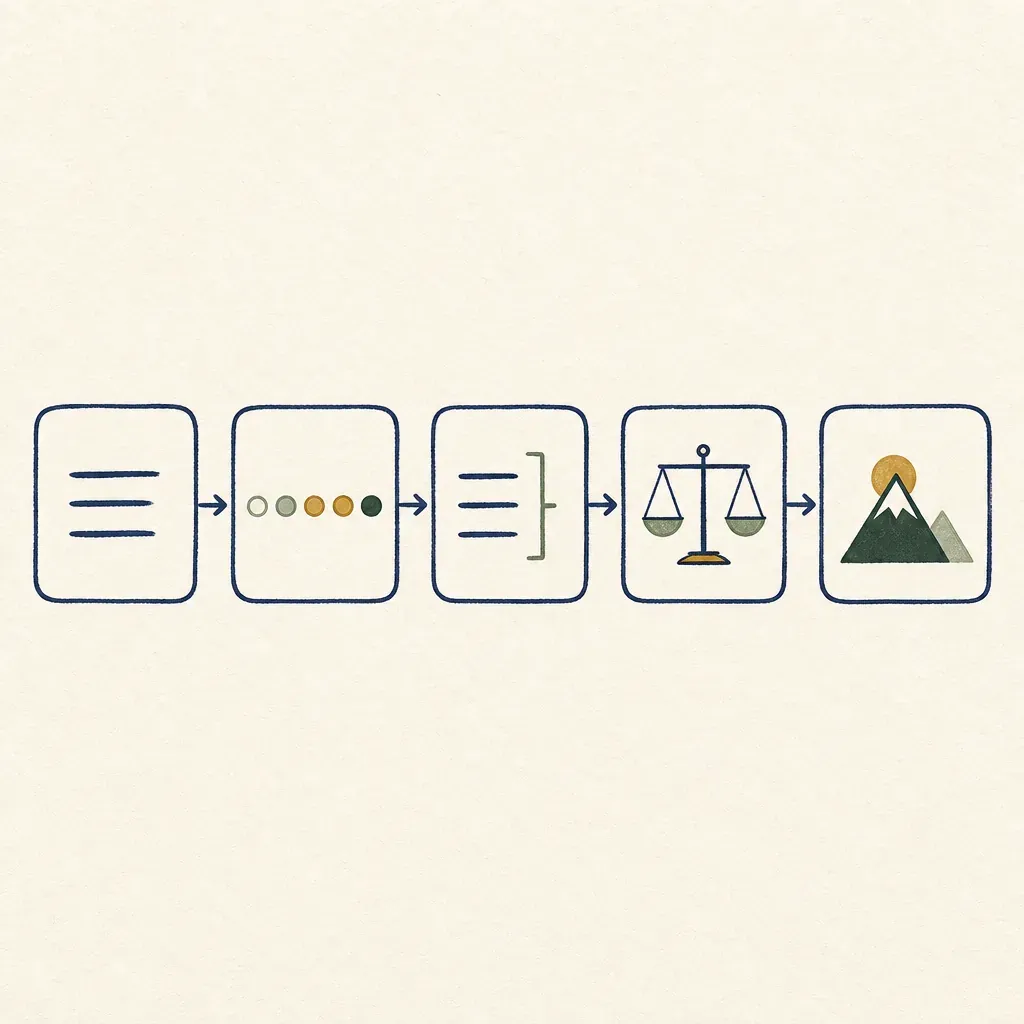
Step 1: write three to six core capabilities. Not a wish list. The capabilities the candidate will actually be assessed on, this round, by this panel. If you cannot fit it on one page, you have not picked yet.
Step 2: pick the rating scale. Five points is the workable default. Wide enough to discriminate, narrow enough that the panel can hold it in their heads. The mechanics matter less than the anchors that sit on it. McClelland (1998), in the foundational paper on Behavioural-Event Interviewing, made the case that anchors should be drawn from real behavioural events from past work - what someone actually did in similar circumstances - rather than from generic statements of attitude. That principle is the heart of a good rubric.
Step 3: write the anchors. For each capability, describe what a 2 looks like, a 3, a 5. Use the language of the actual role. "Reads incident reports and proposes a sequence of fixes with a stated hypothesis" beats "exceeds expectations on diagnostic skill" every time. Generic exceeds-expectations filler is what scorecards turn into when no one writes the anchors.
Step 4: weight the capabilities, but only if you can defend the weights. If "role-relevant problem solving" is genuinely twice as important as "communication clarity" for this role, weight it. If you cannot justify the ratio, leave the weights equal. Equal weighting is honest. Made-up weights are worse than none.
Step 5: borrow heavier framing for senior roles. For executive or senior leadership hires, topgrading's mission-outcomes-competencies framing gives you a more demanding rubric: the role's mission, the measurable outcomes it must hit, the competencies required to hit them. The shape changes; the discipline does not.
If you want a longer cookbook, there are good guides on step-by-step rubric construction. The five steps above are the working set. A panel that can write its own scorecard will use it. A panel handed someone else's tends to put it in a drawer.
Installing the scorecard so the panel actually uses it
A rubric on its own does not install itself. Most companies print one, run it for a cycle, and watch it quietly drift back to gut-feel hiring within a quarter. The form survives; the discipline does not. The bit that breaks is rarely the document. It is everything around it - how interviewers are trained to elicit evidence, how the panel debriefs, how the final decision gets reached when two scorecards disagree. That is where the work has to go.
This is the territory HireSchool covers. HireSchool sells a self-guided digital programme called the Structured Hiring Method, delivered as video content plus a learning management system. The buyer onboards their own team, works through the curriculum, and tracks everyone's progress through it. The programme codifies the parts of structured interviewing that most companies never quite get round to: Leadership Values, codified scorecards, behavioural interviewing training, decision management, and the underlying standard, First Past the Post.
Three components matter most for anyone serious about scorecards. Codified Performance Assessment turns the rubric from a per-interviewer artefact into a shared standard the whole panel applies the same way - the move from four people scoring privately to four people measuring against the same anchors. Behavioural interviewing training teaches interviewers to ask in a way that produces the specific evidence the rubric is asking for, rather than the friendly conversation that produces ambiguous ratings. And Decision Management codifies the part of the process that quietly undoes most rollouts: the post-interview debrief, where, in unstructured settings, the form gets back-filled to fit the candidate the panel has already decided they like.
HireSchool is not consultancy. It is not an applicant tracking system. It is not a recruiting agency. There are no HireSchool consultants embedded in your hiring process. The customer's team installs the method; HireSchool supplies the kit, the videos, and the learning management system that holds them together.
If you want a scorecard your panel actually applies after lunch as well as before, the structure around the scorecard is the missing piece. Explore the Structured Hiring Method programme to see what installing it looks like end to end. The scorecard is the visible artefact; the discipline that keeps it useful is what the programme teaches.
Where scorecards quietly fail (and how to keep yours honest)
Even a good interview scorecard can be undone by the way it is used. A few failure modes account for most of the damage.
Rubric drift. The panel follows the scorecard in the first cycle, then quietly starts skipping the rows that produced uncomfortable scores. By cycle three, the rubric is a polite formality and the decisions are back where they started. The fix is mundane: a calibration session every quarter where the panel re-scores a recorded interview together and compares notes.
Post-interview rationalisation. Bohnet (2016) is sharp on this: score each answer immediately after it is provided, not at the end. Interviewers reliably remember vivid late answers and forget early strong ones. Bohnet also recommends comparing candidates horizontally - across question one, then across question two - rather than vertically through one candidate at a time. It feels mechanical. It also stops the brain from confecting a coherent narrative around whichever candidate told the best story.
Anchor erosion. Behavioural anchors that started concrete drift, over months, into "good", "great", "amazing". The vocabulary collapses back to gut-feel without anyone noticing. Print the anchors on the scorecard itself, not in a separate document. If they are not visible at the moment of scoring, they are not anchors.
Weighted-after-the-fact scoring. The weights get nudged in the debrief to make the favoured candidate win on paper. The instrument was the rubric; the operator was the panel; the discipline went home. Lock the weights in writing before the first interview. If they need to change, change them between roles, never between candidates.
The scorecard works. The trick, as ever, is using it.