.webp)
Competency-based selection interviews: a complete employer guide
The research is clear: structured behavioural interviews predict performance twice as well as unstructured ones. Here is how to build them.

Why the job interview keeps failing
The employment interview is one of the most studied selection tools in psychology and one of the most poorly used in practice. Ulrich and Trumbo (1965) surveyed 852 organisations and found that 99% used interviews as a selection tool. Decades later, that figure has barely moved. What has moved is our understanding of how useful those interviews actually are - and the picture is not flattering.
The predictive validity of an unstructured interview hovers around 0.20. To put that in context, a validity coefficient of 0.20 means the interview explains roughly 4% of the variance in subsequent job performance. You could flip a coin and do only marginally worse on certain decisions. McDaniel, Whetzel, Schmidt and Maurer (1994) confirmed this in a comprehensive meta-analysis of 86,311 individuals: the format and structure of the interview matters far more than most hiring managers realise. Structured interviews achieved validity coefficients of 0.35 to 0.62 across the same body of evidence, a range that represents a genuinely different level of predictive power.
Campion, Palmer and Campion (1997) documented this gap across 80 years of interview research and identified 15 specific components of interview structure that drive the improvement. The conclusion was unambiguous: structuring the interview enhances its psychometric properties, and the improvement is achievable without specialist equipment or an HR team of twenty.
Yet the difference in predictive power between structured and unstructured interview formats has not translated into a majority of employers using structured formats. Fewer than 30% of employers in practice use fully structured interviews. The awareness gap is real but it is not the whole story. Many hiring managers know the theory; the barrier is usually implementation. What follows is a guide to closing that gap.
What a competency-based selection interview actually is
A competency-based selection interview is a structured format in which every question targets a specific, role-relevant competency, every candidate is asked the same questions in the same order, and answers are scored against pre-agreed criteria. That definition has three parts, and all three matter. Dropping any one of them - same questions but no scoring criteria, scoring criteria but questions varied at the interviewer's discretion - produces a weaker method.
The competency-based approach is sometimes conflated with any structured interview, but the distinction is meaningful. A structured interview standardises the process; a competency-based structured interview anchors that process to a competency framework built from a proper job analysis. The questions are not chosen because they sound sensible or because the interviewer likes asking them. They are chosen because they test something the role genuinely requires.
The theoretical foundation is the principle that past behaviour predicts future performance. McClelland (1998) formalised this in the Behavioural Event Interview (BEI): candidates are asked to describe real situations from their history - what they said, thought, felt, and did in specific episodes. The data coded from those descriptions predicts subsequent executive performance significantly better than expert panels guessing which competencies matter. In samples at a large multinational, experts correctly identified relevant competencies only 74% of the time and correctly identified the performance levels that distinguished outstanding from typical executives for only 3 of 7 key competencies. Structured behavioural evidence outperformed expert intuition.
Salgado and Moscoso (2002) add a useful technical point. Behaviour interviews - the category to which competency-based interviews belong - mainly assess job knowledge, situational judgement, and relevant experience. Conventional interviews, by contrast, tend to assess general mental ability, personality dimensions, and social fluency. These are different constructs. This is part of why behaviour interviews predict job performance better: they are measuring things that are more directly relevant to how the role is done.
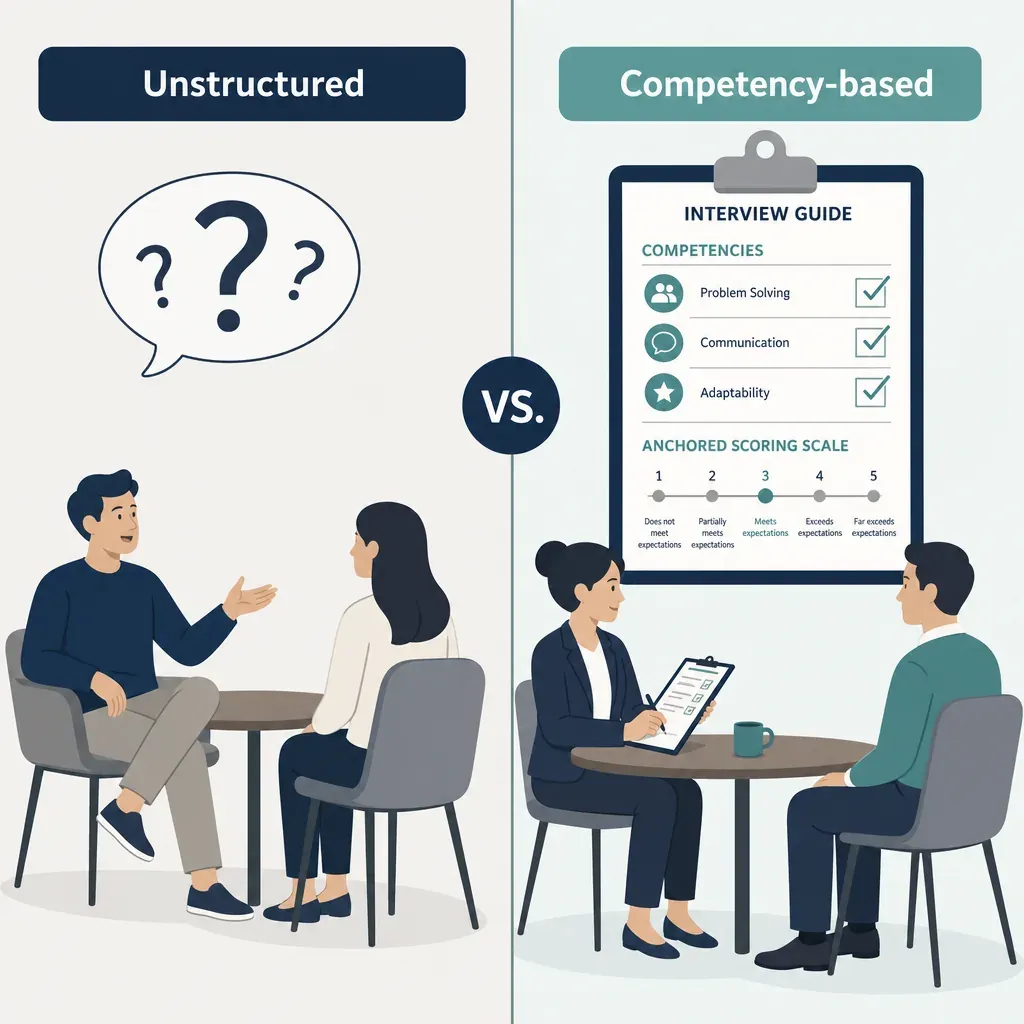
Interview based on competency is, in short, not a softer or fuzzier alternative to other selection tools. It is a more systematic one.
The evidence: why it works
Twelve meta-analyses have now examined the relative predictive validity of structured versus unstructured interviews. Levashina, Hartwell, Morgeson and Campion (2013) reviewed that entire body of evidence in Personnel Psychology. The finding is consistent across all twelve: structured interviews outperform unstructured ones. Validity coefficients for structured formats range from 0.35 to 0.62; for unstructured formats, 0.14 to 0.33. That gap, repeated across decades and thousands of studies, is not a quirk of sampling. It is one of the more reliable findings in applied psychology.
What does that mean in practice? Consider validity coefficients across meta-analyses comparing structured and unstructured formats: at the midpoint, a structured interview is roughly twice as predictive of actual job performance as an unstructured one. Twice as likely to identify the candidate who will actually perform. In a company making five senior hires a year, that is not an abstraction.
McClelland (1998) provides the most striking applied example. At a large multinational food and beverage company - referred to as "Tastyfood" in the research - executives hired through traditional processes in 1992 left the company at a rate of 49% within three years. Each departure at that level cost the company approximately $250,000. The total cost of that cohort's attrition exceeded $4 million. In 1993 and 1994, the company switched to a BEI-based competency-selection algorithm. Of 32 executives hired under the new system, only 2 had left the company by early 1996 - a turnover rate of 6.3%. The competency-based process did not just predict performance better; it produced measurably different outcomes.
Levashina et al. (2013) note a further advantage: structured interviews provide incremental predictive validity over personality tests and cognitive ability tests, because the constructs they measure are largely non-overlapping. A structured competency-based interview is not a substitute for other selection tools; it adds to them.
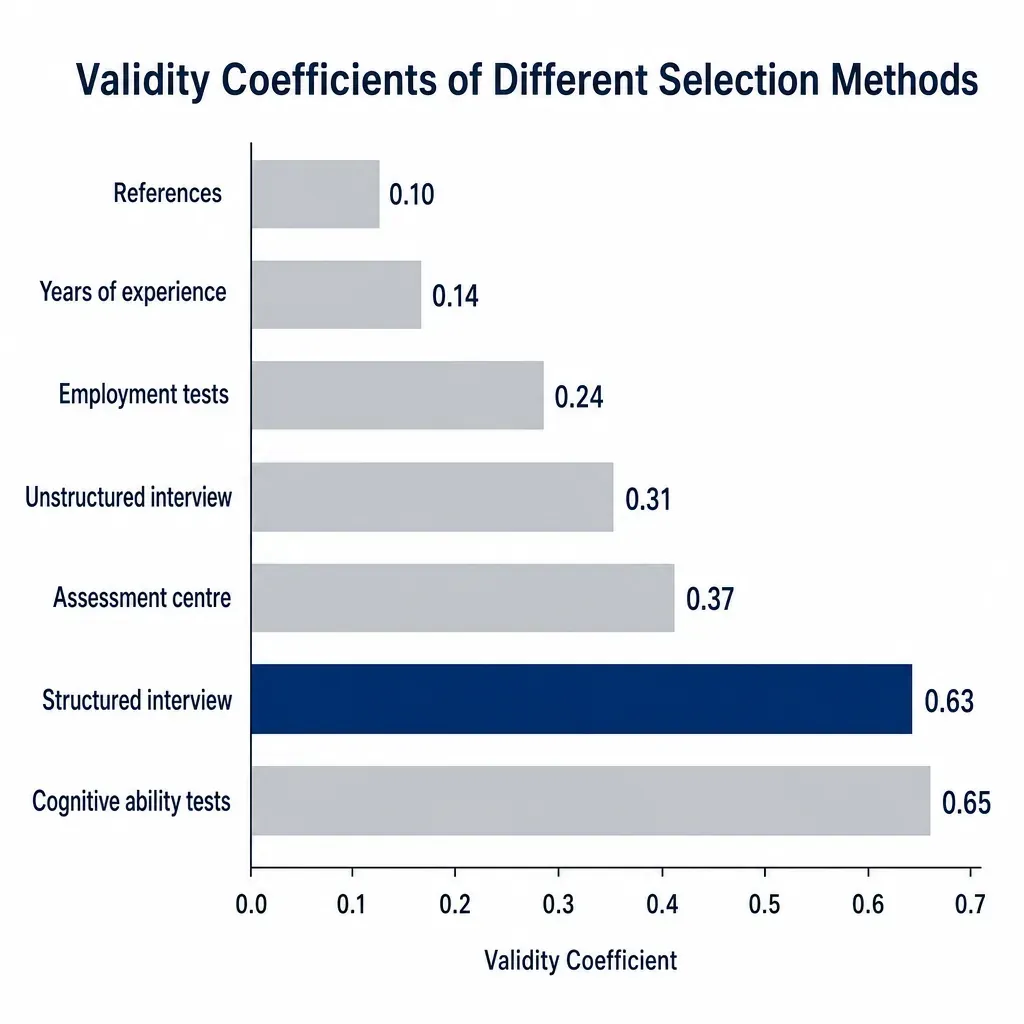
The mechanism is not mysterious. Standardised questions reduce the role of rapport and personal chemistry. Anchored scoring reduces the role of post-hoc rationalisation. Independent scoring before debrief reduces the spread of anchoring effects through the panel. Each step reduces noise. Less noise means the signal - the evidence about what this candidate actually does in the situations the role demands - comes through more clearly.
How to design questions and scoring rubrics
The design work happens before the interview, not during it. If the questions and scoring criteria are settled after the candidates start arriving, the method has already been compromised. Here is what that design work looks like.
Start with a job analysis, not a list of nice-to-haves. Identify three to six competencies that genuinely separate strong from average performers in the role. These should come from speaking with current top performers, their managers, and people who have seen both sides of the function. A competency defined in observable, behavioural terms - "adjusts message and medium to the audience's context without being asked" - is usable. "Good communicator" is not; it will mean something different to every interviewer in the room.
Campion, Palmer and Campion (1997) identify basing questions on a job analysis as one of the 15 components of structure most strongly associated with improved validity. It is not optional groundwork; it is what makes the rest of the method work.
One question per competency, designed to elicit a concrete past example. The phrasing matters. "Tell me about a time you had to deliver difficult feedback to a direct report - walk me through what happened" is a behavioural question. It asks for a specific episode, a specific action, and a specific result. "How would you handle a difficult feedback conversation?" is a situational question that invites the candidate to describe their hypothetical best self rather than their actual history. McClelland (1998) found that real behavioural events, coded systematically, outperform hypothetical responses as predictors. There is a place for situational questions in some formats, but for most small employers building their first competency framework, behavioural questions are the more reliable tool.
Build a behaviourally anchored rating scale for each question. A generic 1-to-5 scale produces inconsistent scoring because each interviewer defines "4" differently. The steps for building a behaviourally anchored rating scale involve anchoring each score point to a specific description of the type of response it maps to. A score of 1 might mean "no relevant example offered; candidate described general preferences or hypothetical approaches." A score of 3 might mean "clear example provided, candidate's action described, outcome vague or absent." A score of 5 might mean "specific episode, candidate's ownership of the action clear, measurable or observable outcome stated, learning drawn." With those anchors in place, two interviewers scoring the same response independently will reach similar scores more often than not.
Weight the competencies before the interviews begin. Not all competencies matter equally. A must-have competency - say, the ability to manage ambiguity in a role that has none of the clarity the candidate is used to - should carry more weight than a desirable one. Setting those weights in advance prevents post-hoc rationalisation where the panel emphasises the competency that the strongest candidate happened to demonstrate best.
Finally: keep scores independent until after all interviews are complete. Campion et al. (1997) identify note-taking and independent rating as structural components that reduce anchoring effects. The cost of unfocused interview techniques is measured in bad hires; the cost of calibrating the panel properly is an afternoon. The arithmetic usually works out.
Common mistakes that kill the method
Adopting competency-based interviewing in name while undermining it in practice is more common than outright rejection. Here are the failure modes worth knowing.
Vague competency definitions. "Leadership" is not a competency. "Influences others without direct authority in resource-constrained situations" is. When the competency definition is abstract, interviewers score against whatever mental model of leadership they happen to hold. The difficulty of maintaining stable definitions of abstract competencies without calibration is not a theoretical concern; it is why two interviewers using the same rubric can still produce wildly different scores. The fix is to invest time in the definition, not assume it is shared.
Skipping calibration. A scoring rubric that has not been calibrated is a scoring rubric that will be applied inconsistently. One calibration session - watch a sample response, score it individually, compare scores and discuss - closes most of the gap. Salgado and Moscoso (2002) found that behavioural interviews assess quite different constructs from conventional ones; the implication is that interviewers who have not been trained in what to look for will revert to evaluating personality and social fluency even when they believe they are scoring competencies. Training is not optional.
Treating prepared answers as a deal-breaker. Candidates prepare for competency-based interviews. That is not a flaw in the method. A rehearsed answer is still drawn from the candidate's actual history; the question is what they chose to rehearse and how specifically they can describe it when probed. The structured interview still produces better decisions than the unstructured alternative. Campion, Palmer and Campion (1997) found this across multiple meta-analyses: structure improves validity even when candidates have been briefed on the format.
Failing neurodivergent candidates on format rather than competency. How competency interview formats can disadvantage neurodivergent candidates is a genuine fairness issue. Autistic candidates, in particular, often give literal and detailed responses that do not follow the narrative arc that STAR-trained interviewers expect. The result is a score that reflects format compliance, not competency. Training interviewers to probe - "can you tell me more about what you did specifically?" - and to score on evidence of competency rather than storytelling fluency protects both fairness and the quality of the hire.
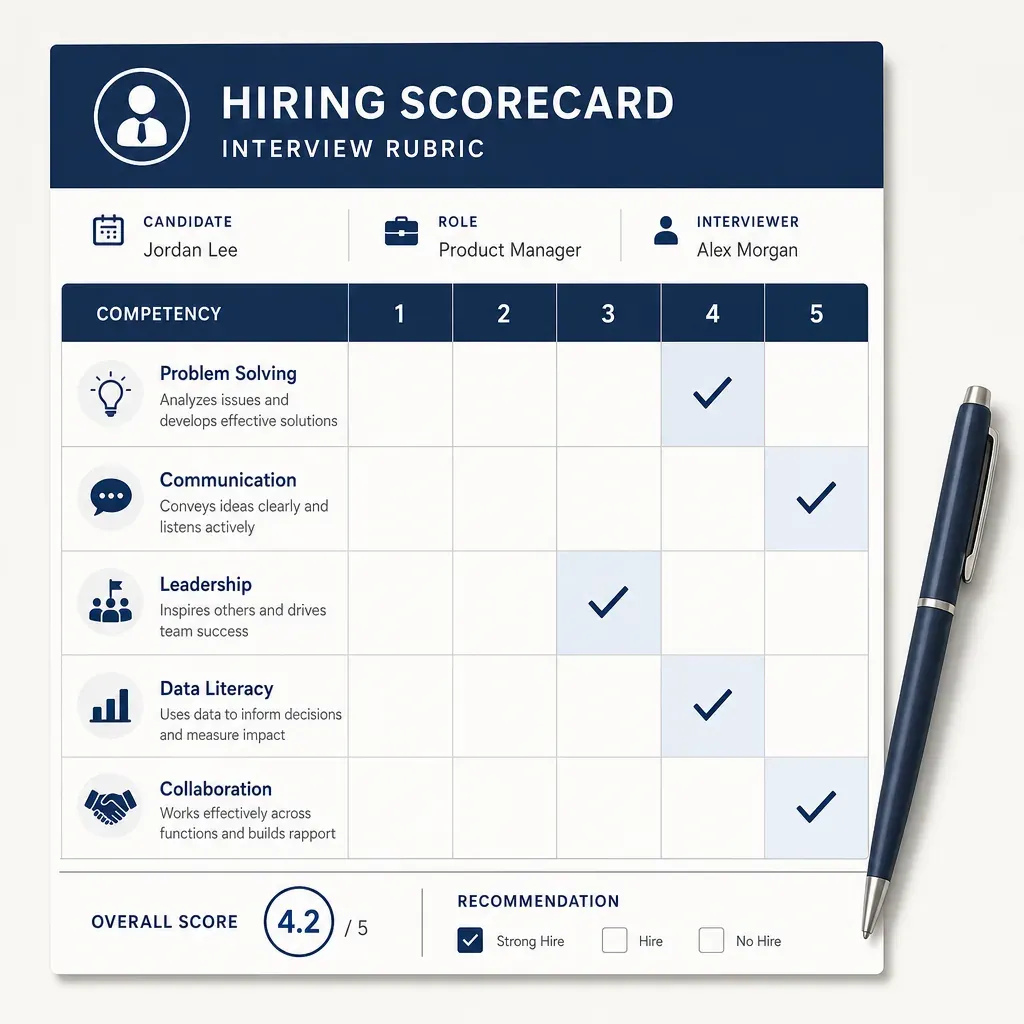
The structured interview does not solve hiring on its own. It reduces the noise that makes hiring decisions worse than they need to be. Whether the remaining signal is well used depends on how well the method is actually implemented.
How to install this in your company
The research case for competency-based selection interviewing is settled. The execution gap is where most companies get stuck. The companies that try to implement the method and quietly abandon it within six months tend to share the same pattern: no shared framework, no consistent training, interviewers who are using the method in name only. The question is not whether the evidence supports structured behavioural interviewing - it does - but how to get it into the room and keep it there.
What real installation requires is four things: a competency library built from your actual roles rather than a generic HR list; a standard question bank with one calibrated question per competency; behaviourally anchored scoring rubrics that your interviewers review together before each hiring round; and a decision process that aggregates scores before deliberation begins. Campion, Palmer and Campion (1997) identified all of these as structural components associated with improved validity. Levashina et al. (2013) confirmed the finding held 20 years later. These are not experimental suggestions; they are the known working parts of the method.
For a small or growing company doing this for the first time, the overhead can feel disproportionate. It is not. One bad hire at a senior level costs - in McClelland's (1998) data - around $250,000 in direct turnover cost alone. The investment in getting the competency framework and scoring system right is measured in days of effort; the cost of skipping it is measured in months of recovery.
This is where the Structured Hiring Method from HireSchool is designed to help. HireSchool is a self-guided digital programme that gives hiring leaders the complete toolkit to install competency-based structured hiring without external consultants. The programme is delivered via video content and a learning management system you roll out to your team at your own pace. It is built for the company that needs consultancy-grade structure at a fraction of the cost - the scale-up or small business where the founder or head of people owns the hiring process and cannot afford to get it wrong as the team grows.
The Structured Hiring Method covers the full sequence: Leadership Values, which is the programme's approach to defining and codifying the competencies you hire against; behavioural interviewing training, so your interviewers understand how to elicit and score specific evidence rather than general impressions; and Decision Management, which gives you a codified process for reaching a well-considered, defensible decision once the scores are in. There is also an optional Quality Assurance module for companies at the scale where an independent interviewer function - the kind Google and Amazon operate - becomes worth building.
HireSchool is not a consultancy. There is no embedded team running a transformation inside your company. It is not an applicant tracking system, and it is not a recruiting agency. You implement the method; HireSchool gives you the structure, the training, and the materials to do it properly.
If you want to understand how the programme is structured and what it covers, explore the Structured Hiring Method programme at hire.school. The programme is self-guided, so you start when it suits you and roll it out at the pace your team can absorb.
What good looks like
A well-run competency-based selection interview does not feel like an interrogation or a bureaucratic exercise. It feels structured without feeling rigid. Every candidate gets the same questions, the interviewer takes notes in real time against each competency, scores are recorded before the post-interview discussion begins, and the debrief starts with the numbers rather than the impressions.
The downstream effects accumulate. Consistency across candidates makes comparisons cleaner because everyone has been asked the same things. A written score record makes decisions easier to explain - to the panel, to the hiring manager who was not in the room, or to the candidate who asks for feedback. Each hiring round that runs the process properly sharpens calibration for the next one. Campion, Palmer and Campion (1997) describe this as one of the underappreciated benefits of structured interviewing: the process improves with use, because interviewers who score consistently learn what strong evidence actually looks like in their specific context.
McClelland (1998) found that executives who received feedback on their competency scores - where they stood relative to the tipping points associated with success in the role - showed larger improvements in subsequent performance than those who did not. The competency framework, used well, is not just a selection tool. It tells the successful candidate what good looks like in the organisation. That is a reasonable return on the design work.
There is also a less-discussed benefit: how the process feels from the candidate's side. A competency-based selection interview is transparently fair in a way that a freeform conversation is not. Every candidate knows the questions were designed to assess specific capabilities, that they were all asked the same things, and that the decision will be made against consistent criteria. Candidates who are not hired are less likely to attribute the decision to arbitrary factors, and less likely to describe the experience negatively to people they know. At the scale where every candidate knows someone at the company, that is worth taking seriously.
The competency-based selection interview is not a guarantee of good hires. No selection method is. What it is - consistently, across four decades of evidence - is a systematic reduction in the noise that makes hiring decisions worse than they need to be. That is a modest promise, but it is an honest one, and it is deliverable.