.webp)
Leadership competency framework: a practical guide for managers
Most leadership competency frameworks live in a shared drive. Here's how to build one that actually changes how you hire and develop leaders.

Why "we'll know a good leader when we see one" stops working
The scene is familiar. A fast-growing company needs a senior hire - a VP of People, a Chief Operating Officer, a Head of Product - and the founders or board conduct a few conversations, check some references, and make a decision based on who felt right. The person joins, takes six months to settle in, and then proceeds to either quietly underdeliver or actively cause problems. The post-mortem conversation usually goes nowhere useful, because nobody can point to what, specifically, they got wrong. The assessment was not documented; the criteria were not defined; the comparison was not structured.
The traditional unstructured interview for a leadership role has a predictive validity of around 0.15 to 0.20 - meaning it is barely better than a coin toss, as Van Clieaf's review of published and unpublished research demonstrates. Yet it remains the dominant selection tool at senior levels, precisely where the cost of a wrong hire is highest. A bad hire at director level does not just affect one team's output; it shapes culture, influences dozens of decisions, and costs three to four times the annual salary to unwind.
A leadership competency framework is the tool that makes "good leader" concrete, observable, and assessable before the hire is made. It answers the question: what behaviours, reliably demonstrated in the past, predict success in this role? Done well, it gives you something to hire against, develop against, and promote against. Done badly - and most are - it becomes a 40-slide deck that gathers dust on an intranet.
This article covers what a leadership competency framework actually is, what the research says should go into one, the design errors that make most of them useless, how to build one that holds up, and how to connect it to the hiring process that gives it any teeth. The evidence on all of this is better than most people realise, and cleaner than the consulting industry tends to let on.
What a leadership competency framework actually is
A competency is a cluster of behaviours, skills, and attributes that distinguishes outstanding performers from typical ones in a given role. The word "behavioural" is doing real work in that sentence. A competency is not a personality trait ("collaborative"), a value ("integrity"), or a job requirement ("ten years of relevant experience"). It is a pattern of observable actions - things a person demonstrably did, said, or decided - that can be described, assessed, and scored.
A leadership competency framework organises those clusters into a coherent picture of what effective leadership looks like inside a specific organisation. It is calibrated for roles where the person exercises meaningful influence over others, whether or not they carry a "manager" job title. A senior individual contributor who shapes strategy and moves decisions forward is a leadership-level role for framework purposes. A team leader three months into their first management role is not.

The distinction between a leadership competency framework and a management competency framework is worth holding onto. Leadership frameworks tend to focus on direction-setting, vision, influence, and culture - the behaviours that shape where the organisation is going. Management frameworks tend to emphasise execution, planning, process adherence, and operational oversight - the behaviours that get it there efficiently. The better frameworks cover both, because the most common failure mode at senior level is a leader who is brilliant at setting direction and cannot organise a quarterly review cycle without it becoming a crisis.
The empirical foundation for competency-based approaches was laid by David McClelland's work on Behavioral Event Interviews (BEIs). McClelland (1998) showed that expert panels asked to identify which competencies distinguished outstanding from typical executives agreed with the empirically derived list only 74% of the time on which competencies mattered - and correctly identified the performance levels at which those competencies began to predict success for only 3 of 7 validated indicators. The implication is pointed: how competencies translate into observable behaviours and key actions cannot be resolved by asking a group of experienced people to guess. You have to look at what your outstanding performers actually do.
What goes into one: the evidence on which competencies actually predict success
Three clusters appear repeatedly across the best-supported research on leadership competencies. The Centre for Creative Leadership, drawing on five decades of 360-degree feedback data from mid-level managers around the world, organises its findings into leading the organisation, leading others, and leading yourself. McClelland (1998), working from Behavioral Event Interview data across more than 30 organisations, identifies a closely related structure. The convergence is worth noting: when very different research methods arrive at the same architecture, it is usually because that architecture reflects something real.

Leading the organisation covers the outward-facing, strategic dimension: setting direction, managing change, making decisions under uncertainty, and scanning the environment for what is coming. In McClelland's data, the competencies that most frequently validated across samples of executives included Achievement Orientation (present in 66% of comparisons at frequency level), Impact and Influence (67%), and Initiative (49%). These are the behaviours that push an organisation forward rather than maintaining equilibrium.
Leading others covers the relational dimension: building trust, developing team members, managing performance honestly, and creating conditions in which diverse people can contribute. The most frequently validated competencies here included Team Leadership (30% at frequency level, 42% at level of complexity) and Developing Others (47%). The CCL research adds a dimension that most frameworks neglect: the career derailers. Interpersonal relationship problems, difficulty building and leading teams, and narrow functional perspective are the behaviours that derail otherwise promising leaders - and a framework that only describes the positive side is incomplete for succession planning purposes.
Leading yourself covers the internal dimension: self-awareness, learning agility, composure under pressure, and the ability to manage one's own energy and limits. Self-Confidence validated in 58% of McClelland's executive comparisons at frequency level - not arrogance, but the settled belief in one's own judgement that allows a leader to hold a position under pressure without freezing.
The organisational impact of getting this right is measurable. Organisations implementing training and mentoring for leadership competencies are 3.4 times more likely to be rated as a best place to work, according to the most frequently validated competencies across decades of research. Only 40% of organisations currently rate their leader quality as good or excellent - which suggests there is considerable headroom for companies willing to be systematic about it.
Why most frameworks fail in practice
The most common failure mode is complexity. One company, documented by the Clemmer Group, built a leadership competency model with 12 competencies and 144 behavioural indicators. No leader could remember what they were. The model was technically comprehensive and practically useless - which is not a contradiction in HR, it is a design pattern. The more exhaustive the framework, the more likely it is to exist only in documentation.
Three structural problems explain why the most common reasons leadership competency frameworks fail to change anything cluster around the same themes. First, overcomplexity: too many competencies, each subdivided into too many indicators, produce a framework that requires a specialist to interpret and that leaders cannot internalise during a normal working week. Second, weak validation: the competencies were chosen by an expert panel using informed intuition rather than derived from performance data. McClelland's research showed that expert intuition gets the competency list roughly right but consistently misjudges the levels at which those competencies start to predict success. Third, disconnection: the framework is not embedded in how the company actually makes decisions about people. It was launched at a town hall and then never appeared again in a hiring brief, a promotion conversation, or a performance review.
A subtler critique comes from Lucy Adams at Disruptive HR: traditional competency frameworks perpetuate why complex competency models rarely survive contact with a busy working week. They push leaders to invest in fixing weaknesses they will only ever be mediocre at, rather than building on what makes them distinctively effective. They also implicitly favour extroverted, high-charisma candidates - the leaders who perform well against a visible checklist - over those who build trust slowly, operate behind the scenes, and produce results quietly. The framework ends up selecting for presentation rather than performance.
The design fix is simpler than it sounds: three categories, maximum. Two to four competencies per category. Each competency defined by two to four behavioural indicators that are observable, specific, and past-tense formulated. McClelland's algorithm for predicting executive success did not require excellence across all 12 validated competencies - it required reaching a tipping point on just 6, including at least one from the initiative cluster and one from the organisational-skill cluster. The lesson is that coverage is less important than precision. A framework with eight well-chosen competencies that every hiring manager can recite is worth more than one with 30 that nobody uses.
How to build one that holds up
The starting point is not competencies. It is performance outcomes. Before listing a single behaviour, define what outstanding performance looks like in quantifiable terms for each leadership level you are building the framework for. Van Clieaf's position analysis approach specifies performance measures first - what results you want, and the critical success factors that will tell you whether those results were achieved - before moving to the activities and behaviours that produce them. Skipping this step is how organisations end up with competency lists that look plausible but do not connect to anything that actually matters.
Once you have defined what outstanding looks like, identify the behaviours that distinguish outstanding from typical performers in your specific context. Generic lists from research are a useful starting point, not a finished product. Talk to your best current leaders. Run short critical-incident interviews - ask them to describe three or four situations where they made a real difference, and probe for what specifically they did, said, and decided. Look at your performance data. The steps most organisations skip when rolling out a leadership framework are exactly these: the empirical grounding, the internal validation, the translation from generic list to context-specific behaviour.
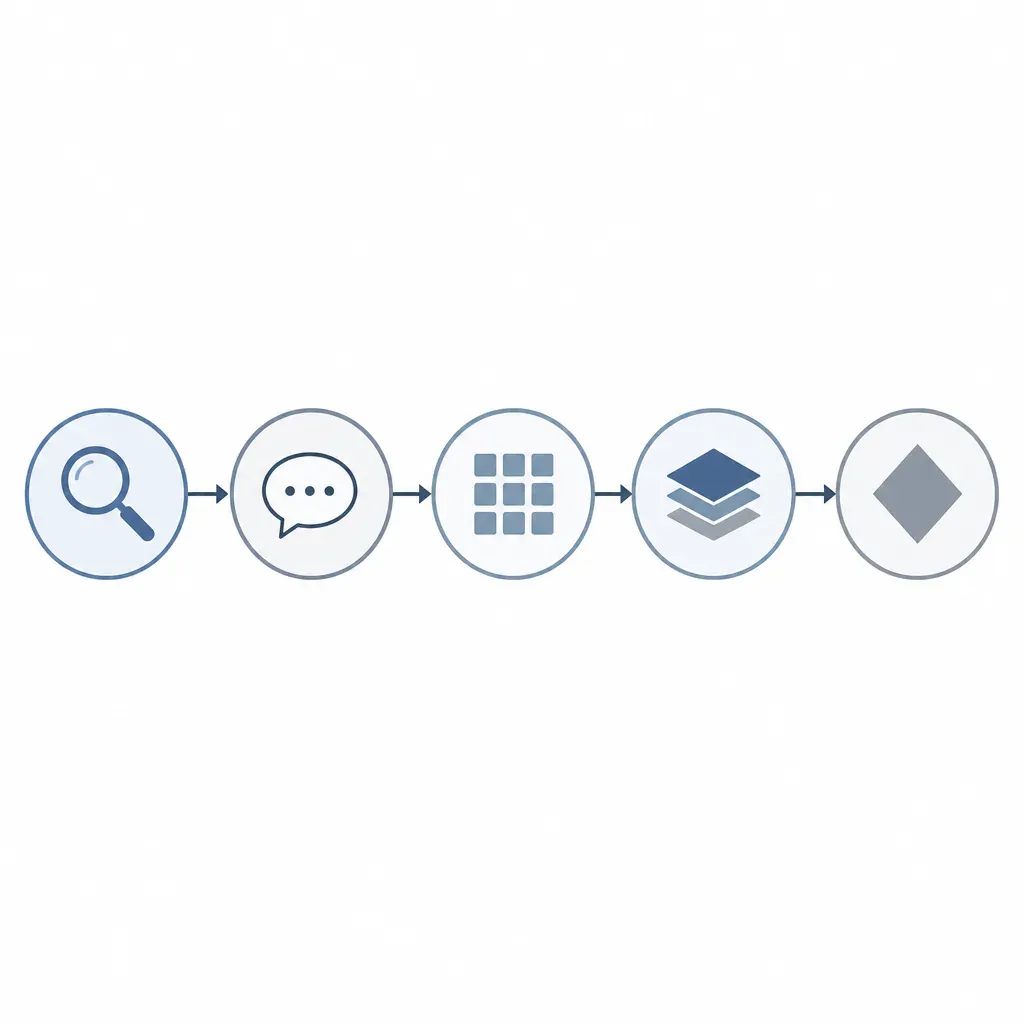
Organise the validated behaviours into three categories, with two to four competencies per category. Write each competency as a short label ("Building trust") followed by two to four behavioural indicators. Each indicator should be observable and specific - "sought input from stakeholders before finalising the plan" rather than "is a good communicator". The past-tense formulation is not stylistic; it forces specificity, because you cannot write a past-tense behavioural indicator without specifying what someone actually did.
Differentiate by level. A team leader, a director, and a C-suite executive may all need to demonstrate "strategic perspective", but what that looks like at each level is materially different. A team leader sets direction for five people within a defined scope; a director shapes strategy for a function; a Chief Executive sets direction for the whole organisation. Build proficiency descriptions per level, or the framework will be either too demanding for junior roles or too unspecific for senior ones.
Finally, embed the framework in every talent decision. A leadership competency framework used only in annual reviews will drift into irrelevance within two years. It needs to appear in how roles are scoped when a vacancy opens, in how candidates are assessed during hiring, in how internal promotions are evaluated, and in how succession is planned. Why frameworks need derailer descriptions alongside strength indicators is worth revisiting here: the framework should describe not just what outstanding looks like, but also the behaviours that predict derailment, so that succession conversations can flag risks early rather than discover them after a promotion.
From framework to hiring: the role of structured interviews
A leadership competency framework without a hiring process to use it in is a planning document, not a selection tool. The framework defines what good looks like; a structured behavioural interview is how you find out whether a candidate has actually demonstrated it.
The evidence on validity is worth stating clearly, because it is more decisive than most hiring conversations acknowledge. Van Clieaf's review of published and unpublished research puts the predictive validity of a structured behaviour interview at 0.55 to 0.70, compared with 0.15 to 0.20 for the traditional unstructured interview. Campion, Palmer and Campion (1997), synthesising meta-analytic findings across multiple studies, report corrected validities of 0.35 to 0.62 for structured interviews versus 0.14 to 0.33 for unstructured. The direction of the finding is consistent even when the exact numbers vary: structuring the process produces meaningfully better predictions of how a person will perform once hired.
The business case is not only about prediction. McClelland (1998) documented one large multinational that introduced competency-based hiring for executives. In the two years before the change, 49% of newly hired executives had left the company, at an estimated cost of more than $4 million. After the introduction of BEI-based competency assessment, turnover in the same role cohort fell to 6.3%, with an estimated saving of $3.5 million. Fowler, Posthuma and Tsai (2016) add a selection-ratio dimension: at a selection ratio of 10% - one hire from every ten candidates - structured interviews produced successful hires 84% of the time, compared with 50% from random selection. The implication is that how you assess candidates and how selectively you hire interact: a valid process combined with genuine selectivity produces a compounding advantage.
How behavioural interviewing uses past evidence to predict future leadership performance is straightforward in principle. Each interview question targets a specific competency from your framework and asks the candidate to describe a real situation in which they demonstrated the relevant behaviours. The STAR format - Situation, Task, Action, Result - provides the structure. Your scoring rubric, derived from the behavioural indicators in your competency framework, provides the consistency. Two candidates are compared on the same evidence, scored against the same standard, by interviewers working from the same criteria.
That is the logic. Putting it into practice - defining the questions, training the interviewers, building the rubrics, running the panel, reaching a structured decision - is where most organisations stall. The individual components are straightforward; the challenge is installing them as a system that holds up across different roles, different hiring managers, and different time pressures.
That is precisely the problem HireSchool was designed to solve. The Structured Hiring Method is a self-guided digital programme - video content delivered through a learning management system - that enables small businesses and scale-ups to build and run exactly this kind of evidence-based hiring process without bringing in external consultants.
The Leadership Values module inside the programme is a direct implementation of what this article has been describing. Rather than building a competency framework from scratch, the business chooses from a set of predefined core behaviours calibrated for leadership roles, adapts them to their context, and uses them as the hiring standard across every leadership interview. The Behavioural Interviewing Training module covers how to build STAR-format questions against those competencies and how to score responses consistently. The Decision Management module codifies how the hiring panel reaches a well-considered, evidence-based decision once interviews are complete - so the competency framework is not just used during the interview; it structures the final conversation too.
HireSchool is not a consultancy, not an applicant tracking system, and not a recruiting service. It does not source candidates or run the hiring process on your behalf. It gives your team the method and the materials to run a rigorous process themselves. If you want to see how the programme is structured and what the implementation looks like, you can explore the Structured Hiring Method programme at hire.school.
Making it stick: maintenance without the bureaucracy
The research on competency feedback is encouraging on a point that rarely makes it into the design conversation. McClelland (1998) found that executives who received detailed feedback on their competency profile - specifically, where they stood relative to the tipping points that predicted success in their role - and then had a year to act on that feedback, improved their performance (as measured by standardised bonuses) at a higher rate than those who received feedback in the same year the bonus was assessed. Among all executives, 62% of those who received feedback a full year in advance showed better-than-expected improvement, versus 39% of those who received it later. The implication is not subtle: a leadership competency framework does not just improve hiring; it creates the conditions for structured development, and that development produces measurable results when it is timely and specific.
That is the case for maintaining the framework actively, not treating it as a one-time project. Three maintenance rules help without adding bureaucracy.
First, review the framework when your strategy shifts materially. The competencies that made a founding team effective at building a product may not be the same ones needed to run a 200-person organisation through a commercial transformation. When to update or replace a leadership framework is not a fixed calendar question; it is a question of whether the current framework still describes the performance that matters.
Second, check annually whether your behavioural indicators still describe your outstanding performers. Talk to the leaders who are clearly succeeding; run a short round of critical-incident conversations; update the language where it has drifted. The goal is not to rewrite the framework every year - it is to stop it calcifying around a version of the company that no longer exists.
Third, resist the temptation to add competencies to cover every new priority. That path leads directly back to 12 competencies and 144 indicators. If a genuinely new theme has emerged - say, the organisation has reached a scale where managing across cultures has become critical - consider whether it fits within an existing competency cluster before creating a new one. Usually it does.

Ownership matters as much as process. A leadership competency framework that belongs only to HR will struggle to survive contact with a busy senior leadership team. It needs a named sponsor at a level senior enough to ensure it is used in real decisions - promotion panels, succession conversations, hiring sign-offs - and a regular moment in the annual cycle when it is reviewed against what the organisation is seeing in its best and worst performers.
A short, evidence-grounded, behaviourally specific leadership competency framework - embedded in how you hire, develop, and promote - is one of the clearest ways to ensure that the leaders you bring in and grow are the ones your organisation actually needs. The research behind it is solid. The design principles are not complicated. The hard part is the discipline to keep it simple and use it consistently. That, as it turns out, is also a leadership competency.