.webp)
Competency framework templates: copy-ready examples that work
A working competency framework template, three copy-ready job-family examples, and the failure modes that quietly turn one into shelfware.
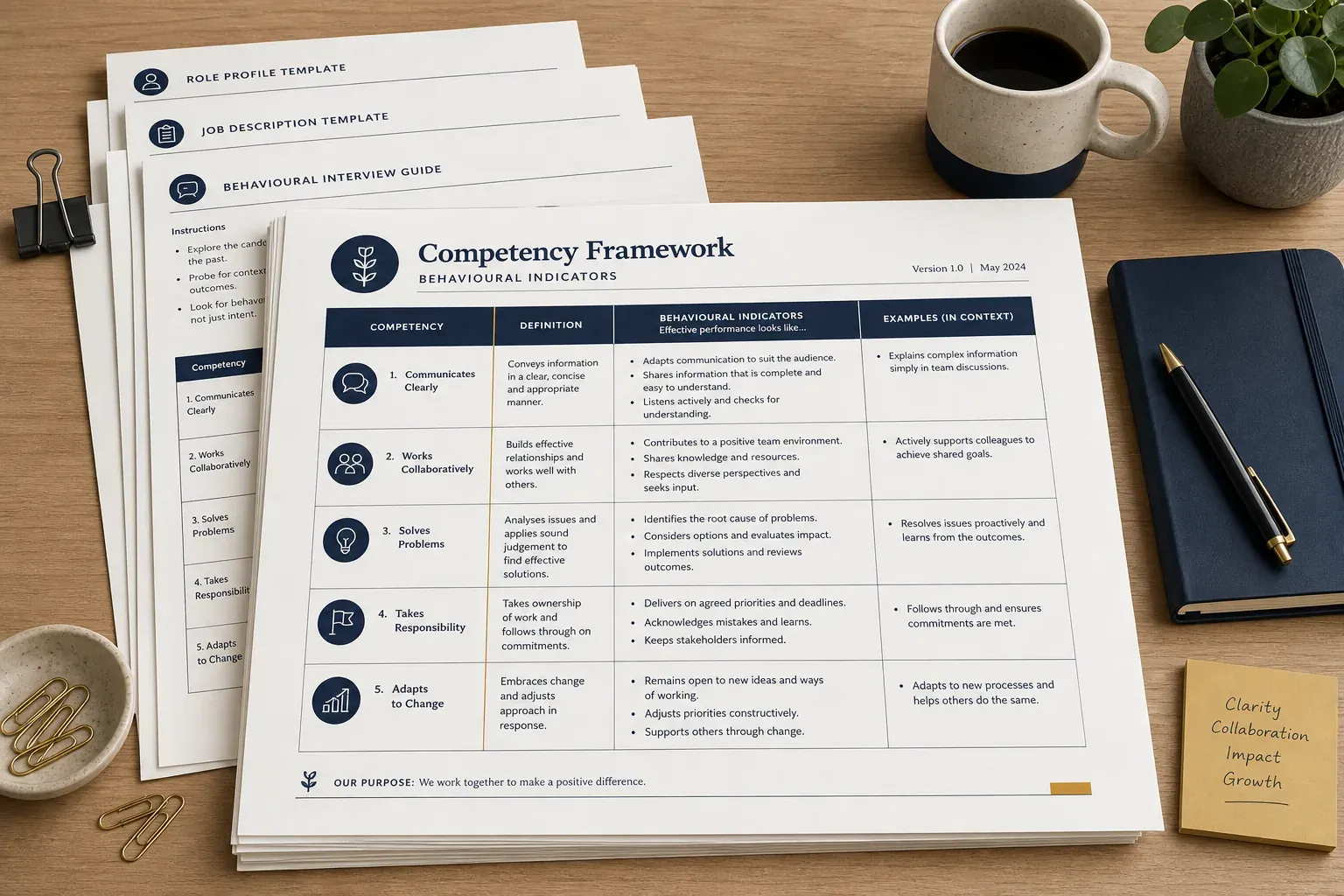
Why most downloaded templates end up in a drawer
Search "competency framework template" and the internet will hand you a hundred free downloads inside an hour. Word, Excel, PDF, the occasional PowerPoint, all promising a copy-ready scaffold for whatever role you happen to be hiring for. A handful even arrive without an email gate. The supply is not the problem. The problem is what happens after the download lands in the shared drive.
In practice, most of these templates get opened twice. Once when they arrive, full of optimism. Once six months later, when someone asks where the competency framework is and the file is found half-completed, last edited by the previous head of HR. The template is not the framework, in the same way a kitchen is not a meal. The template is the wrapper, and the wrapper is the easy part. The work sits in the choices: which competencies to include, what observable behaviour each one means, how levels actually differ, and how all of it ties back into the way the company hires. The most common reason competency work fails is not a bad template; it is everything that did not happen around it.
The rest of this article walks through the parts of a working competency framework template, gives you a copy-ready structure you can rebuild in fifteen minutes, three job-family worked examples to adapt, and the failure modes that quietly turn a Word document into shelfware. The argument runs through it: the template earns its keep when it shapes the interview, not when it sits in a drawer.
What a competency framework template actually contains
Strip away the branding and every credible competency framework template has the same four parts. A list of competencies, each with a one-line definition; three to five proficiency levels; and three to five observable behavioural indicators per level. Anything thinner than this is a checklist; anything more elaborate has been over-engineered. The skeleton is famously dull, which is part of why it works.
The terminology is loose. "Competency framework" and "competency model" are used almost interchangeably across the practitioner literature; CIPD treats them as near-synonyms and positions the artefact as the bridge between individual and organisational performance. In careful usage, the framework is the wrapper - the document that holds the competencies and indicators - and the competency model is the calibrated content inside it for a specific role or family. In practice nobody minds which word you use, provided the parts inside are sound.
This is where the template tradition diverges from the research tradition, and where most off-the-shelf documents quietly fail. McClelland (1998) defined a competency as a cluster of behaviours that distinguishes outstanding from typical performers, identified through behavioural-event interviews with people who actually do the job well. That is not the same exercise as listing "leadership", "communication", and "teamwork" and writing four levels of progressively more enthusiastic prose. A competency framework template is only a competency framework when its content has been chosen and worded to discriminate between people who do the work well and people who do not. The wrapper does not do that work. It only holds it.
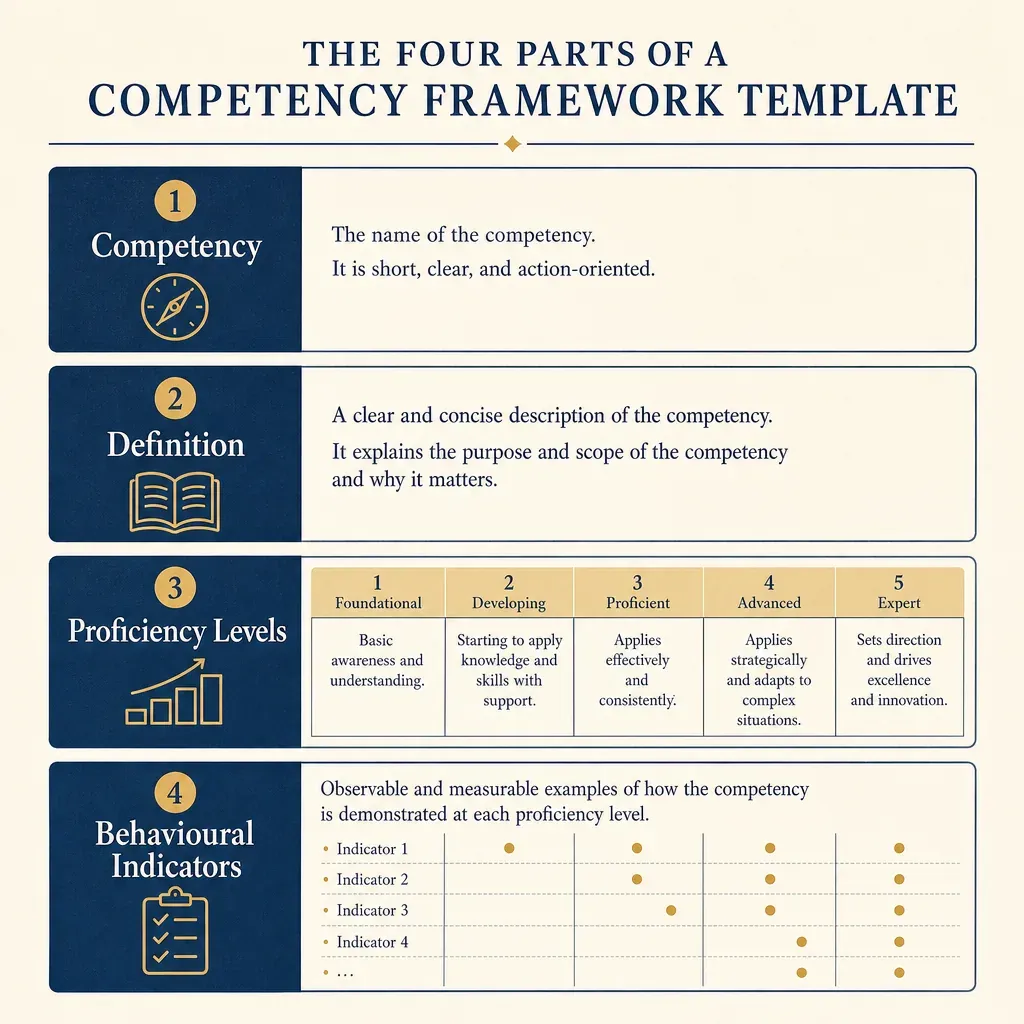
The practical implication is small but important. When you open a template, the first question is not "is this Word file pretty?" but "are these indicators specific enough that two interviewers would score the same person the same way?" If the answer is no, you are looking at a stationery exercise.
A copy-ready competency framework template you can adapt today
Here is the bones of a template you can rebuild in Word, Excel, or a PDF in roughly fifteen minutes. The shape is the same in any format. The first column names the competency; the second defines it in one line; the remaining columns describe what each proficiency level looks like in observable behaviour.
| Competency | Definition | Foundational | Intermediate | Advanced | Expert |
|---|---|---|---|---|---|
| Communication | Conveys information clearly and tailors the message to the audience. | Explains routine work to immediate teammates without needing a follow-up conversation. | Runs structured updates with stakeholders outside the team and handles questions on the spot. | Adapts tone and detail across audiences in the same meeting; defuses tense exchanges without losing the point. | Sets the communication standard others copy; writes documents the company uses as templates. |
Replicate the row pattern for each competency in the framework. Five to eight competencies for an individual contributor role; eight to twelve for a leadership role. The level labels are not sacred - Foundational, Intermediate, Advanced, Expert is one common four-level scheme; Learner, Practitioner, Experienced Practitioner, Leader, Expert is another. Pick one and stick to it across every role family in the company so a person at "Advanced Communication" means the same thing in engineering and in sales.
Word is the cleanest format for the framework document itself, because the body of each indicator wants to read as prose rather than spreadsheet shorthand. Excel comes into its own when you sit the assessment matrix on top - one row per person, one column per competency, scores filled in by interviewers or line managers. PDF is the distribution format. The competency framework template question that goes "Word or Excel?" is operational detail; the shape underneath is identical.
When you start, do not write the competency list from a blank page. Vendor catalogues hand you a starter library of around 140 core, functional, and technical competencies; public-sector frameworks like the Greater London Authority's are free and serious. Pull a shortlist from existing libraries, then prune and rewrite for your own organisation. The job is editing, not invention.
Three competency framework examples for common job families
The same template wrapper has to flex across job families. What "problem solving" looks like for a software engineer is not what it looks like for a salesperson, and the template that pretends otherwise is the one nobody trusts. The trick, as the practitioner literature keeps repeating, is keeping the structure constant and tuning behavioural indicators to the realities of each job family. Below, three short worked examples - engineering, sales, and leadership - each with its competency list and one fully fleshed out competency to copy.
Engineering. Five behavioural competencies cover most software roles: Communication, Problem Solving, System Thinking, Code Quality, and Mentorship. The worked example is Problem Solving:
- Foundational. Solves bounded problems within a single service when the path is documented. Asks for help before getting stuck.
- Intermediate. Diagnoses unfamiliar bugs across two or three components without help; writes a short post-mortem when the fix is non-obvious.
- Advanced. Designs solutions that hold up under business and technical constraints simultaneously - latency, headcount, vendor lock-in - and explains the trade-offs to non-engineers.
- Expert. Sets the architectural pattern others reach for. Reframes problems other engineers have given up on.
Sales. Five competencies: Customer Focus, Negotiation, Pipeline Discipline, Resilience, Commercial Acumen. The worked example is Customer Focus:
- Foundational. Runs a discovery call from a script and captures what the prospect said in the CRM the same day.
- Intermediate. Adapts the pitch to the prospect's stated priorities and follows up on objections without being asked.
- Advanced. Tailors complex pitches to nuanced business needs; identifies the unstated buying criterion the prospect did not surface.
- Expert. Becomes the prospect's de facto advisor; called for input on decisions that have nothing to do with the immediate deal.
Leadership. Five competencies: Setting Direction, Developing Others, Decision Quality, Influence, Holding the Line. The worked example is Developing Others:
- Foundational. Gives feedback on specific work products inside the regular review cycle.
- Intermediate. Coaches direct reports through stretch projects; writes development plans that match real career steps.
- Advanced. Builds a bench. Several of the people on the team are visibly ready for the next role up.
- Expert. The team is a recognised source of leaders for the rest of the company.
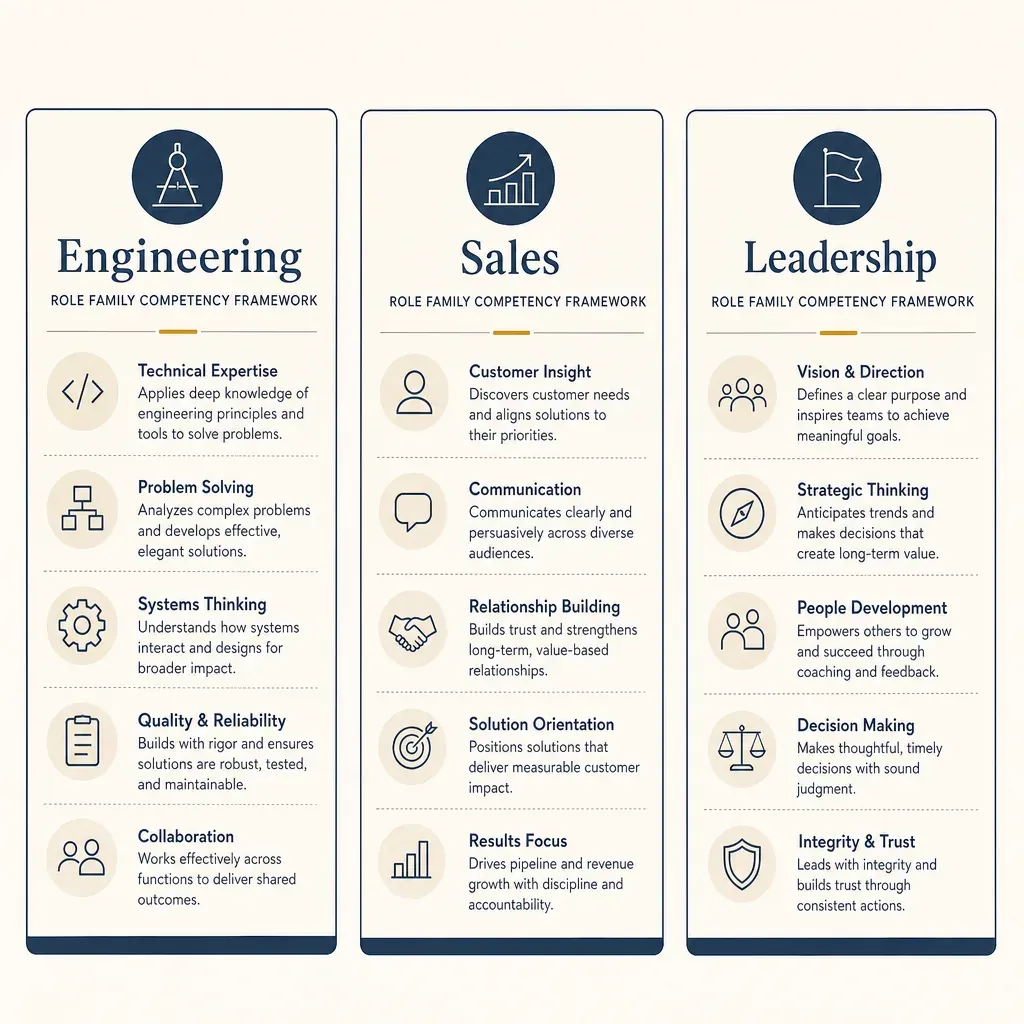
None of the three examples runs to more than six competencies. That is deliberate. The McClelland (1998) tradition built its competency dictionaries by isolating the small cluster of behaviours that genuinely distinguished outstanding from typical performers; the practitioner consensus has settled on eight to twelve as the practical ceiling. Past that, assessors stop being able to keep the indicators straight, and the framework starts inflating its own credibility.
How to adapt a template to your company without diluting it
Adapting a template properly is short, structured work. Start with a generic competency framework template that already has the wrapper right. Run a behavioural-event interview with one or two outstanding people in the role - the McClelland-Boyatzis classic - and ask them to walk you through three positive and three negative episodes from the last year, in their own words. The behaviours that distinguish them from a typical performer are usually visible inside an hour. Rewrite the template's indicators in the language those interviewees actually used. Then prune ruthlessly.
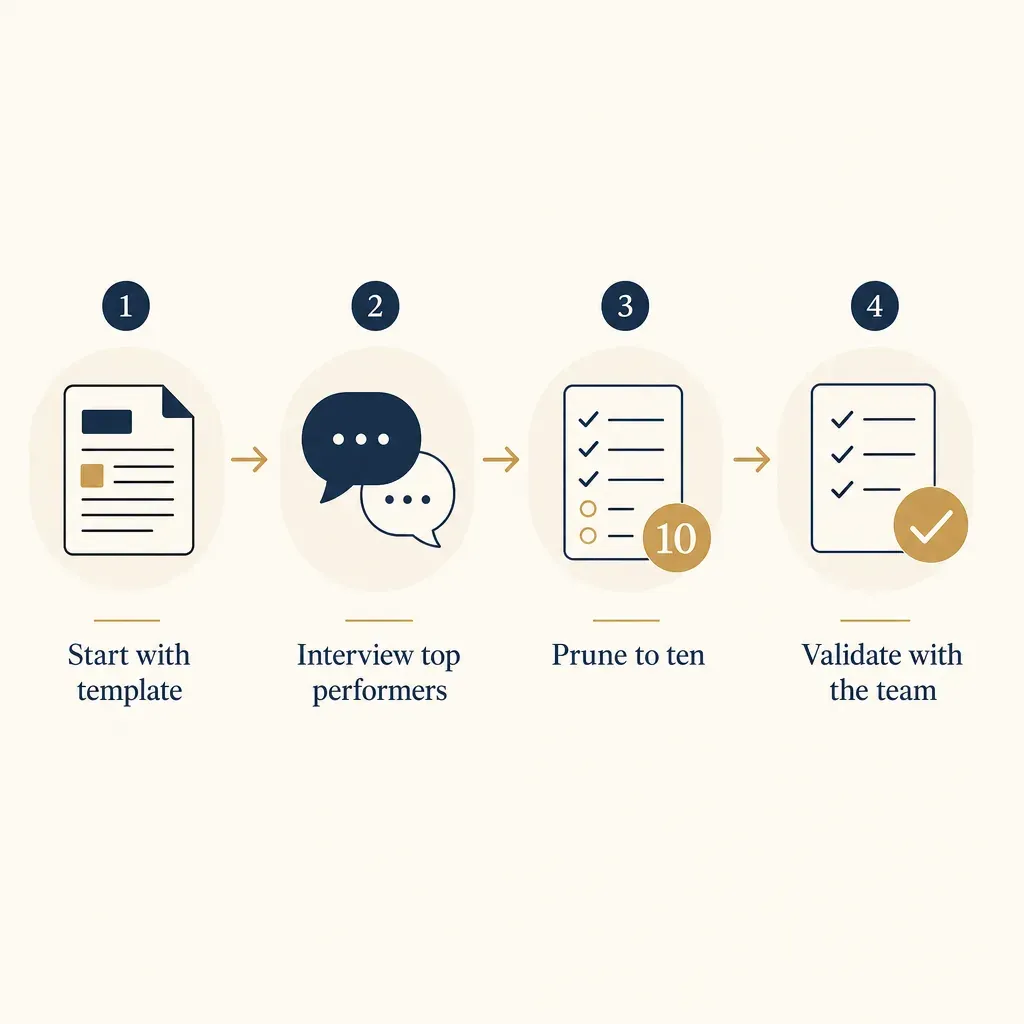
The pruning is the part most adopters skip and most failures depend on. Off-the-shelf libraries err generous; a maximum of twelve competencies for individual contributors and fifteen for leaders is the practitioner ceiling, and the reasoning is mechanical rather than ideological. Assessors cannot reliably hold more than about ten competencies in working memory while interviewing a candidate. A framework with eighteen competencies asks every interviewer to score the same person on eighteen separate dimensions in fifty minutes, and it cannot be done. Cut to a list a panel can actually use.
The deeper reason a generic template never quite fits is what McClelland (1998) called the substitutability principle. Outstanding performance does not correlate with any single competency; it correlates with a *pattern* of competencies that distinguishes outstanding from typical performers in this role, in this company, in this market. Different competencies inside a cluster substitute for each other - Achievement Orientation, Initiative, and Conceptual Thinking can each represent "individual initiative", and which one matters depends on the job. Adaptation is calibration, not redecoration. The wrapper stays. The pattern inside has to be local.
One last step worth not skipping: validate the draft with people who actually do the job, not only HR. The frameworks that go in the drawer are the ones built without job-holder input. The frameworks that get used are the ones the team recognises as describing their own work.
How structured interviews use the framework you've just built
The competency framework is the blueprint; the structured interview is the tool that uses it. Without the framework, "structured" reduces to "we asked the same questions in the same order", which is the weakest version of the practice and produces predictably weak results. Of the fifteen components of interview structure that Campion, Palmer and Campion (1997) identified, two depend directly on the framework: questions based on a job analysis, and questions tied to specific competencies. The framework is what makes a question diagnostic rather than decorative.
This is also where the choice of indicators stops being cosmetic. Salgado and Moscoso (2002) showed in a construct-validity meta-analysis that conventional and behaviour-description interviews measure different things. Conventional interviews load on personality and social skills; behavioural interviews load on job knowledge, job experience, and behavioural patterns. A competency framework full of vague traits will produce a conventional interview no matter how rigorous the process looks on the schedule. The behavioural indicators are the lever that swings the interview from one to the other. Behavioural competencies are not jargon; they are the difference between an interview that predicts performance and one that predicts confidence.
The case for building the framework properly is sharpest in McClelland (1998). At the multinational the paper anonymises as Tastyfood, executive turnover before the competency programme ran at 49% - 17 of 35 hires lost over two years - at an estimated cost of $4 million. After hiring against a behavioural-event-interview competency algorithm, only 2 of 32 executives left across the next two years, a turnover rate of 6.3%, with an estimated saving of $3.5 million. The mechanism was the framework: tipping points on at least one initiative competency, one organisational competency, and six of twelve overall. The structured interview was the tool that read the framework. Neither did the work alone.
The reader takeaway is short. The competency framework template earns its keep when it shapes the interview. Sitting in a drawer it is decoration; in the interview room it is the difference between a panel that can defend its decision the next morning and one that cannot.
How HireSchool turns a competency framework into a working hiring process
By this point the reader has the raw material: a competency framework template with the right shape, three job-family worked examples, the McClelland-Boyatzis lineage that explains why it matters, and a clear link from the framework to the structured interview that uses it. What is left is the install. Turning a framework on a shared drive into a hiring process every interviewer in the company runs the same way is the gap between owning a template and benefiting from one, and it is the part most companies underestimate.
HireSchool is a self-guided digital programme called the Structured Hiring Method. It is video content plus a learning management system, designed for small businesses and scale-ups installing structured hiring themselves. The programme codifies the entire chain: defining Leadership Values, building scorecards from a competency framework, training interviewers in behavioural interviewing so the same competency-based questions get asked the same way every time, running decision management so the panel actually arrives at a defensible answer at the end, and (where the business can support it) a Quality Assurance module that keeps the standard honest as the team grows. First Past the Post is the underlying scoring standard, which is what stops a panel quietly negotiating with itself after the candidate has left the room.
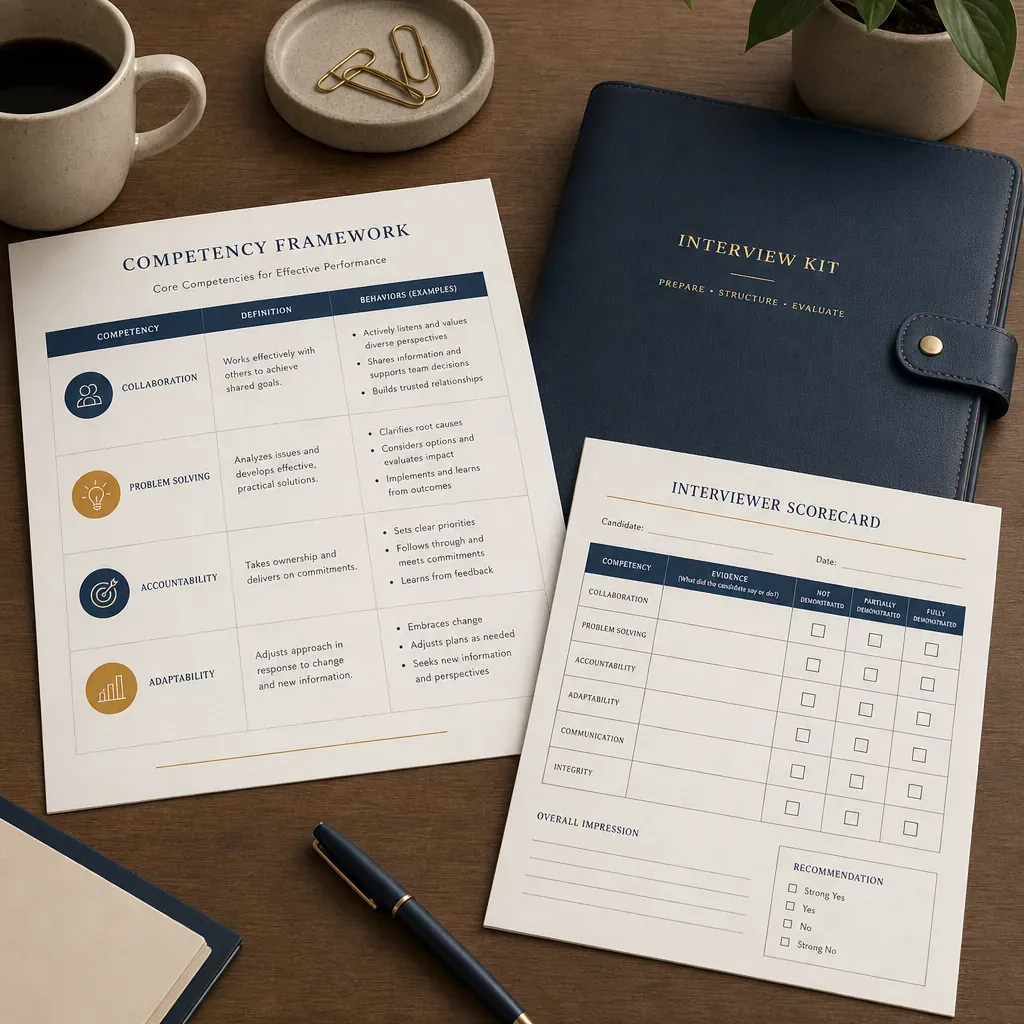
Two parts of the programme matter most for an article about competency framework templates. The scorecards module takes the competency list and behavioural indicators you have just adapted and turns them into a one-page scoring sheet every interviewer uses live in the room - the artefact that closes the loop between framework and decision. The behavioural-interviewing training takes the second half of that loop and trains hiring managers to ask competency-based questions properly: same questions, same probes, same scoring rubric. McClelland's research assumed the people running the interview had been trained that way; in most companies they have not. The training is what makes the assumption true.
HireSchool is not consultancy, not an applicant tracking system, and not a recruiting agency. The customer's team installs the method themselves; the LMS is the scaffolding that lets them onboard interviewers, track progress, and keep the standard consistent as the company hires through it. There is nobody to send a brief to. There is a programme to run, with the kit it needs to run.
If a competency framework template has done its job in your reading so far, the next step is to install the practice it implies. Explore the Structured Hiring Method programme - it is built around exactly the competency-to-scorecard-to-interview chain this article describes, and it is the route most readers will find faster than building the install themselves.
A short list of mistakes that turn a template into shelfware
The same failure modes show up in every practitioner write-up of competency framework adoption, and they are worth flagging plainly. Too many competencies, somewhere north of fifteen, dilutes the focus and exhausts the assessor; the practical ceiling is twelve for individual contributors. Vague language - "strong leadership", "great communicator" - leaves indicators that two interviewers cannot independently agree on, which means they are not indicators at all. Unrealistic level jumps come next: a Level 2 to Level 3 step ought to represent six months of focused development, not five years of executive seasoning. Drafts written without input from the people who do the job almost always describe the work HR thinks the role involves rather than the work the role involves. And the most common one of all: the framework is signed off, filed, and never connected to anything that happens afterwards - no scorecards, no interview kits, no review template. The failure modes the practitioner literature keeps surfacing are remarkably consistent on this point.
McClelland's (1998) finding on expert ratings makes the same point quietly. When expert panels guessed which competencies mattered for a role, they agreed with the BEI-derived data only 74% of the time on the competencies themselves, and far worse on the *level* of each competency required. A pristine, untouched competency model template downloaded yesterday is exactly that kind of expert guess. It might be 74% right; the other quarter is the part that decides whether the framework predicts performance or just describes ambition.
The argument the article has been making lands here. The competency framework template is the easy part - the wrapper, the shared formatting, the column headings. The work is choosing the right competencies, writing indicators someone can actually score, calibrating against the people who already do the job well, and feeding the result into how the company hires. Done well, that is what stops a hiring panel from running on instinct, snacks, and the calendar of whoever booked the room.