.webp)
Competency-based interview questions for employers: a working bank
A working bank of competency-based interview questions for employers, with the scoring rubric that turns answers into evidence you can defend.
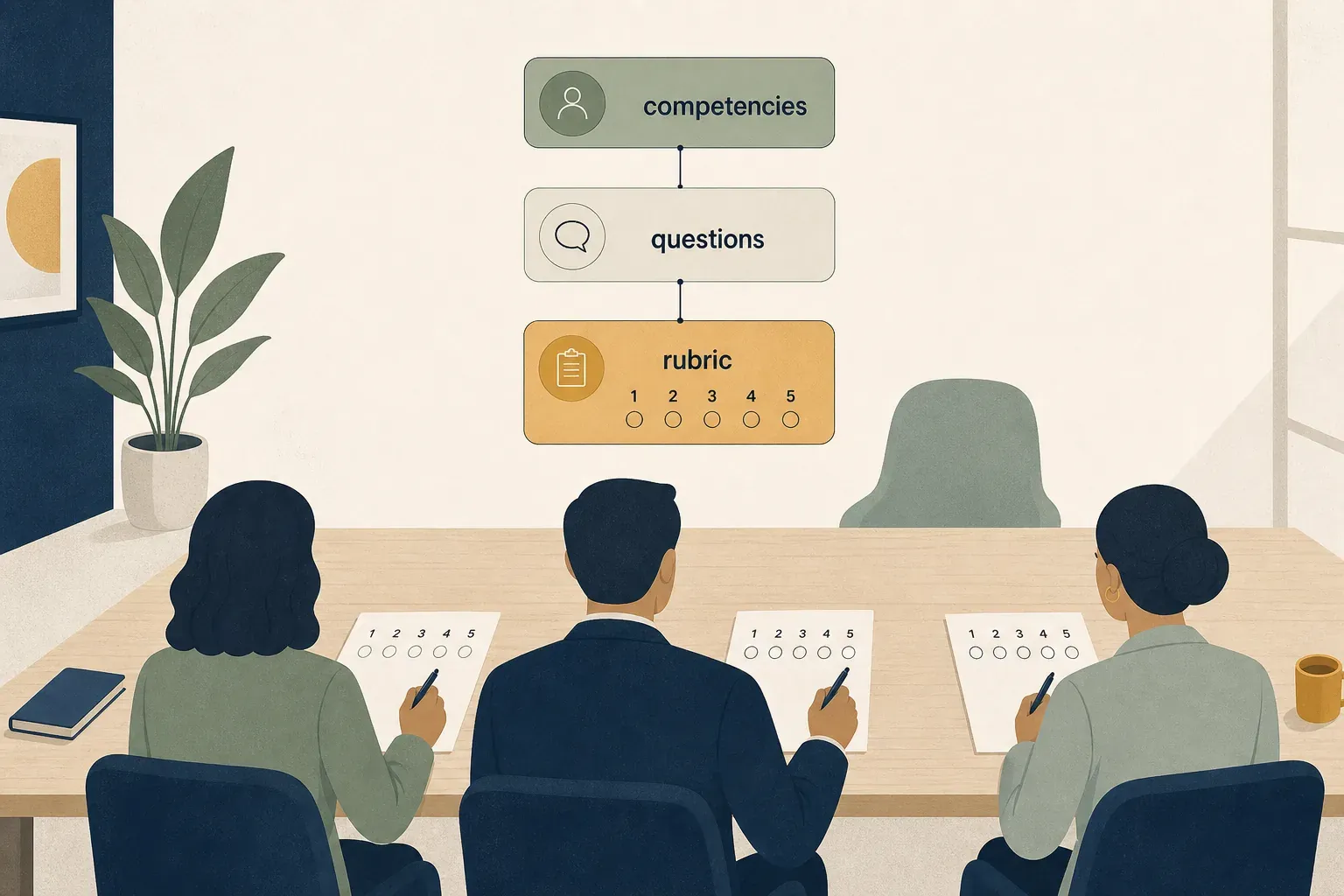
Why competency-based interviewing is the safer bet
Most interviews still feel useful while quietly failing to predict who will do the job well. The research has been blunt about this for decades. McDaniel et al. (1994) and Schmidt and Hunter (1998), in the canonical meta-analyses of employment selection, place structured interviews at an operational validity of around 0.51, and unstructured ones closer to 0.38. Levashina et al. (2013) confirmed the picture had not shifted in the twenty years that followed. The active ingredient is the structure, not the cleverness of the interviewer.
Competency-based interviewing is the practical form of the structured interview that most employers actually run. You decide which competencies the job requires, you write past-behaviour questions that probe each one, you score every answer against the same rubric, and you compare candidates on that evidence rather than on who interviewed best. It is the bit of the literature that survives contact with a real hiring panel.
This article hands over the working materials. A bank of competency-based interview questions, organised by competency, with follow-up probes. A scoring rubric with behavioural anchors. A short calibration step that keeps a panel honest. And the common pitfalls and red flags worth knowing about before you walk into the next interview.
What "competency-based" actually means
A competency-based interview is a structured interview organised around a small set of competencies. Each question is mapped to one of those competencies. Each answer is scored against a behavioural rubric. Every candidate sees the same questions and is judged against the same anchors. The output is comparable evidence rather than a panel's collective vibe. That is, broadly, the working definition most practitioners use.
The terminology is loose in practice, so it helps to draw the lines. A behavioural interview is the question style: past-behaviour prompts using STAR, the situation-task-action-result frame, on the assumption that what someone did before is the best signal for what they will do next. A structured interview is the system: same questions, same scoring, same process for every candidate. Competency-based interviewing names the framework that ties those two together. It says which behaviours we are measuring and what good looks like at each level.
The frame goes back to McClelland (1998), who developed the Behavioral Event Interview to surface the operant thoughts and actions that distinguished outstanding executives from typical ones. Salgado and Moscoso (2002) later showed why behaviour-style questions hold up in practice: they assess job knowledge, job experience and situational judgement, while conventional credentials questions mostly assess general mental ability and personality. The two interview types are functionally different instruments, even when the conversation looks similar from the outside.
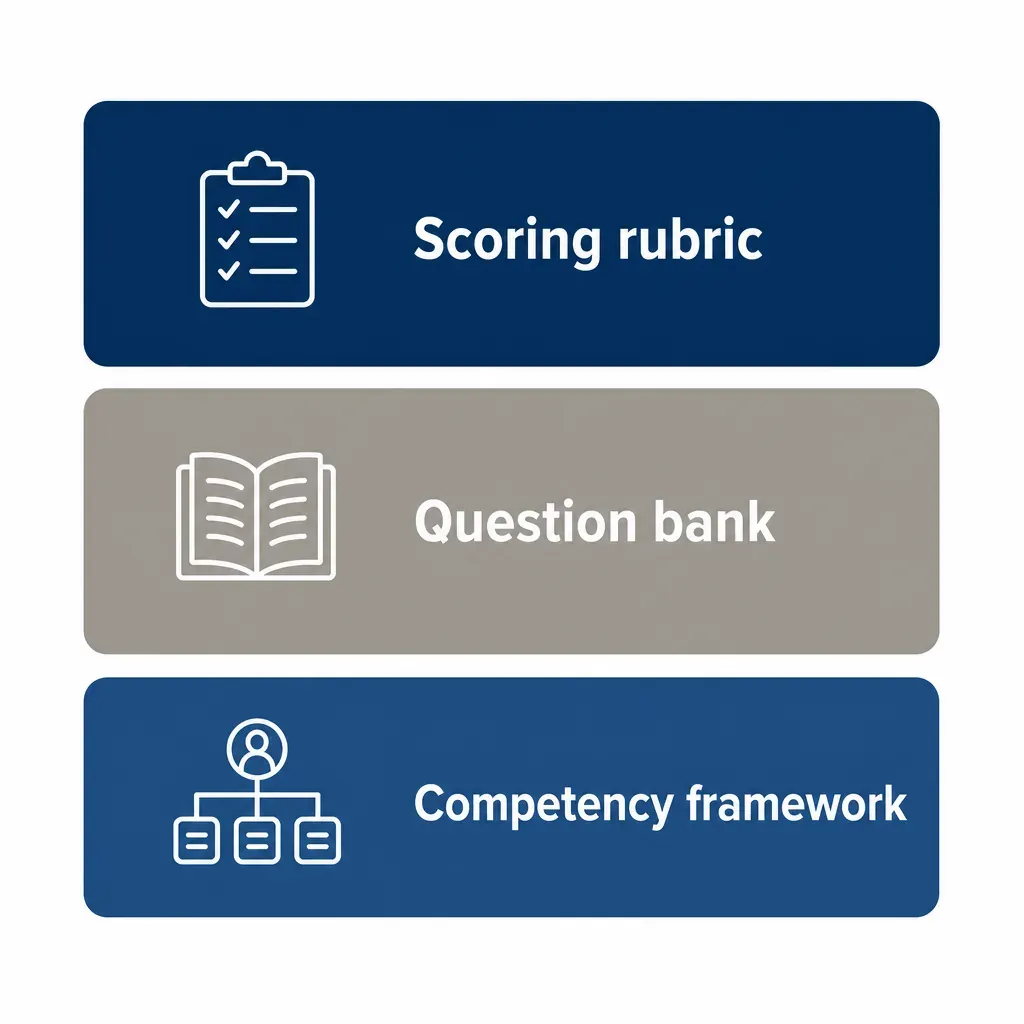
The headline finding from Campion, Palmer and Campion (1997) and the reviews that followed is that the active ingredient is the structure itself, not the genius of any single question. Standardising the questions, the scoring and the panel discipline does most of the predictive work. The competency framework is what makes that structure intelligible to interviewers and defensible to candidates.
Choose three to six competencies, not twelve
Start from the job, not from a generic library. Talk to the hiring manager, talk to the people who do the role well today, look at the performance review data if you have it. The aim is a short list of behaviours and capabilities that consistently separate the strong performers from the average ones in this organisation, in this role. Three to six is the working range. Fewer than that and you miss something material; more than that and the interview gets thin everywhere.
Two to three competencies per interviewer, five to six across the full panel, is roughly the ceiling. Anything more and you are skimming - asking one question per competency, accepting the first answer, and never probing hard enough to tell a rehearsed story from a real one. Depth beats breadth almost every time. A 30-minute slot can do justice to two competencies. It cannot do justice to five.
A worked example helps. For a customer success role, the bank might land on customer focus, problem-solving, communication, ownership and adaptability. For an early-career engineering hire it might be problem-solving, learning agility, communication and collaboration. For a sales lead it is more likely to be ownership, resilience, communication and stakeholder influence. The pattern is consistent: the practical advice every guide converges on is to pick the three to six that actually matter and leave the rest on the cutting-room floor.
Generic competency libraries are useful as vocabulary. Lift one wholesale and you end up testing somebody else's job.
A working bank of competency-based interview questions
The shape of a good competency-based interview question is open, past-tense and specific. Stems like "Tell me about a time...", "Walk me through...", "Describe a recent example of..." pull a candidate towards a real story instead of a hypothetical answer. Each question maps to one competency. Hypotheticals have their place as follow-ups, never as the primary prompt. Writing competency based interview questions is largely the discipline of resisting the clever-sounding stem and asking for a recent, observable example.
Below is a working bank, organised around eight competencies that the recurring set of competencies most question banks cluster around. Pick the three to six that match the role and ignore the rest.
- Leadership. "Tell me about a time you had to motivate a team through a difficult stretch. What did you do, and what was the result?"
- Teamwork and collaboration. "Describe a recent example of working across departments or teams. What did you do to keep alignment, and how did it land?"
- Problem-solving. "Walk me through a problem you couldn't solve with the standard approach. How did you work it out?"
- Communication. "Tell me about a time you had to explain a technical or complex idea to a non-technical audience. What did you change in how you delivered it?"
- Decision-making under uncertainty. "Describe a decision you made with incomplete information. What did you weigh, and how did it turn out?"
- Adaptability. "Tell me about a time priorities shifted unexpectedly. How did you respond?"
- Delivering at pace. "Walk me through a time you had to ship against a hard deadline with constrained resources. What trade-offs did you make?"
- Customer or stakeholder focus. "Describe a time you went out of your way for a customer or internal stakeholder. What was the situation, and what did you do?"
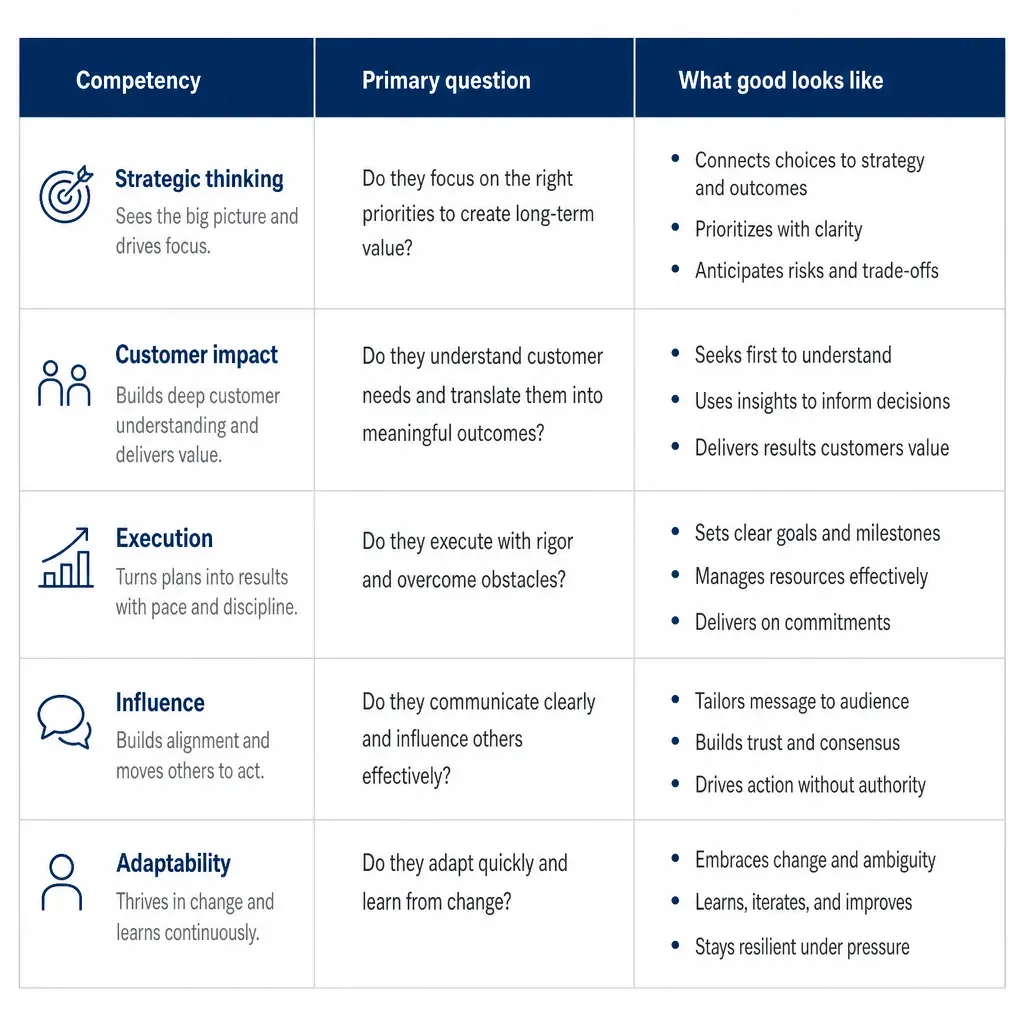
The single biggest failure mode is taking the first answer and moving on. Competency based hr questions only work if you probe. Two follow-ups per question is the realistic floor. The first probe pushes for specificity: "What exactly did you say?", "Who else was in the room?", "When was this?". The second probe pushes for the candidate's own contribution: "What was your part in that, specifically?", "What did you do that someone else might not have?". Rehearsed answers tend to thin out under the second probe. Real ones get richer.
The bank above is a starting set. The point is not to ask all eight questions to one candidate. It is to choose the three to six competencies that matter for the role, draw one main question and one or two probes for each, and ask every candidate the same set in the same order.
The scoring rubric that turns answers into evidence
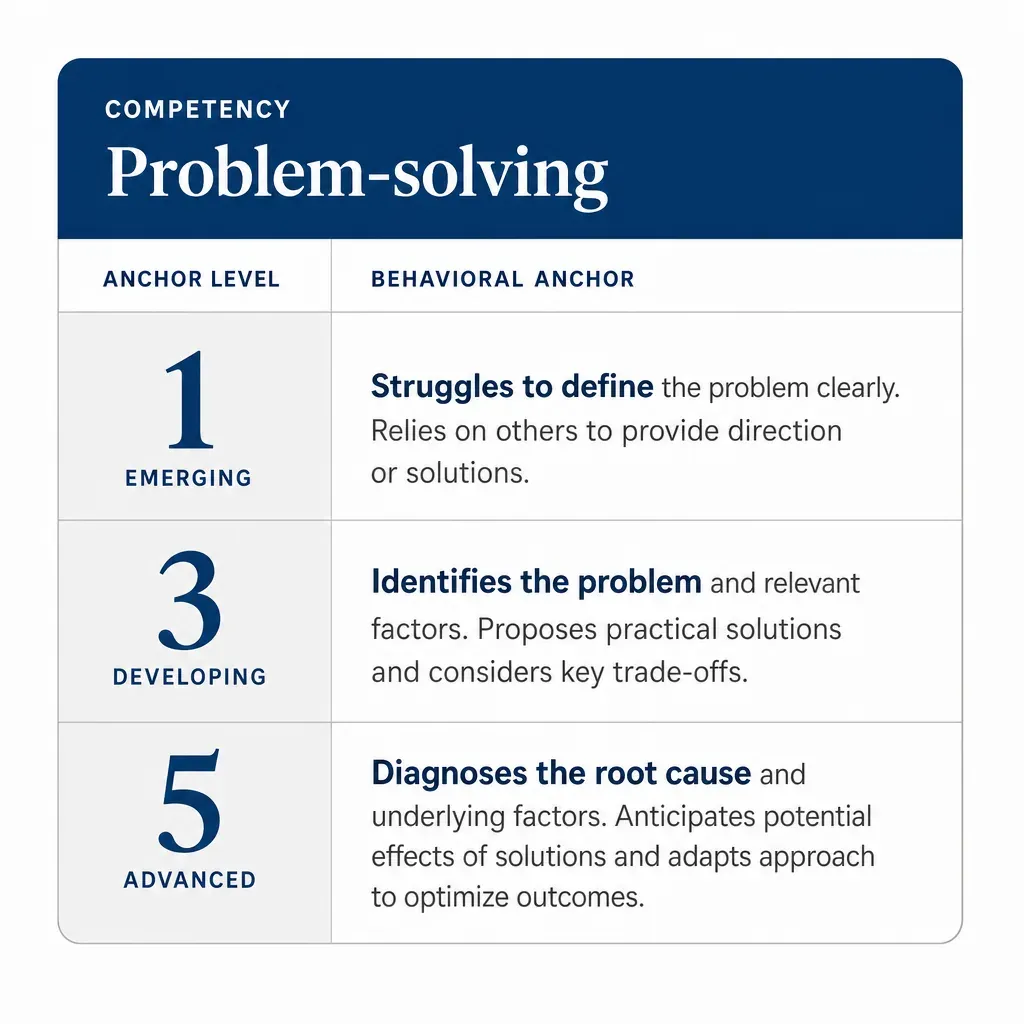
A bank of questions on its own is a stack of prompts. The scoring rubric is what turns answers into evidence. The standard form is a 1-to-5 numeric scale with behavioural anchors per competency, written as observable descriptions of what a candidate at each level actually says or does. The standard 1 to 5 anchored format is well-trodden territory; the work is in the anchors, not the scale.
A worked example for problem-solving makes it concrete. A 1 looks like a candidate who struggles to define the problem and waits for guidance. A 3 identifies the problem, frames it accurately, and proposes a reasonable solution that would work in most cases. A 5 diagnoses the root cause rather than the symptom, proposes more than one credible solution, weighs them against each other, and anticipates second-order effects before being asked. The 2 and 4 levels sit between. Every interviewer scoring problem-solving is reading the same anchors and asking themselves the same question: which level does this answer match.
McClelland (1998) made a related observation that is worth keeping in mind. Competency scores in his data did not behave linearly. They had thresholds - tipping points - below which a candidate was indistinguishable from a typical performer and above which they were reliably outstanding. The practical implication is that aggregating raw averages across competencies is the wrong move. What matters is whether the candidate clears the bar on the must-have competencies for the role. A candidate who is brilliant in three areas and failing in one critical one is not a hire; the strong scores do not pay off the weak one.
Independent scoring before discussion is the other discipline that makes a structured interview different from a chat with a scoresheet attached. Each interviewer writes their score before the panel speaks. Then they share. Discussing first and scoring second contaminates everyone's number with the loudest voice in the room and the warmest first impression. The scoresheet exists so the room argues about anchored evidence rather than feelings about the candidate.
How to install this without it falling apart - and where HireSchool fits
Knowing what good looks like and getting a hiring panel to deliver it consistently are different problems. The dropouts are predictable. Three interviewers each interpret "good communication" in three slightly different ways. Calibration gets skipped because the diary is full. The senior person in the room scores first and the rest of the panel anchor on them. Within a handful of loops the rubric is a piece of paperwork and the decision is back to the gut.
The minimum installation that actually holds together is small. A 30-minute calibration session before interviews begin, in which the panel walks through the competency framework, the rubric, and two scored example answers - one strong, one weak - so everyone is reading the anchors the same way. A short written interview guide that each interviewer reads on the way into the room. Independent scoring on a shared scoresheet before any discussion. A single decision meeting where scores are surfaced first and stories second. None of this is exotic. The hard part is doing it the same way every time, especially when hiring is busy.
This is the gap HireSchool is designed to close. The Structured Hiring Method is a self-guided digital programme that codifies a small business's hiring process end to end - the capability map per role, the interview flow, the question bank, the rubric, and the decision mechanics - and delivers it as video plus a learning management system. It sits on top of whatever applicant tracking system the business is already running. Every interviewer trains on the same material, hires to the same standard, and produces evidence in the same format.
For the reader of this article, that is the practical step beyond the question bank. The bank and rubric here will get you through the next interview. The Structured Hiring Method is what stops you starting from scratch on the role after that, and the role after that. The competencies, the questions, the anchors and the calibration become the operating system rather than something a senior person has to babysit each loop.
HireSchool is not a recruiter, not a one-off training workshop, and not bias-training theatre. It is a system small businesses install once and reuse. If you have read this far, the natural next step is to explore the Structured Hiring Method programme and see whether the shape fits.
Common pitfalls and red flags worth catching
The pitfalls on the panel side are the predictable ones. Trying to cover too many competencies in a single slot, so each one gets a single shallow question and no probe. Letting the candidate drift into hypotheticals - "what I would do is..." - when the question asked for a real past example. Scoring "likability" implicitly while pretending the rubric did the work. Skipping calibration because everyone has read the brief. The literature is dry on this point. Dana, Dawes and Peterson (2012) called it the persistence of the unstructured-interview illusion: the warmer and more conversational the interview feels, the less reliably it predicts performance. The interview that feels best is often the one to trust least.
On the candidate side, a small set of patterns are worth flagging during the interview rather than after it. Rehearsed but vague stories with no specifics about who, when or what was actually done. Results without actions, where the candidate jumps from "the team needed to" straight to "and we hit the target". Blame-shifting under probe, where the second follow-up turns into a story about everyone else's failings. Inability to give a recent example - when "tell me about a time" produces something from a decade ago. A consistent pattern of "we" with no "I", which usually means the candidate cannot separate their contribution from the team's.
None of those is disqualifying on its own. People get nervous, and a single weak story is just a single weak story. A pattern across two or three competencies is the signal. Note the flags on the scoresheet, score against the rubric anyway, and bring them to the calibration meeting as evidence to discuss rather than gut calls to act on alone.
The 5 C's, the question count, and what to do tomorrow
The 5 C's of interviewing get asked about often enough to deserve a short note. One common articulation is competence, character, communication, culture and capacity. It is a useful memory aid for a quick gut check on a candidate at the end of a process. It is not a substitute for a real competency framework tied to the job. The bank above subsumes most of it: competence and capacity sit inside the job-specific competencies you choose, communication is one of the eight, character and culture surface naturally from past-behaviour stories told well. Treat the 5 C's as a checklist on the way out the door, not as the operating model on the way in.
The practical question count, again, is two to three competency questions per interviewer and five to six across the panel. More than that and depth gets sacrificed; fewer than that and the panel ends up making decisions on a single bad day rather than a pattern.
A brief note for the candidates this article is written about. The way to do well at a competency-based interview is to come prepared with five to eight specific, recent examples mapped to the common competencies, and to answer in STAR: situation, task, action, result. Employers can help themselves here by briefing candidates that this is the format. It improves the quality of the answers, reduces the proportion of rambled stories, and keeps the playing field level between the candidate who has been told what to expect and the one who has not.
The whole approach reduces to three things. The bank, the rubric, and the calibration step. Pick the competencies that matter, ask every candidate the same questions, score against anchored evidence, calibrate before you decide. Everything else - the templates, the panels, the scoresheets, the structured debrief - is a variation on those three. Get those right tomorrow, and the next hire is already a better-evidenced one than the last.