.webp)
People management interview questions: what to ask and why
The questions that predict people manager performance - and the scoring framework that makes the decision defensible.

Why people management interviews keep producing wrong hires
The people management interview usually goes well. The candidate is articulate, their examples are clear, and the panel leaves the room feeling confident. Then six months later, their team is struggling and nobody quite understands why - because nothing in the interview predicted it.
This is not a coincidence. Most management interviews are designed to feel good, not to predict performance. They reward polish, confidence, and storytelling, but the gap between interview performance and on-the-job management behaviour is one of the more consistent findings in hiring research. Candidates learn to describe leadership thoughtfully. That does not mean they exercise it.
The problem compounds with preparation. The standard management interview questions - "describe your management style", "how do you handle underperformers", "what makes a great team?" - have been on the internet since before LinkedIn existed. How candidate preparation has degraded interview signal is well-documented: candidates practise answers, share questions on review sites, and optimise for the feeling of confidence rather than the reality of their track record.
The result is a people management process that mostly measures how well someone has thought about management in the abstract. What it almost never measures is whether they have actually done it well. The fix is not a longer list of questions. It is asking the right type of question - and scoring the answers with something more rigorous than a gut feeling.
What a people management interview is actually measuring
Before designing the questions, it helps to be precise about what you are trying to assess. A people management interview is not a test of management knowledge or a character reference. It is an attempt to observe a candidate's pattern of behaviour when managing other people - specifically, the behaviours associated with outstanding rather than merely adequate performance.
McClelland (1998) developed the Behavioral Event Interview methodology by comparing outstanding executives (top 5-10%) against typical executives (next 11-25%) across six work episodes each, three positive and three negative. The resulting competency dictionary - validated across more than 30 organisations - identified 12 behaviours that consistently distinguished the two groups. The most reliably differentiated included Impact and Influence, Team Leadership, Achievement Orientation, Initiative, and Interpersonal Understanding. These are not personality traits; they are specific, codifiable patterns of thought and action that show up consistently when the evidence is gathered carefully.
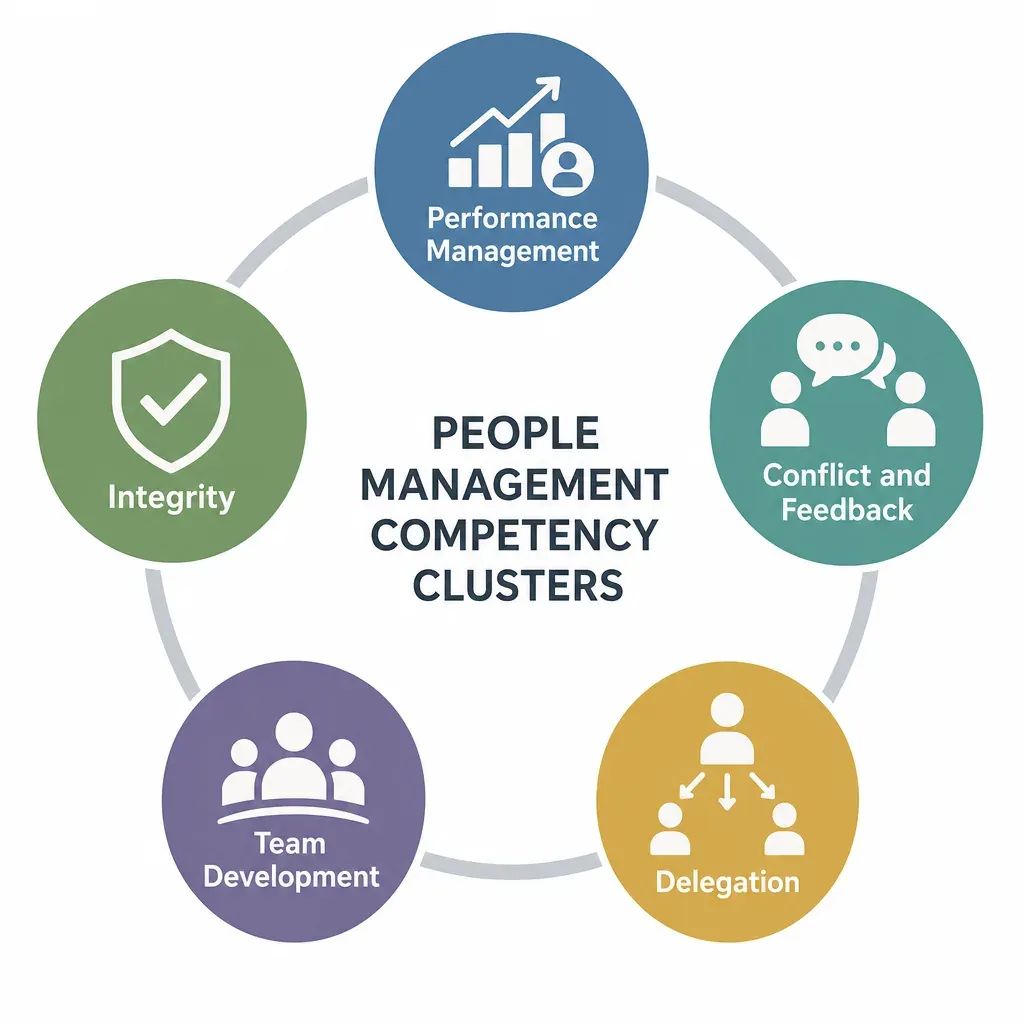
For a people management role specifically, the relevant competency clusters tend to fall into five areas: performance management (how the candidate handles underperformance and gives feedback), delegation and accountability (how they assign work and track it), conflict resolution (how they navigate disagreements within and across teams), team development (how they build capability in the people reporting to them), and integrity under pressure (how they behave when the right thing to do is also the unpopular thing to do).
What strong answers to people management questions actually look like is instructive: they are specific, they name outcomes, and they include an honest account of what did not go well. Generic answers ("I believe in open communication", "I treat people as individuals") describe values. They do not describe evidence. The interviewer's job is to notice the difference.
Why the question format matters more than the question itself
The most common mistake in designing a people management interview is treating all questions as roughly equivalent and focusing on whether the list is comprehensive. It is not. The format of the question - not just its content - determines whether the answer you receive predicts job performance.
The validity evidence here is consistent across decades of research. Sackett et al. (2022) found structured interviews achieve validity of around 0.42 against subsequent job performance, compared with 0.19 for unstructured interviews - approximately twice as predictive. McDaniel, Whetzel, Schmidt and Maurer (1994) reached similar conclusions across 245 validity coefficients drawn from 86,311 individuals. The research on the predictive validity gap between structured and unstructured interviewing is about as settled as any finding in applied psychology.
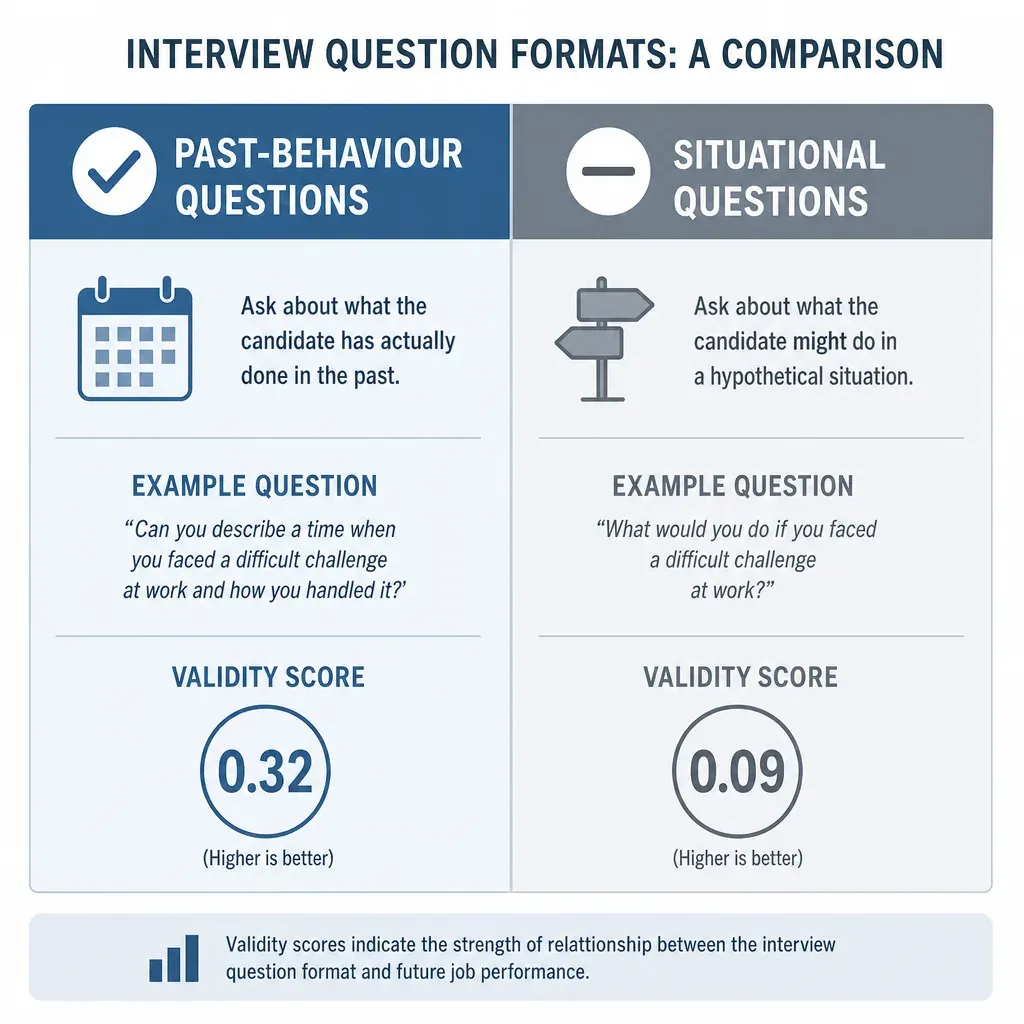
But within structured interviews, not all question types are equal - and the difference matters most for managerial roles. Krajewski, Goffin, McCarthy, Rothstein and Johnston (2006) studied 157 applicants to high-level managerial positions and found that past-behaviour questions (asking what the candidate actually did) predicted subsequent job performance with a correlation of r = .32, p < .01. Situational questions (asking what the candidate would do in a hypothetical scenario) produced r = .09 - statistically indistinguishable from zero. When the researchers ran hierarchical regression, the past-behaviour format predicted significant additional variance over the situational format; the situational format predicted nothing additional over the past-behaviour format. A 2019 study in the Journal of Business Research confirmed that background and which question types significantly predict job performance are the ones grounded in past behaviour - job knowledge questions did not reach significance.
The mechanism is not hard to understand. Past-behaviour questions require the candidate to recall and reconstruct a real experience - what actually happened, what they specifically did, what the result was. Situational questions mostly elicit what the candidate believes is the right answer to a hypothetical dilemma. For experienced management professionals, that belief is often well-calibrated to what sounds good in an interview. It is far less reliably calibrated to how they actually behave when the situation arises for real at 4pm on a difficult Thursday.
The questions that actually work: what to ask a people manager
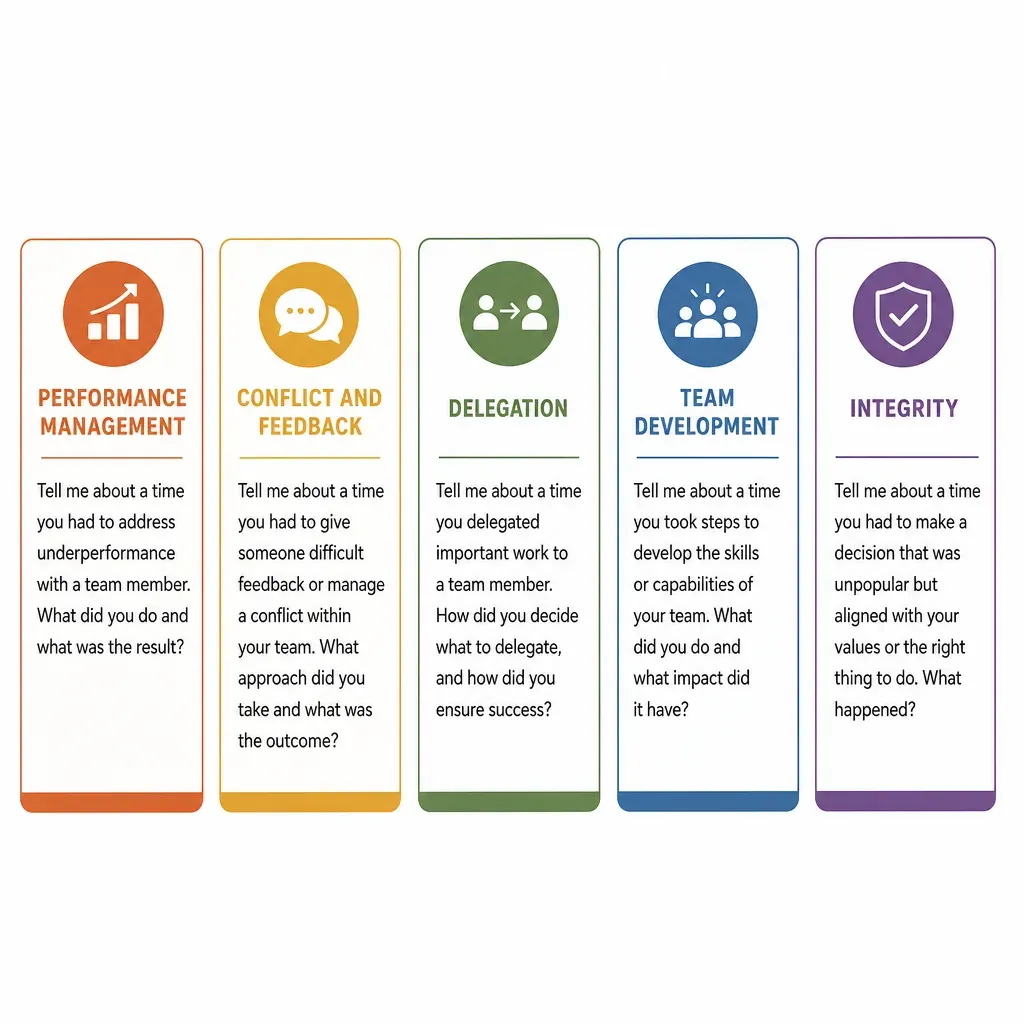
With the format established - past-behaviour, specific, scored - the question is which competency areas to cover. The following five cover the core of people management and each comes with one strong behavioural question. The questions are not the only valid ones; they are starting points that can be adapted to the role's context.
Performance management. "Tell me about a time you managed someone who wasn't meeting expectations. What specifically did you do, and what happened?" This is the most revealing people management question there is. Strong answers describe a real person, a specific conversation, a sequence of actions, and an honest outcome - including cases where the intervention did not work. Vague answers ("I believe in early conversations and clear expectations") describe a philosophy, not a track record.
Conflict and feedback. "Give me an example of a difficult conversation you had with a direct report. How did you prepare for it and what was the outcome?" This probes whether the candidate approaches hard conversations as a tool or avoids them as a hazard. The preparation question matters - managers who invest in how they frame feedback tend to be more effective with it.
Delegation and accountability. "Describe a project you delegated fully to your team. How did you decide who was responsible for what, and how did you track progress without micromanaging?" What to listen for in manager interview responses on delegation includes evidence of a thought-through allocation process and a monitoring approach that gave people room while keeping the work on track.
Team development. "Tell me about someone you managed who went on to a bigger role. What did you specifically do to support that progression?" BrightHire's research notes that the competency areas a well-designed people management question bank should cover include ownership of team members' development, not just their performance. This question tests both the intention and the mechanics.
Integrity under pressure. "Tell me about a time you had to make an unpopular decision as a manager. How did you handle your team's reaction?" This probes McClelland's validated competency of Impact and Influence at a higher level - the candidate had to act on a decision despite pushback, and how they navigated that reveals both their judgment and their relationship skills.
One addition worth considering: a humility question. "What is the most useful piece of constructive feedback you have received from a direct report?" screens for self-awareness and openness to upward feedback - both strong markers of long-term management effectiveness. Candidates who cannot name one are telling you something.
How to build a scoring framework around these questions
Asking the right questions is half the work. The other half is scoring the answers consistently enough that two interviewers independently watching the same candidate arrive at comparable conclusions. Without that, the people management interview is still subject to whoever spoke loudest in the debrief.
Campion, Palmer and Campion (1997) identified 15 components of interview structure across two dimensions - what you ask and how you evaluate it. Among the most impactful on the evaluation side: scoring each question immediately after it is answered (not after the whole interview), using behaviourally anchored rating scales rather than global impressions, and requiring panel members to score independently before comparing notes. Each of these is a modest procedural change. Together they substantially reduce halo effects, recency bias, and the dominance of whoever has the strongest opinions.
Krajewski, Goffin, McCarthy, Rothstein and Johnston (2006) were explicit about this in their managerial study: assessors scored each competency dimension immediately after the relevant question, not at the end. That protocol is there for a reason. Immediate scoring captures what the candidate actually said; post-interview scoring captures the interviewer's overall impression, which is heavily influenced by the most recent and most vivid answers.
A behaviourally anchored rating scale does not need to be complex. For a people management competency like performance management, a three-anchor scale might read: 1 - vague or philosophical response, no specific example or outcome; 3 - specific example with clear actions taken, partial outcome described; 5 - specific example, clear actions, outcome named (including challenges), evidence of reflection or learning. That is enough structure to make independent scoring reliable and the final decision defensible.
The practical minimum for a people management interview is five past-behaviour questions, each scored immediately on a structured scale, with at least two interviewers who do not compare notes until after individual scoring is complete. That is a 90-minute process. It is also meaningfully more predictive than a two-hour chat that ends with the panel agreeing on whoever felt most like a "good fit."
How to install a structured approach to hiring people managers
So we have the questions, and we have the scoring logic. The harder problem is making this stick across your organisation rather than existing only in the notes of whoever read this article. Most small businesses and scale-ups have a version of the same gap: individual managers run interviews their own way, with no shared question bank, no scoring rubric, and no structured debrief. The process is only as consistent as whoever happened to be in the room on the day.
That is where a structured method - one your whole hiring team can learn and run together - makes the difference between a single well-run interview and a reliably well-run hiring process.
The Structured Hiring Method is a self-guided digital programme from HireSchool that codifies exactly this kind of structured interview practice into a system small businesses and scale-ups can install themselves. It is video content plus a learning management system - not consultancy, not a recruiting agency, not an applicant tracking system. You and your team work through it at your own pace and come out the other side running a consistent process.
For people management hiring specifically, the programme includes a behavioural interviewing module that trains your hiring managers on how to write past-behaviour questions anchored to specific competencies, how to build and use a scoring rubric, and how to run a structured post-interview debrief - the kind where individual scores are locked in before anyone speaks, rather than the kind where whoever has the most confident voice shapes the outcome. It also covers how to set up Leadership Values for your organisation so the competencies you are assessing reflect what you actually need, not a generic template.
The relevance to a people management hire is direct. If you are bringing in a head of people, a first team lead, or a functional manager for a team that is starting to grow, the hire you make now compounds. A structured process means the questions improve with repetition, the scoring calibrates across your panel over time, and the decision is auditable six months later when you - or the new manager - wants to understand what the hiring logic was.
HireSchool is not a one-off workshop or a set of templates you download and shelve. It is a method that your team installs into the way you hire, with enough scaffolding that it holds even when the hiring manager is new or the role is unfamiliar. The distinction matters because the value of structured interviewing compounds only if the structure is actually used - not just known about.
If the argument in this article has landed, the next step is to explore the Structured Hiring Method programme and see how it is structured. The programme page sets out what is covered and how the learning is delivered.
Making people management interviews work in practice
The structural advantage of getting this right is not hypothetical. Scur, Cornwell and Schmutte (2019) analysed a decade of employer-employee data from Brazilian firms and found that companies with structured management practices hire managers from the 58th percentile of the worker quality distribution, while firms without such practices hire from the 46th percentile. That 12-point gap compounds: the same structured firms also retain top-quartile employees at significantly higher rates and, when they do part ways with someone, they are more likely to be parting with a genuinely poor fit rather than a casualty of disorganised management.
The people management interview is the point where that structural advantage is either created or squandered. Most organisations are already using reasonable questions. The ones that consistently hire better people managers are using the right question format - past-behaviour rather than situational - with anchored scoring applied immediately, and a debrief process that aggregates independent judgments rather than deferring to the most confident voice in the room.
None of that requires an elaborate process. The practical minimum is five behavioural questions, scored question-by-question on a structured scale, by at least two interviewers who record their assessments independently before comparing notes. That is enough to produce decisions that hold up to scrutiny and improve with repetition. It is also, in the experience of most organisations that try it, a better use of ninety minutes than an unstructured conversation that leaves everyone feeling positive and nobody quite knowing why they chose who they chose.