.webp)
How to run a structured interview process
Most employers know interviews are imperfect. The research has solved the problem - here is the structured interview process, step by step.

Why most interviews are less useful than they feel
Almost every organisation uses interviews. In Ulrich and Trumbo's 1965 survey, 99 % of the 852 organisations they spoke to reported using interviews as a selection tool. The number has barely shifted since. This makes the following finding somewhat uncomfortable: without structure, interviews have a predictive validity for job performance somewhere between .14 and .33. To put that in plain terms: not much better than chance, and substantially worse than a well-designed work sample test.
The research on why this happens is blunt. Dana, Dawes and Peterson (2012) ran a series of studies on what they called "sensemaking" - the tendency for interviewers to construct a plausible narrative from almost anything a candidate says. In one study, interviewees secretly answered questions according to a random system. Participants' predictions were not perturbed by this. The random interviews generated confidence indistinguishable from real ones. In a further study, participants predicted fellow students' grade point averages better when they had NOT conducted an unstructured interview than when they had. The interview added noise, not signal.
Kausel, Culbertson and Madrid (2016) extended this line of research into hiring specifically. Their participants exhibited significantly more overconfidence in their hiring predictions when given unstructured interview information alongside test scores than when given test scores alone. The interview did not just fail to help - it actively impaired decision quality by inflating confidence without improving accuracy. Interviewers felt more certain. They were not more right.
The predictive validity gap between structured and unstructured interviews is not a matter of academic dispute. Wiesner and Cronshaw (1988) found that structured interviews produced validity coefficients approximately twice those of unstructured interviews across their meta-analytic sample. The most common reasons companies hesitate to change are organisational and cultural - not evidential. The evidence is already in.
The interview is not the problem. The absence of structure is. That gap is, as will become clear, entirely closable.
What "structured" actually means
The word "structured" gets used loosely. Some interviewers mean they have a loose agenda. Some mean they prepared a few questions in advance. The research definition is more specific: a structured interview is an assessment method designed to measure job-related competencies by systematically enquiring about behaviour in past experiences and proposed behaviour in hypothetical situations, with consistent questions, consistent order, and a standardised evaluation process applied equally to all candidates.
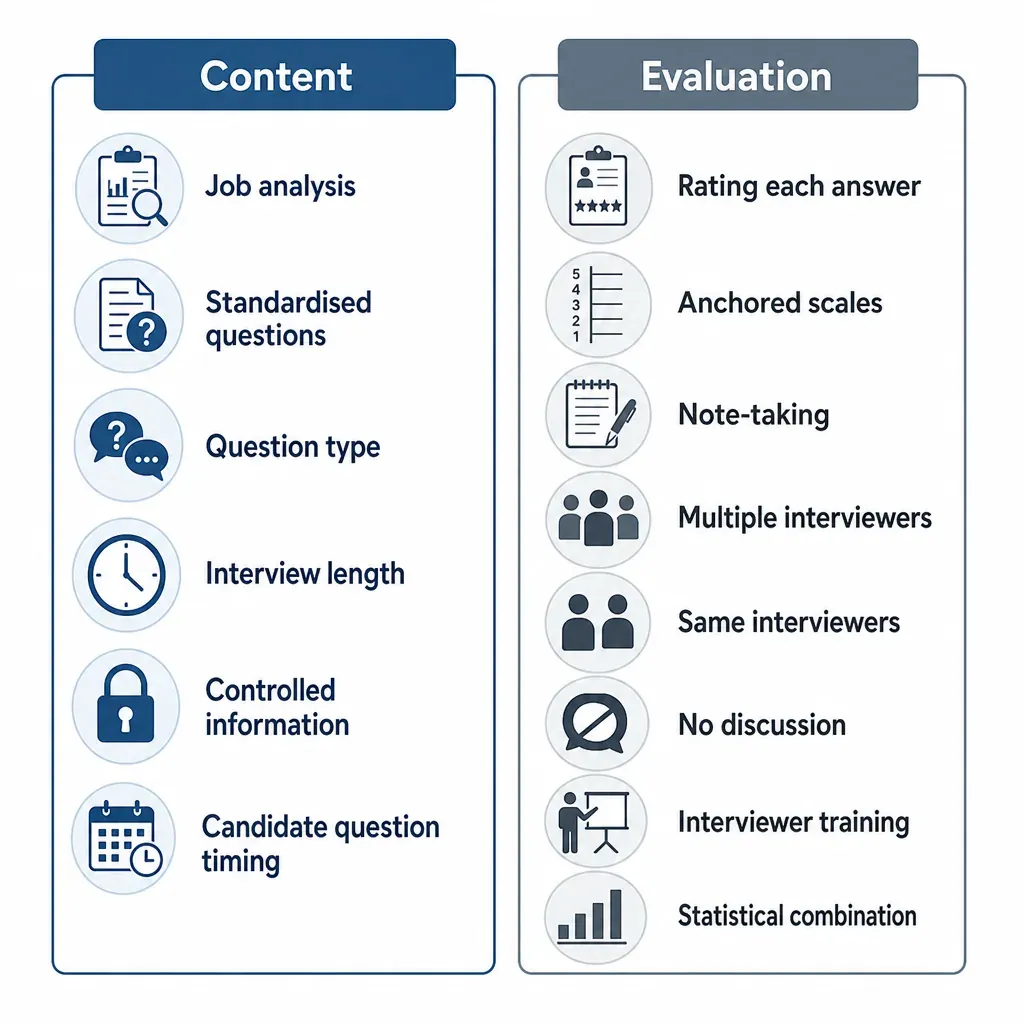
The most useful framework for understanding what this means in practice comes from Campion, Palmer and Campion (1997), who reviewed nearly 200 articles and books on the topic and identified 15 components of interview structure. These fall into two clusters. The first cluster covers the content of the interview - what gets asked. The second covers the evaluation process - how answers get assessed. Both matter; most organisations focus only on the first and wonder why their structured interviews do not perform better.
The content side includes: basing questions on a job analysis, asking every candidate the same questions in the same order, using better question types (behavioural and situational rather than vague open questions), using an appropriate number of questions, controlling access to ancillary information before the interview, and not taking uncontrolled candidate questions during the interview. The evaluation side includes: rating each answer individually rather than forming a single global impression, using anchored rating scales, taking detailed notes, using multiple interviewers, having the same interviewers for all candidates, not discussing candidates between interviews, providing interviewer training, and aggregating scores statistically rather than through discussion.
Structured interviews include both behavioural questions ("tell me about a time you...") and situational questions ("imagine you were faced with..."). These are types of question, not separate processes. Either can be used within a structured format; the structure is in the standardisation and scoring, not in the question style alone.
What structured interviews are not: a rigid script that makes conversations feel mechanical. The questions are fixed; the rapport, tone, and human exchange are not. Campion et al. noted that some components - particularly restricting candidate questions until after the interview - can produce mixed user reactions, and that a pragmatic rather than maximally rigid approach often serves better in practice. Structure is a discipline, not a straitjacket.
The evidence case: structured vs unstructured
The argument for structured interviewing is not built on intuition or vendor claims. It is built on one of the most consistently replicated bodies of research in organisational psychology.
The landmark meta-analysis is McDaniel, Whetzel, Schmidt and Maurer (1994), which analysed 245 validity coefficients derived from 86,311 individuals. Their conclusion: structured interviews had higher predictive validity than unstructured interviews across all outcome criteria - job performance, training performance, and tenure. Wiesner and Cronshaw (1988) reached the same conclusion a few years earlier, with corrected validity coefficients for unstructured interviews ranging from .14 to .33, and for structured interviews from .35 to .62. This is not a marginal difference. Levashina, Hartwell, Morgeson and Campion (2013) reviewed the subsequent 20 years of research and found 12 meta-analyses, all reaching the same conclusion. That level of replication is unusual even in well-developed fields.
The most current validity coefficient comparison from Sackett et al. (2022) puts the figures at .42 for structured and .19 for unstructured - structured interviews are roughly twice as effective at predicting job performance. These numbers should be read with a standard caveat: they are corrected for range restriction and measurement unreliability. Observed coefficients in any single company will be lower. The ratio, however, is stable across corrections and samples.
A note on the scorecard: the validity advantage of structured interviews depends on both the question standardisation and the evaluation mechanism. A structured question set without an anchored scorecard is semi-structured at best. The reason unstructured interviews persist despite the evidence against them is partly cultural, partly the perception that scorecards add administrative burden, and partly the human tendency (documented rigorously by Dana et al., 2012) to trust our own judgement regardless of what the data suggest.
One controversy is worth noting. Schmidt et al. (2016) applied a newer statistical correction and suggested the gap between structured and unstructured interviews largely disappeared. Sackett et al. (2022) subsequently found that those corrections overcorrected for range restriction. The gap is restored. This is how science is supposed to work: the finding survives scrutiny, even contested scrutiny.
Building the process step by step
The structured interview process is not a single event - it is a sequence of design decisions made before any candidate sits down. Here is how to build it.
Step 1: conduct a job analysis. Identify four to six competencies that distinguish strong performers in this role from adequate ones. Campion, Palmer and Campion (1997) recommend the critical-incidents approach: collect examples of behaviour that mark the difference between excellent and poor performance, drawn from people who have done the job or managed it. This step is the foundation. Questions derived without a job analysis are questions that have not been tested against the actual requirements of the role, and the scorecard built on them is measuring something other than performance.
Step 2: write the questions. For each competency, write at least two questions - one behavioural ("tell me about a time you had to...") and one situational ("imagine you were in a situation where..."). Fix the question text. Every candidate gets the same wording, in the same order. Campion, Palmer and Campion (1998) found that most effective structured interviews contain 15 to 20 questions and last between 30 and 60 minutes - a useful calibration if you are building from scratch.
Step 3: build the scorecard. For each question, define what a strong answer looks like, what an average answer looks like, and what a weak one looks like. Attach a 1-5 scale to each, with behavioural descriptors for each point. Evaluative adjectives ("excellent", "marginal") work less well than behavioural ones because different interviewers interpret them differently. The scoring rubric, not the question, is where most organisations underinvest.
Step 4: brief the panel. Every interviewer should have the scorecard before the interview, not handed to them as they walk in. They should understand the competencies, the questions, and - critically - the expectation that they score independently during the interview and do not share their assessments until everyone has finished. Panel briefing is training, not a five-minute preamble.
Step 5: conduct the interview. Ask the questions in order. Take notes against each answer. Completing evaluations in real time rather than from memory is not a bureaucratic preference - it is a reliability mechanism. Memory distortion and post-hoc rationalisation compound quickly once the candidate has left the room.
Step 6: score independently, then discuss. After the interview, each interviewer completes their scorecard privately before sharing it with others. Aggregate the scores arithmetically. Discussion is valuable for adding context; it should happen after the numbers are fixed, not instead of them. A numerical average is more reliable than a negotiated consensus - especially when the most senior person in the room has a strong view.
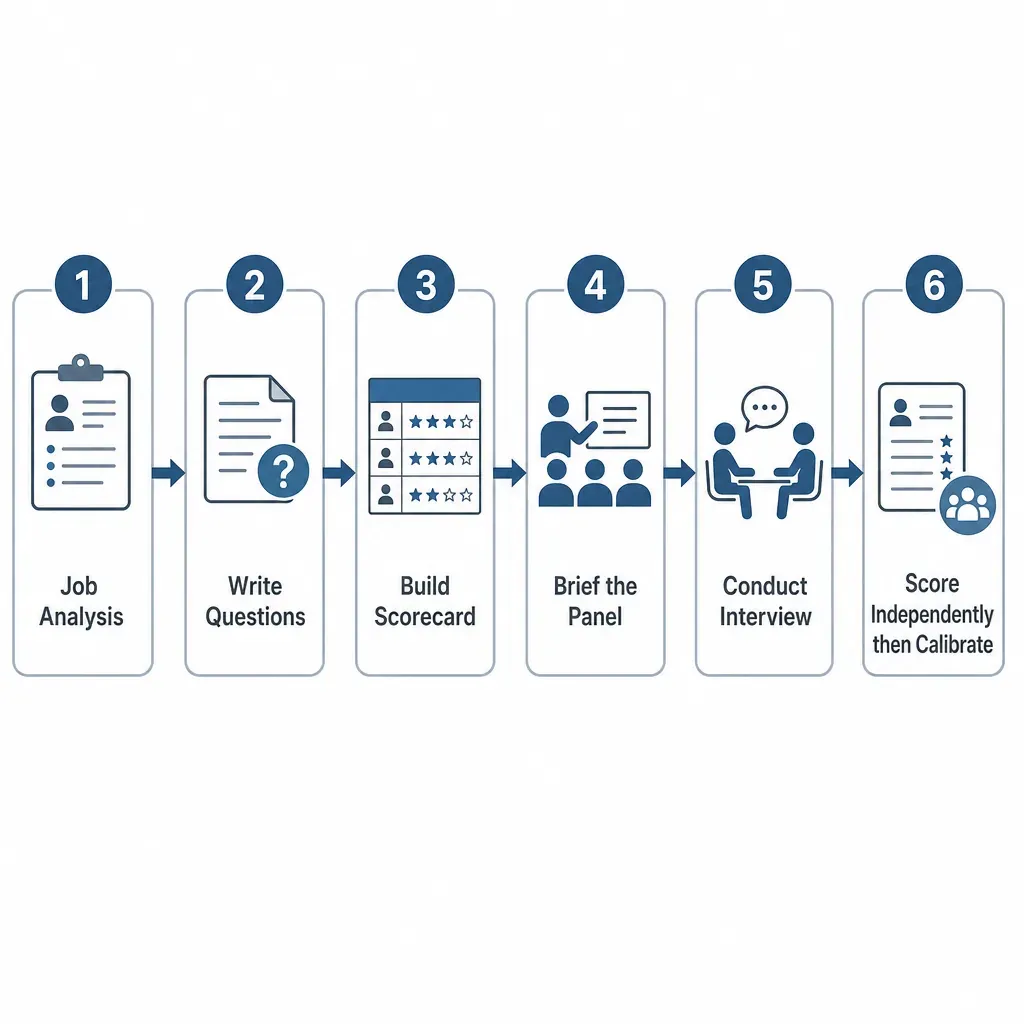
These steps are practical steps for designing a structured interview that can be adapted to most organisational contexts. The sequence matters. Skipping job analysis because it feels bureaucratic, or skipping independent scoring because it feels awkward, undermines the process at precisely the points that drive its validity advantage.
The scorecard in practice
The scorecard is the most underrated part of the structured interview process. Most organisations that have attempted structured hiring have designed questions; fewer have designed the evaluation mechanism that makes those questions useful. Without an anchored scorecard, a structured question set produces structured impressions rather than structured evidence.
The purpose of the scorecard is to convert the interviewer's subjective reaction to a candidate's answer into a piece of documented, comparable, auditable evidence. It is not a bureaucratic form. It is a tool for reducing the three things that most reliably corrupt hiring decisions: memory distortion (we remember first impressions more than midway answers), confirmation bias (we score evidence in the direction we already lean), and the influence of whoever speaks most confidently in the debrief.
A well-built scorecard contains: candidate name, role, date, interviewer, and interview stage at the top; one row per competency with a 1-5 anchored rating scale and a notes field for specific behavioural evidence; and an overall hire/no-hire recommendation at the bottom with a required justification sentence. The notes field matters. Without it, a score of 3 from one interviewer and a score of 3 from another may be responses to entirely different things the candidate said.
The anchoring is the technical part. Campion, Palmer and Campion (1997) identified four types of anchor that are commonly used: example answers or illustrations, descriptions of elements to look for, evaluative adjectives, and relative comparisons. Behavioural anchors - specific descriptions of what a 1 answer, a 3 answer, and a 5 answer look like for this competency in this role - produce the most reliable inter-rater agreement. Evaluative adjectives like "excellent" or "marginal" are better than nothing, but they leave too much room for interpretation. Different interviewers will use them differently.
The critical operational rule: score in the room, not afterwards. Kausel, Culbertson and Madrid (2016) demonstrated that confidence compounds when recall is the basis for assessment; interviewers who score from memory are overconfident in ways that do not correspond to accuracy. Completing the scorecard during the interview - or immediately after, before speaking to anyone - contains this effect.
Once all interviewers have completed their scorecards independently, share and aggregate arithmetically. Designing scorecards that produce consistent inter-rater ratings requires independent scoring before discussion. The debrief is then a conversation about evidence - "you gave a 2 on commercial judgement; I gave a 4; here is what I heard" - rather than a negotiation about who liked the candidate most. That distinction changes the character of the decision entirely.
How to install a structured interview process in your company
The evidence is clear and the method is well-understood. The remaining question for most small businesses and scale-ups is a practical one: how do you actually install this when you do not have a head of HR, an L&D team, or a consultancy budget?
This is the gap that HireSchool was built to fill. HireSchool is a self-guided digital programme called the Structured Hiring Method. It is built for growing businesses - the 20-to-200-person company where hiring is becoming consequential but is still owned by the founders, a small people team, or individual managers who each run their own process (or lack of one). The programme delivers video content and a learning management system that enables you to train your team and track progress without external facilitation.
The Structured Hiring Method works through the same sequence described in this article. It covers Leadership Values (how you define what good looks like in your business, which feeds the job analysis); codified scorecards (built on the anchored-rating-scale approach the research supports); behavioural interviewing training (how to ask behavioural and situational questions well, and how to distinguish evidence from impression); and decision management (how to run the independent-scoring, then-calibrate sequence so the debrief produces a real decision, not a re-run of whoever spoke last). For businesses at a stage where they need it, the programme also includes a Quality Assurance module.
The underlying standard is First Past the Post - a structured decision framework that makes the hire/no-hire decision explicit and repeatable rather than emergent and variable. It replaces the implicit "we felt good about them" with a documented evaluation that managers can stand behind six months later.
HireSchool is not a consultancy. Nobody comes to your office. It is not an applicant tracking system, not a job board, and not a recruiting agency. You run it. Your team builds the capability. The difference from building it yourself from scratch is that the process templates, training materials, and implementation guidance are already designed and tested, so you install a system rather than invent one.

If the steps in this article describe what you know you should be doing - and the honest answer is that most hiring leaders at growing companies do know this - then the practical question is how to move from knowing to doing. You can explore the Structured Hiring Method programme at hire.school. There is no consultant to book, no project to commission; you start the programme and your team follows.
Common objections and why they don't hold
Three objections to the structured interview process appear reliably. They are worth addressing directly, because they are honest objections rather than bad faith ones - they represent real concerns that have been investigated, not shrugged away.
"Our roles are too unique to standardise." Structure is about competency consistency, not role uniformity. The job analysis step exists precisely to identify what distinguishes strong performance in this specific role. A sales director role and an engineering lead role will produce entirely different competencies, different questions, and different scorecard anchors. What is standardised is the process of identifying those criteria and applying them equally - not the criteria themselves.
"Structured interviews make conversations feel robotic." This is the objection most commonly raised by experienced interviewers, and it rests on a conflation between the question list and the conversation. The questions are fixed; the register, the pace, and the human exchange are not. Criteria Corp survey data found that 7 in 10 candidates prefer interviews where questions do not vary from candidate to candidate - they find consistency fairer, not colder. The most common reasons companies hesitate to change rarely include "candidates complained". They include interviewer autonomy and upfront effort.
"It takes too long to set up." It does take longer than booking a room and asking whatever comes to mind. Van der Zee and colleagues (2001) named this barrier explicitly: structured interviews require time and money to implement, and that upfront cost is real. What is also real is that an unstructured interview costs you more slowly - in bad hires, in ramp time, in decisions you cannot explain or defend. Dana, Dawes and Peterson (2012) showed that interviewers are confidently wrong. The setup cost of a structured process is a one-time investment; the cost of misplaced confidence is recurring.
A structured interview process is the mechanism by which a hiring decision becomes one you can defend the next morning. Unstructured interviews feel efficient because they are comfortable. They are expensive in a way that tends to show up later.