.webp)
Unstructured, semi-structured and structured interviews compared
Compare unstructured, semi-structured and structured interviews - what the evidence says, and which fits which role.

The three formats most companies use without naming them
Almost every small business is already running one of three interview formats. The unstructured chat over coffee, the semi-structured conversation with a few prepared questions, the structured interview where every candidate gets the same questions in the same order. Most teams just do not call them anything. They call them "the founder chat", "the second-round", "the proper interview". The labels do not matter; the choices behind them do.
This piece walks through the three interview formats most teams already run, looks at what the evidence says each one is good for, and offers a way to decide which fits the role you are hiring for. It is written for the hiring leader at a 10-to-100-person company who has fifteen minutes between meetings and wants a defensible answer rather than a vendor pitch.
The argument in one line: an unstructured interview is the default because it feels like the most natural one, but the format you pick shapes who you hire as much as the questions you ask. That is worth being deliberate about, because the cost of getting it wrong does not show up at the offer stage. It shows up six months later, when the hire is not working out and nobody can quite explain why.
What each format actually is
An unstructured interview has no fixed questions and no scoring rubric. Each interviewer leads the conversation wherever curiosity takes them, and writes up impressions afterwards. Different candidates get different questions, in different orders, evaluated against different mental yardsticks. Picture a free-flowing conversation with no predetermined script: "Tell me about yourself", followed by wherever the answer leads. It is the format most people imagine when they think of an interview, and the one most small businesses run by default.
A structured interview sits at the other end. Every candidate is asked the same job-relevant questions in the same order. Each answer is scored against a rubric with anchored examples of what a 1, 3, or 5 looks like. If a panel runs the interview, panellists rate independently and consolidate at the end. Wiesner and Cronshaw (1988) define structure as the disciplined removal of variation between interviews so that the differences in scores reflect differences in candidates rather than differences in interviewers.
A semi-structured interview sits between the two, on purpose. The interviewer prepares a prepared list of topics rather than a script: a small set of core questions every candidate answers, plus permitted follow-ups so the conversation can adapt to the person in the room. A short example: "Walk me through how you handled a missed deadline in your last role" as a core question, with permitted probes on what they tried first, who they involved, and how it ended.
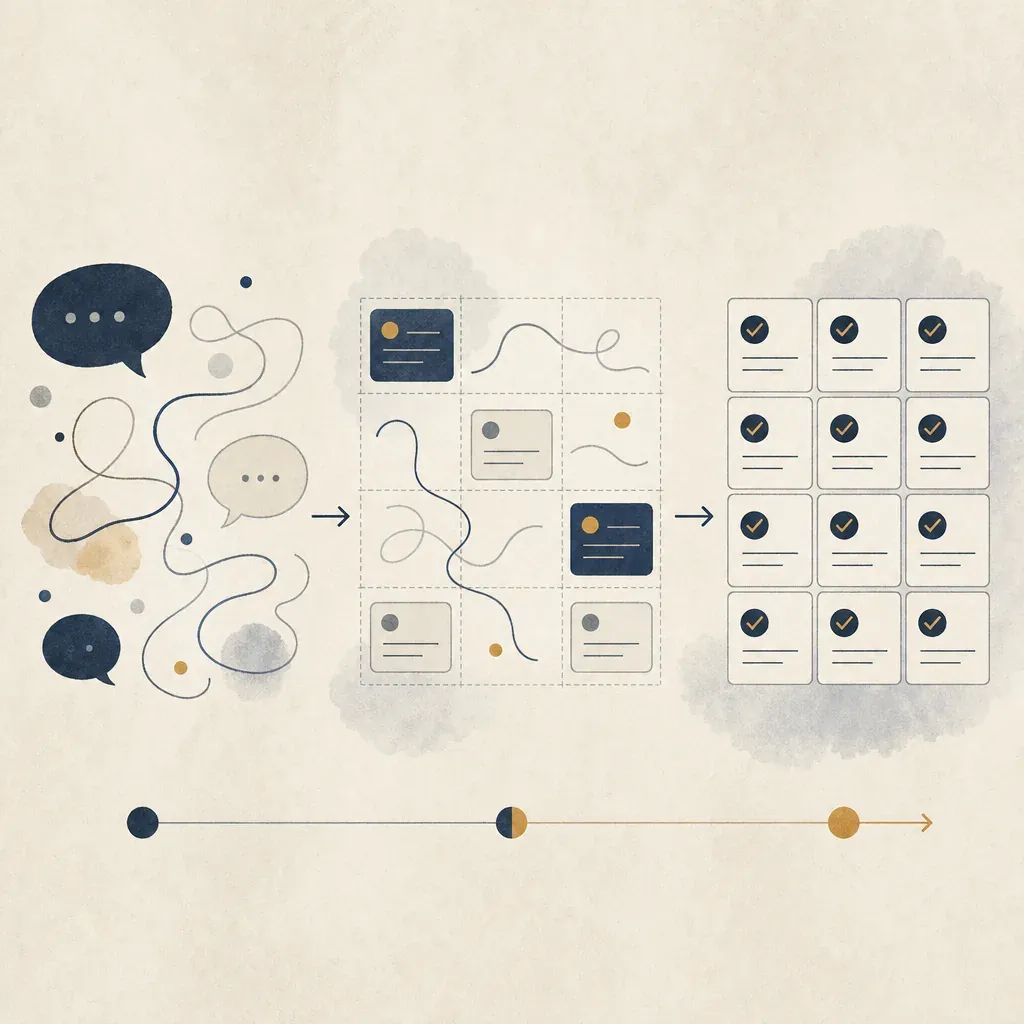
The thing to notice is that "structure" is a spectrum rather than a binary. The Campion, Palmer and Campion (1997) framework breaks it into 15 separable components - standardised questions, anchored rating scales, panel composition, note-taking, and so on. Two interviews can both be called "structured" while differing materially in how many of those pillars are actually in place. That ambiguity is what makes the semi-structured category genuinely useful and occasionally misleading.
What the evidence says about each
Across every meta-analysis the field has produced, structured interviews predict job performance roughly twice the predictive accuracy of an unstructured interview. That is not a small effect, and it is not a contested one. The exact coefficients move around by study, but the direction never does.
The clearest single number comes from Wiesner and Cronshaw (1988), whose meta-analysis of 150 validity coefficients found mean validities for structured interviews about twice those for unstructured ones. McDaniel et al. (1994) repeated the exercise on a much larger dataset of 245 coefficients drawn from over 86,000 individuals, and reached the same conclusion. Campion, Palmer and Campion (1997) summarised the meta-analytic literature as a range: corrected validities of .14 to .33 for unstructured interviews, .35 to .62 for structured. Levashina et al. (2013) confirmed the gap had not narrowed in the 20 years since Campion's framework was published.
The predictive validity argument is therefore boring. It is also settled. Where it gets interesting is the middle of the spectrum.
There is no clean meta-analytic estimate for semi-structured interviews specifically, because the term covers a wide range of practice. Some semi-structured interviews are essentially structured interviews with permitted probes; some are unstructured interviews with two prepared questions at the top. The honest reading of the evidence is that semi-structured validity sits between the two endpoints, and where exactly it lands depends on which structure components have been kept. Anchored scoring rubric? Closer to structured. Just a list of topics in the interviewer's notebook? Closer to unstructured.
This is the part that surprises people. The label "semi-structured" promises a deliberate trade-off. In practice, it sometimes hides the absence of one. The unstructured interview vs semi structured distinction collapses if the only difference is that someone wrote three bullet points before the meeting.

Why unstructured interviews persist anyway
The obvious question, given the evidence, is why anyone still runs unstructured interviews at all. Two reasons, and they are not the ones most people give.
Dana, Dawes and Peterson (2013) ran an experiment in which interviewers conducted unstructured interviews with candidates whose answers were generated by a random system - the candidate flipped a coin to decide whether to answer "yes" or "no" to questions whose intended answers required nuance. The interviewers did not realise. They formed interview impressions formed just as confidently from random answers as from real ones. Their predictions of outcomes were worse than the predictions of people who had not interviewed the candidates at all.
The authors named two cognitive mechanisms. Sensemaking: the mind's habit of manufacturing meaning from any input it is given. Dilution: the way irrelevant information drags down the predictive value of the relevant information that came with it. Both are normal human cognition. Neither switches off because the interviewer is experienced. The conclusion the paper draws is unusually direct for an academic journal: do not use unstructured interviews for screening decisions.
Kausel, Culbertson and Madrid (2016) extended the picture. Hiring managers given test scores plus an unstructured interview were measurably more confident in their hiring predictions than managers given test scores alone. The added confidence did not make them more accurate. In a follow-up betting study, that overconfidence cost real money.
The honest version of "I just know a good one when I see them" is that the interviewer remembers the hires that worked and forgets the ones that did not. It is a habit, not a method. The evidence is not telling anyone they have bad judgement. It is telling them that the unstructured interview is the wrong instrument for this particular job.
When semi-structured earns its place
None of the above is an argument that every interview must be a rigid script. There is a real case for a semi-structured interview, and it is worth making honestly.
The case is this. For most roles, parts of the work are predictable enough to compare candidates against the same questions, and parts are unusual enough that you genuinely need to follow the answer. A semi-structured interview keeps the standardised core questions and rubric for the comparable parts, and allows permitted probes for the rest. Done well, it is a deliberate balance between consistency and conversational depth.
In practice, that looks like four or five anchored core questions every candidate answers, scored against a rubric, plus a defined set of probes the interviewer can deploy if the answer raises something worth chasing. For a senior product role, the core might be questions on prioritisation, stakeholder management, and a recent decision the candidate would now reverse. The probes might cover the texture of how those decisions were taken: who was involved, what data was on the table, what the candidate would do differently. The probes are recorded; the rubric still applies.
The trade-off has a clear failure mode. A semi-structured interview without an anchored scoring rubric is not a moderate version of a structured interview. It is an unstructured interview wearing a script. The standardised opening questions buy you nothing if every interviewer evaluates the answers against a private mental model. Campion, Palmer and Campion (1997) makes that point explicitly: structure has 15 components, and dropping the rating-scale ones quietly costs most of the predictive validity gain.
One related question worth flagging. Strengths-based interviewing and competency-based interviewing are often discussed as if they were rival formats. They are not. Both are question styles. Either can be run as a structured interview, a semi-structured interview, or an unstructured one. Format is orthogonal to question style; they do separate jobs.
Installing structure as a small business
The evidence-led case for structured or semi-structured interviewing is easy enough to make on a slide. The harder problem is installing it inside a real 30-person company without hiring a consultancy or buying enterprise software. That is the problem HireSchool is built to solve.
HireSchool is a self-guided digital programme called the Structured Hiring Method. It is delivered as video content plus a learning management system. A business buys access, the team works through the modules, and every interviewer ends up trained to the same standard, working from the same scorecards, scoring against the same anchors. The reader's company builds the muscle; HireSchool provides the kit.
For the unstructured-vs-semi-structured-vs-structured choice that this article has been working through, two parts of the programme matter most. The first is codified scorecards. Each scorecard is a one-page list of capabilities the role actually requires, with anchored rating descriptions for what a strong, average, and weak answer looks like. That is the missing component that turns "we have a script" into a structured interview, because it removes the private mental model every interviewer would otherwise use. The second is the behavioural interviewing training. The video modules walk every interviewer through how to ask past-behaviour questions that produce evidence rather than opinion, how to probe without leading, and how to rate answers against the scorecard rubric.
Together those two components are the difference between a semi-structured interview that earns its name and one that is unstructured underneath. They are also the difference between an interview a hiring manager can defend a year later and one they cannot. None of this requires a recruiter, a consultant, or a six-figure procurement cycle.
HireSchool is not a consultancy and it is not an applicant tracking system. It does not run interviews on the customer's behalf and it does not source candidates. It teaches the customer's team to do the work themselves, to a standard, with materials they can re-use as the company grows.
If installing structured hiring without hiring a consultant is the next problem on the list, explore the Structured Hiring Method programme to see how the components fit together. The programme is designed for hiring leaders at small businesses and scale-ups; the pace is the customer's, the scope is whatever the business actually needs.
How to decide which format fits the role
A short decision frame to close on. Use a structured interview when you are hiring more than one of a kind, when fairness across candidates matters legally or culturally, or when the role has performance criteria you can write down in advance. That covers most roles in most companies, including all of the ones where the cost of a bad hire is meaningful and the volume of candidates is not trivial.
Use a semi-structured interview when the headline competencies are clear but the texture is not - senior roles, unusual hybrids, hires where you genuinely need to see how the candidate thinks rather than just whether they have the experience. Keep the rubric. Allow the probes. Be honest about which is which.
Reserve the unstructured interview for the conversations that are not actually hiring decisions: the relationship-building chat after the offer is accepted, the informal coffee with a senior hire's future team, the "do you want this" call where the company is being interviewed as much as the candidate. Used there, the format does what it is good at: it builds rapport. Used as the basis for a hiring decision, the evidence has been clear for forty years.
Format is a choice, and the evidence makes one of those choices the obvious default. The work is in installing it, not arguing about it.