.webp)
Structured hiring process: how to hire with evidence
A practical guide to structured hiring: role criteria, interview questions, scorecards, evidence and better decisions.

Why hiring needs more structure
A structured hiring process is what you build when "let's just have a chat" has stopped being charming and started being expensive. In most small businesses, every interviewer believes they are being fair. The problem is that each person is collecting different evidence, weighting different traits and remembering different moments from the conversation. By the time the team meets to decide, the debate is not really about the candidate. It is about whose interview folklore sounds most convincing.
Structure does not remove judgement from hiring. It gives judgement a common set of rails. The team agrees what the role needs, asks candidates comparable questions, scores answers against a shared scorecard, and makes the final decision from evidence rather than narrative momentum. That is a more human process, not a colder one, because it gives every candidate a clearer contest.
The danger of informal interviewing is that it feels useful even when it is not. Dana, Dawes and Peterson (2012/2013) showed how interviewers can form coherent stories from weak or even random conversational evidence. Kausel, Culbertson and Madrid (2016) add the managerial version of the same problem: unstructured interview information can increase overconfidence in selection decisions. Put plainly, unstructured interviews can seem valid because they give us a story to believe in.
A better hiring process starts before the candidate joins the call. It decides what evidence would actually change the decision, then designs the interview around collecting that evidence consistently.
What a structured hiring process includes
A structured hiring process is broader than a structured interview. The interview is only one instrument. The process is the whole system that decides what will be assessed, where it will be assessed, who will assess it, and how the evidence will be combined. A current practitioner definition describes structured hiring as using defined criteria, stages and decision-making framework to evaluate candidates consistently.
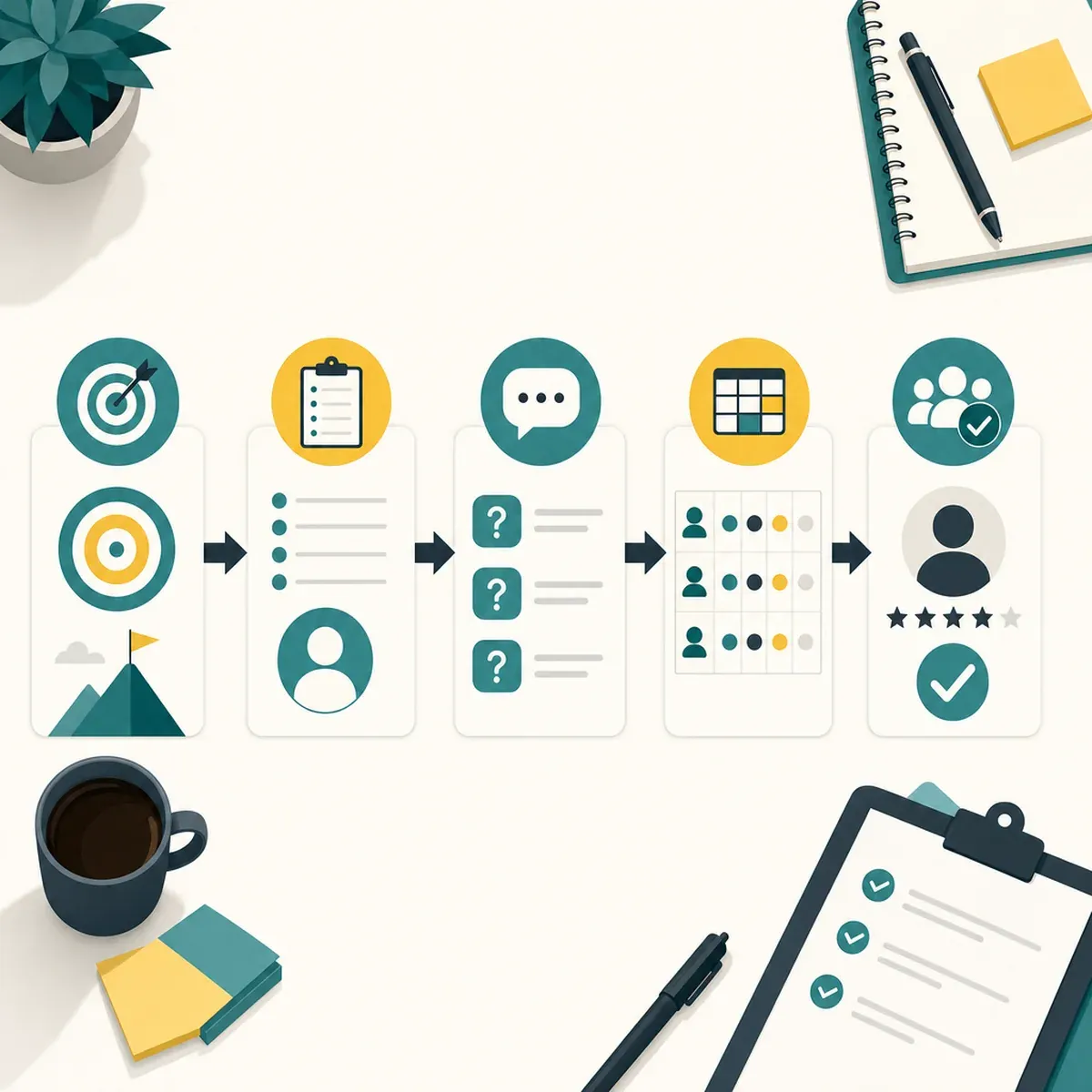
In practice, that means five building blocks. First, the team defines the job outcomes and the few capabilities that genuinely predict success. Second, it maps those capabilities to assessment stages: screening, task, structured interview, work sample or final discussion. Third, it writes structured interview questions that test specific evidence, not generic charm. Fourth, it uses a scorecard with anchored ratings so "good" means the same thing to every interviewer. Fifth, it records independent notes before the decision meeting, so the loudest opinion does not become the data.
Campion, Palmer and Campion (1997) showed that interview structure is not one trick. Their 15 components cover both content, such as job analysis and same questions, and evaluation, such as rating each answer, anchored scales, notes and interviewer training. Levashina, Hartwell, Morgeson and Campion (2013) make the same point in later research: structure is the deliberate use of predetermined rules for questions, observations and evaluations.
This is why a structured interview pdf can help but cannot carry the whole job. A template gives you a starting page. It does not decide which capabilities matter, calibrate your ratings or stop the decision meeting turning into a small courtroom for favourite candidates.
Why structured interviews predict better
The evidence for structured interviews is unusually consistent for a topic involving humans, jobs and people confidently misremembering what "great instincts" looked like last quarter. McDaniel, Whetzel, Schmidt and Maurer (1994) analysed 245 validity coefficients from 86,311 individuals and found that structured interviews had higher validity than unstructured interviews. Wiesner and Cronshaw (1988), using 150 usable validity coefficients, found that structured interviews produced mean validity coefficients around twice as high as unstructured interviews.
The mechanism is not mysterious. Predictive validity improves when each candidate is judged against the same role-relevant evidence. If one candidate gets a careful question about prioritisation and another gets a pleasant detour about hobbies, the team has not run two interviews. It has run two different tests and pretended they are comparable.
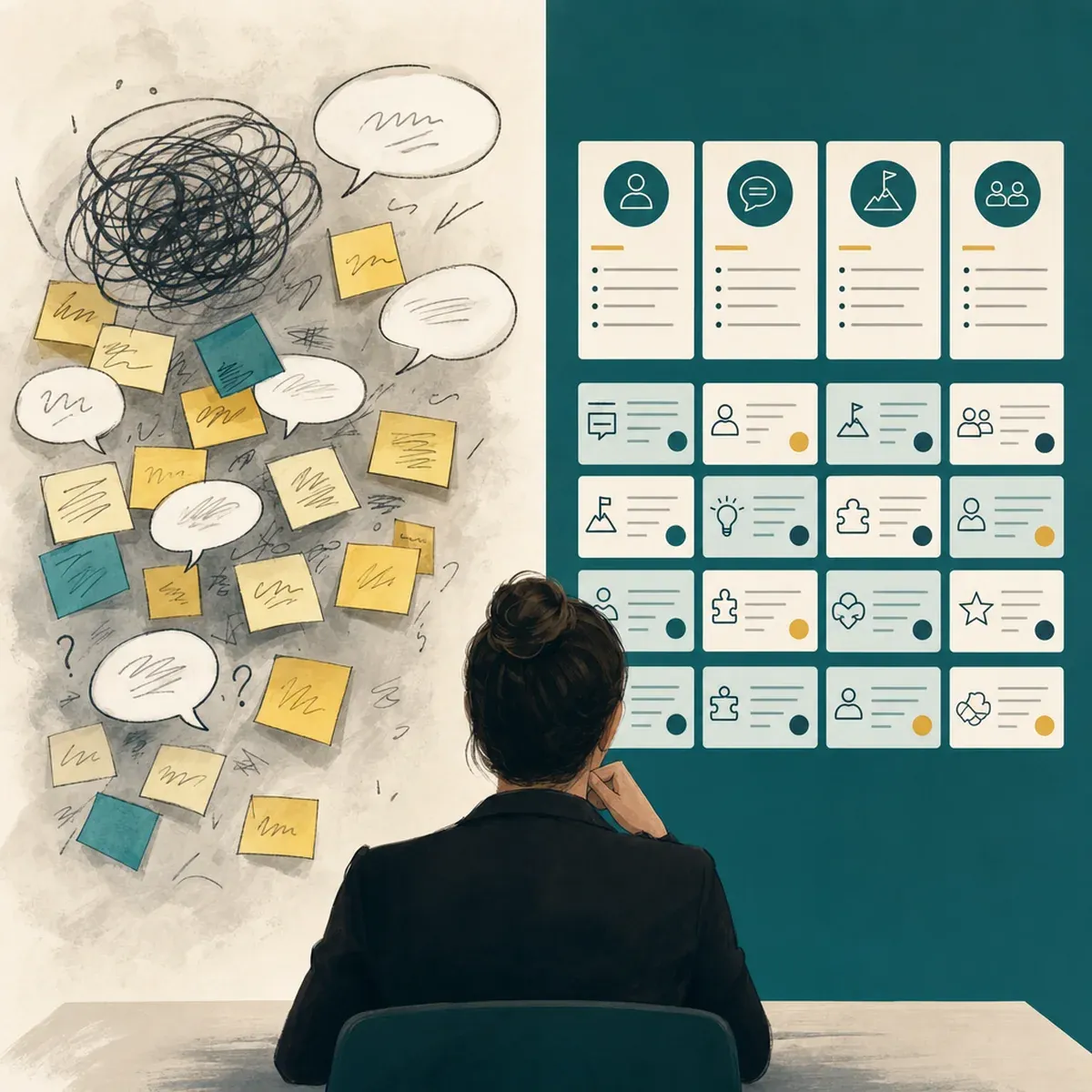
A structured interview improves the signal in three ways. It standardises what is asked, so candidates face the same core evidence test. It standardises how answers are scored, so interviewers are less free to convert fluency into competence. It standardises when evidence is discussed, so early impressions and group dynamics have less room to distort the final call.
Levashina, Hartwell, Morgeson and Campion (2013) summarise the long research pattern: structured interviews are much more reliable and valid than unstructured interviews. There is still nuance. Recent commentary argues that validity varies by design and context, which is exactly why the quality of your process matters. Structure is not a spell. It is a set of design choices.
The five practical stages
If you want the useful version, the five stages of a structured hiring process are: define, design, interview, score and decide. Some recruitment models split the journey into seven stages, adding attraction and onboarding. That is fine for workforce planning, but for better selection decisions these five are the operating core.
Define means agreeing the job outcomes before writing adverts or questions. What will this person need to deliver in six and 12 months? Which capabilities matter enough to assess? Campion, Palmer and Campion (1997) put job analysis at the front of interview structure for a reason: if the role is vague, the questions will be decorative.
Design means mapping each capability to the best evidence source. Some things belong in a work sample. Some belong in structured interview questions. Some do not belong in the process at all, no matter how attached someone is to asking candidates where they see themselves in five years.

Interview means asking the same core questions in the same broad order, with disciplined follow-ups only where they clarify the same evidence for every candidate. Score means rating each answer against behavioural anchors while the answer is fresh, not at the end of the day when the final candidate benefits from being merely recent. Bohnet (2016) is especially practical here: compare answers horizontally across candidates, question by question, rather than letting one overall impression bleed into every rating.
Decide means combining scores and notes before group discussion. Huffcutt and Woehr (1999) found support for interviewer training and for using the same interviewer across applicants, especially where the interview itself is less structured. The broader lesson is simple: make the process comparable before asking people to compare candidates. A scorecard is not there to automate the decision. It is there to make disagreement useful.
For a structured interview example, a question might ask: "Tell me about a time you inherited an unclear priority and had to turn it into a plan." A weak answer might describe being busy. A strong answer would show diagnosis, trade-offs, communication and measurable progress. The scorecard turns those differences into evidence.
Where structure goes wrong
Structured hiring fails when teams copy the visible artefacts and miss the judgement underneath. A list of questions is not a method. A spreadsheet is not fairness. A scorecard with vague labels - "great", "okay", "poor" - is just vibes wearing office clothes.
The honest disadvantages matter. A badly run structured interview can feel stiff. It can miss useful nuance if interviewers are banned from asking clarifying follow-ups. It can increase candidate anxiety if the process feels like an oral exam with no warmth. It also takes real preparation to write job-related questions and anchored scoring criteria. The the main limitations of structured interviews cluster around rigidity, limited depth, candidate experience and upfront design cost.
The answer is not to return to unstructured interviewing. It is to design structure with enough humanity to work. Keep the same core questions, but allow job-related probes that clarify evidence rather than introduce new criteria. Tell candidates what the process is assessing. Train interviewers to take notes and score answers independently. Weight the criteria before seeing candidates, not after the founder has fallen for someone who "just gets it".
Levashina, Hartwell, Morgeson and Campion (2013) are useful here because they do not present structure as settled plumbing. Applicant reactions, probing, impression management and the specific mix of structuring elements all still matter. Good structure reduces noise. Bad structure standardises the wrong noise.
How to install the method without hiring theatre
The awkward part is that most small businesses already know their hiring process is too dependent on individuals. The founder has one style. The hiring manager has another. The "culture interview" is either a useful values check or a polite fog machine, depending on who runs it. The answer is not a giant HR transformation. It is one shared method that everyone can actually use.
That is the work of the Structured Hiring Method programme from HireSchool. It is a self-guided digital programme for small businesses and scale-ups that want consistent, evidence-based hiring without bringing in consultants to live in the meeting room. The programme codifies the interview flow, the capabilities being tested, the candidate assessment, the scorecard and the decision mechanics, delivered through video content and a learning management system so every interviewer is working from the same standard.
The useful distinction is that HireSchool is not selling a prettier template. Templates are fine, but they often leave the hard thinking exactly where it was: inside different people's heads. A proper structured hiring process forces the team to decide what success looks like, how each capability will be tested, what a strong answer sounds like and how evidence will be combined. That is the bit most businesses skip, usually because everyone is busy and the candidate pipeline is already moving.
It also is not a software-only promise. Applicant tracking systems can store scorecards and prompt interviewers to submit feedback, but they do not decide whether the scorecard is testing the right things. The method has to come first. Software can then reinforce it. Otherwise you simply make bad judgement easier to administer.
A sensible installation starts with one recurring role or one high-stakes hire. Define the outcomes. Pick four to six capabilities. Write two evidence-led questions per capability. Build anchored ratings. Train interviewers on what to listen for. Run the decision meeting from the scorecard rather than from the most recent conversation. Then improve the system after each hire. Hiring gets better when the method compounds.
That is the commercial case for structure, but it is also the ethical one. Candidates deserve to be assessed against the job, not against the interviewer they happened to draw. Your team deserves decisions it can explain six months later.
A better hiring decision is quieter than you expect
The best hiring decisions are often less dramatic than the worst ones. There is less performance, less certainty, fewer heroic reads of character from a 45-minute call. There is more evidence sitting calmly in rows: what the role needs, what each candidate showed, how strongly they showed it, and where the gaps remain.
That is also how to think about common interview questions from the candidate side. How long should a structured interview last? Long enough to ask the core questions properly and score them while the evidence is fresh, often 45 to 75 minutes depending on the role. What is a red flag in a job interview? Not a slightly awkward answer. A real red flag is a repeated evidence gap against a capability that matters.
Dana, Dawes and Peterson (2012/2013) showed why informal conversations are so seductive: people can make sense of almost anything. A structured hiring process starts from the opposite discipline. Decide what matters before meeting the candidate. Then make the interview earn its confidence.