.webp)
Recruitment process steps: the sequence that actually predicts hires
The canonical seven recruitment process steps everyone agrees on - and why they only predict hires when each one is actually structured.
Why the recruitment process keeps producing surprises
Most companies have written down their recruitment process. There is a list of steps on a wiki page, an applicant tracking system that mostly behaves, and a calendar invite that says "panel debrief". The steps run in roughly the right order. The hires are still inconsistent. Some weeks the process catches a strong candidate cleanly; other weeks it lets a confident interview performer through who turns out, six months later, to be a different person on the job.
This is not a sequencing problem. The practitioner literature has settled on the same recruitment process steps for years, and the count only varies because writers slice planning and post-hire review at different grains. The harder problem is what happens inside each step - whether the people doing the work are doing it the same way for every candidate, and whether the evidence they produce is actually being weighed when the decision is made. Rozario, Venkatraman and Abbas (2019) found that hiring managers continue to trust intuition and gut feel even when a process exists on paper, and that the gap between a recruitment process that looks right on paper and one that produces consistent hires is mostly the gap between a documented process and a structured one.
"We just know a good one when we see them" is the polite version of the failure mode. The rest of this piece walks through the canonical steps everyone agrees on, shows where the validity actually leaks, defines what "structured" means in plain language, and finishes on how a small business can install a structured recruitment process this quarter without buying a consulting engagement.
The seven canonical recruitment process steps
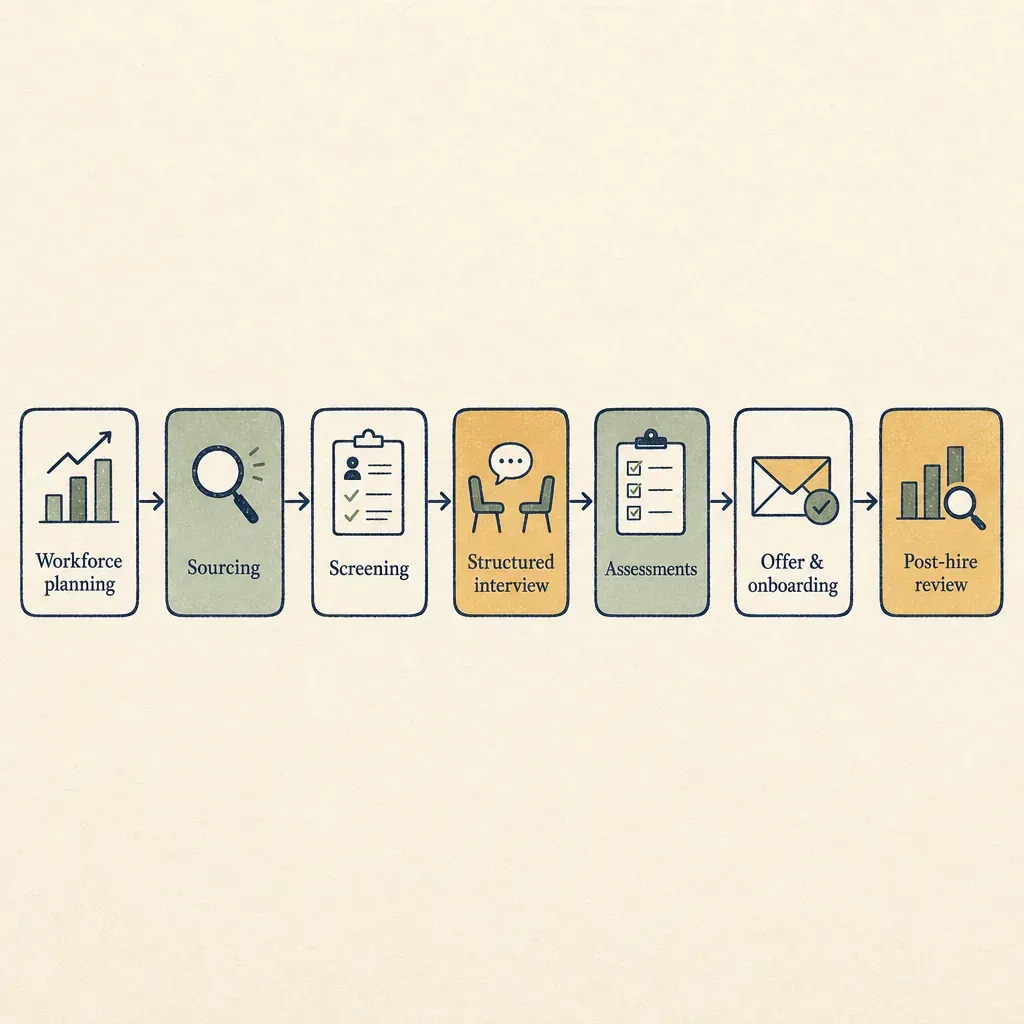
The recruitment process most companies are working from has seven steps. Some practitioners draw it as five, some as eight, but the substance is stable; what varies is whether the writer treats workforce planning and post-hire review as their own stages or folds them into their neighbours. The cleanest version of the seven, in the canonical seven-step framing, runs like this.
- Workforce planning and job analysis. Decide what the role exists to do and which capabilities the post-holder needs to do it. The output is a job description and a short list of capabilities to hire against - not a wish-list, a working hypothesis the rest of the recruitment process will test.
- Sourcing and advertising. Place the role in front of a candidate pool. Job boards, referrals, agencies, internal shortlists. The output is applications.
- CV and application screening. Triage the pile against the capabilities. The output is a shortlist of people worth interviewing.
- Structured interview rounds. Test the capabilities directly with situational and past-behavioural questions, scored against the same scale by every interviewer. The output is per-candidate evidence on each capability.
- Assessments and reference checks. Add work samples, technical exercises, or references where they earn their place. The output is corroboration or contradiction of the interview evidence.
- Offer and onboarding. Combine the evidence by rule, make the offer, and set the new hire up to ramp. The output is a hire who knows what they are walking into.
- Post-hire review. Check, six months later, whether the predictions held. The output is a calibrated process for next time.
The same skeleton sits behind the practitioner version of the same skeleton, with the labels rearranged and the ordering tightened. The "5 steps" and "7 steps" framings simply collapse or expand the planning and review ends. The middle - sourcing, screening, interview, decision - is where the predictive validity of the recruitment process is actually decided.
Where the recruitment process leaks: the validity gap
The recruitment process steps before the interview load the funnel. The interview is where the predictive validity is won or lost. Three decades of meta-analyses agree on the direction of the gap, even when they disagree on the absolute numbers.
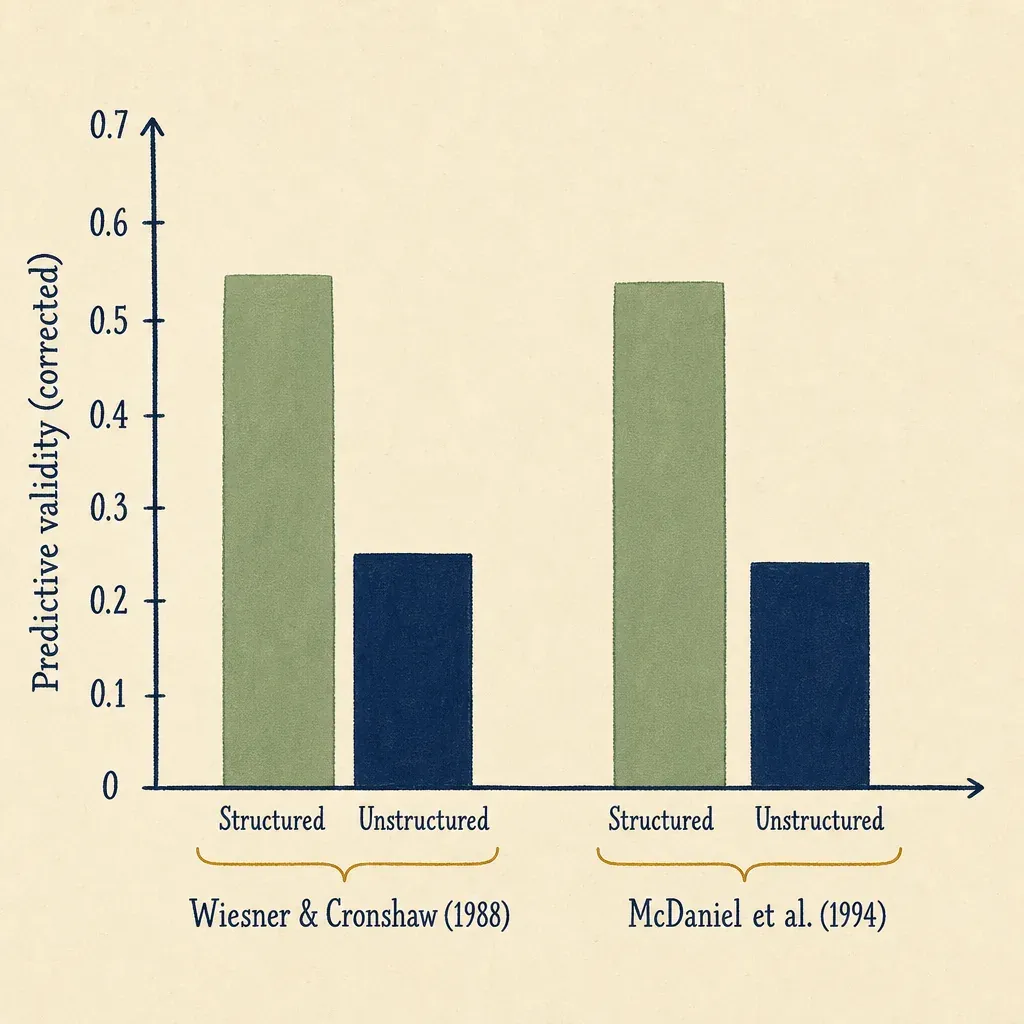
Wiesner and Cronshaw (1988) pulled together 150 worldwide validity coefficients and reported that structured interviews produced mean validity coefficients twice as high as unstructured ones, with the variation in unstructured-interview validity almost entirely explained by statistical artefacts. McDaniel, Whetzel, Schmidt and Maurer (1994) confirmed the same direction across 245 coefficients drawn from 86,311 individuals, with situational questions the strongest performers, job-related questions next, and psychologically based questions last. Campion, Palmer and Campion (1997) summarised the corrected validities across studies as .14 to .33 for unstructured interviews and .35 to .62 for structured ones; Levashina and colleagues (2013) revisited the literature 20 years later and reached the same conclusion. The comparative validity numbers across selection methods place structured interviews well above unstructured ones in the same league as work samples and assessment centres.
The unsettling finding is in Dana, Dawes and Peterson (2012). In one of their studies, participants conducted unstructured interviews in which the interviewee answered questions according to a random system. The interviewers did not notice. They were just as confident about their predictions as they were after a real interview, and slightly less accurate in their predictions than people who had not interviewed the candidate at all. The mechanism is "sensemaking", the human tendency to make sense of any pattern of words; the cost is "dilution", the way non-diagnostic information drags down predictions made from solid information. The recommendation in the paper is blunt: do not use unstructured interviews for screening decisions.
These are corrected coefficients, not raw correlations, and the absolute numbers shift between studies; the structured-vs-unstructured ratio is what holds. Doubling predictive validity inside the one step that decides who gets hired is what changes a recruitment process from a sequence to a system.
What "structured" actually means
"Structured interview" is the kind of phrase that sounds self-explanatory until you try to install one. The shortest workable definition: every candidate is asked the same questions, every answer is scored on the same anchored scale, the panel is consistent across candidates, and the decision is combined by rule rather than negotiated in the room. The U.S. Office of Personnel Management's plain framing - the rules for eliciting, observing, and evaluating responses that define structure - captures the same idea: structure is the discipline of doing it the same way every time.
Campion, Palmer and Campion (1997) catalogue 15 components of interview structure across two families. Content components fix what the interview is about: a job analysis as the spine, the same questions for every candidate, situational and past-behavioural question types, a question pool tied to the role's actual capabilities, and a limit on irrelevant probing. Evaluation components fix what happens to the answers: rate every answer rather than form an overall impression, use anchored rating scales, take notes, train interviewers briefly, and combine the panel's scores by rule. A small business does not need all 15 to capture most of the validity gain; Levashina and colleagues (2013) confirm that the high-leverage components are the same job-relevant questions, anchored scales, and consistent panel.
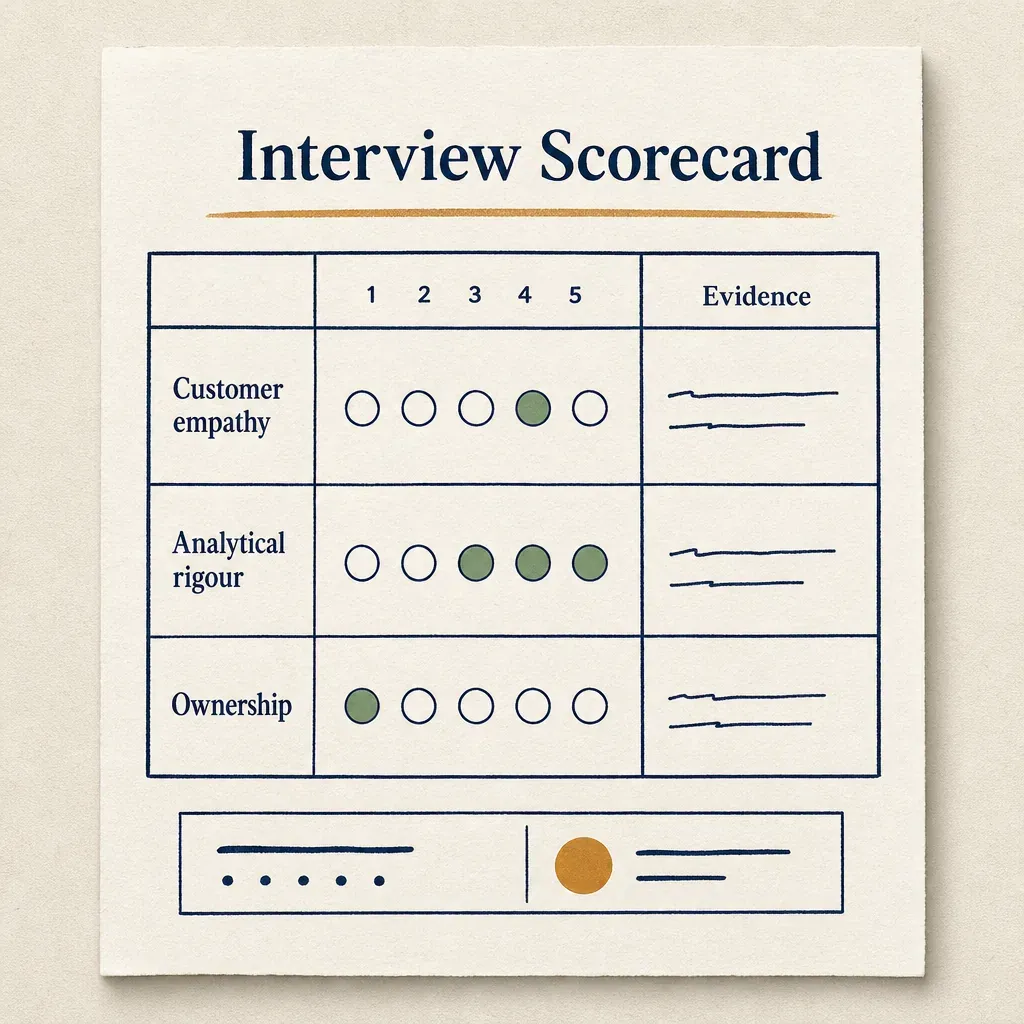
The artefact that holds all of this together is the scorecard. In plain terms, a scorecard is a one-page list of the capabilities the role requires, each with an anchored 1-to-5 scale (with concrete behavioural descriptions at the anchor points) and a column for evidence taken from the interview. The interviewer scores each capability individually before discussing the candidate with the panel. The combined scorecard is the audit trail for the decision; it is also why the decision can be defended, calmly, the next morning.
Huffcutt and Woehr (1999) added two practical findings to the picture: brief interviewer training is enough to move validity, and a consistent panel matters more than a large one. The instinct to "let everyone meet them" tends to add interviewers without adding signal. A four-person panel that uses the same scorecard across every candidate is a stronger predictor than an eight-person rotating cast.
How to install a structured recruitment process
The install pattern for a 30-to-100-person company is not glamorous and it is not enormous. A one-page job analysis per role family. Three or four capabilities you actually want to hire against. Six to eight situational and past-behavioural questions per capability, drawn from the work the person will be doing. A one-page scorecard with anchored 1-to-5 scales. Brief interviewer training - an hour or two, not a course. A short debrief script that pools the scorecards and applies a rule for combining them. Most of the case for a quantitative scorecard tied back to actual job performance falls out of getting these in place once and reusing them. None of it is novel. All of it is real work, and a busy founder will discover that the question-writing and anchor-writing are where the hours go.
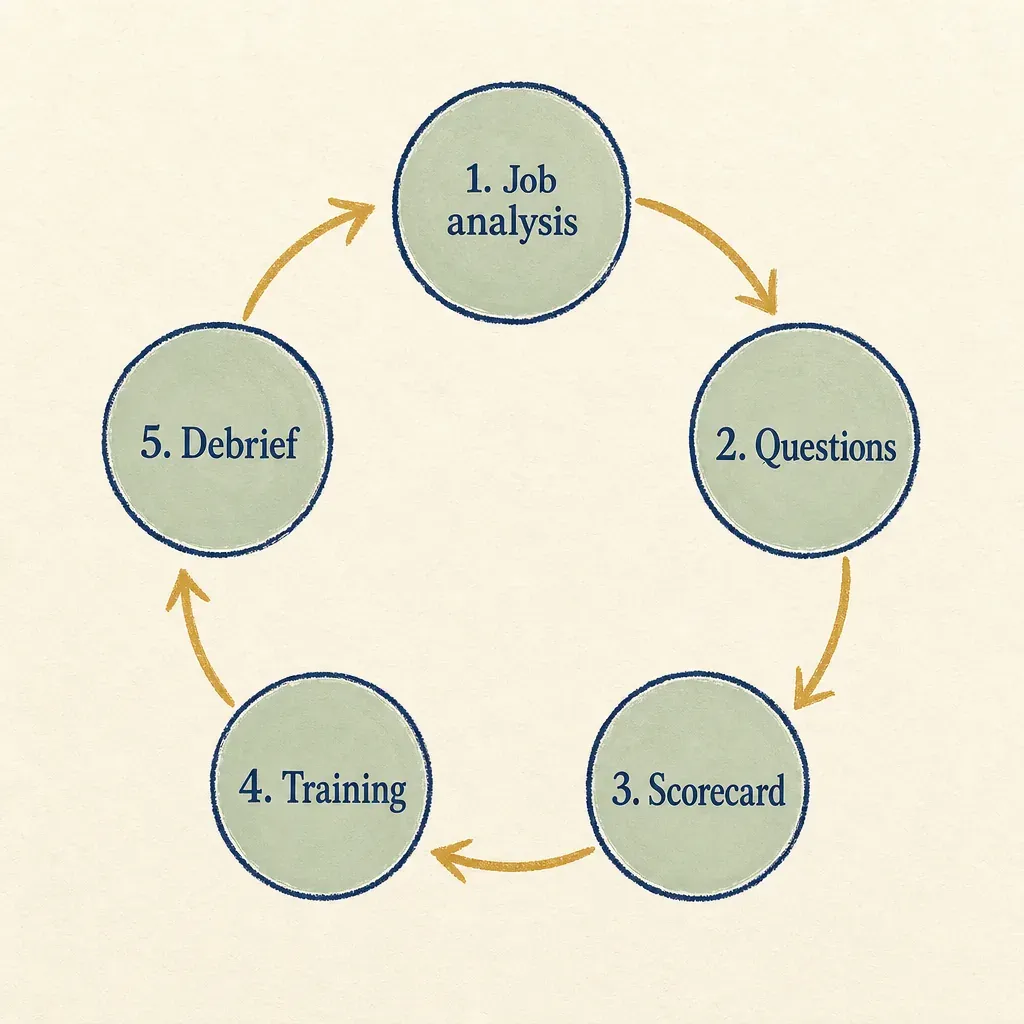
This is what HireSchool sells. HireSchool is a self-guided digital programme called the Structured Hiring Method, delivered as video content plus a learning management system. Customers buy access, onboard their hiring managers and interviewers through the LMS, and run the programme themselves. Inside the programme there is a set of Leadership Values to hire against, codified scorecards, behavioural interviewing training, decision management, the First Past the Post hiring standard (define the bar in advance and hire the first candidate who clears it, rather than holding out for someone better who may not arrive), and an optional Quality Assurance module for businesses that can support an independent interviewer function. The programme is the kit; the customer's team builds the muscle.
The components most relevant to a small business installing a structured recruitment process for the first time are the codified scorecards, the behavioural interviewing training, and the decision-management module. The scorecards remove the inconsistency across interviewers - the situation where one interviewer scores against the role and another scores against their own preferences. The behavioural training takes the situational and past-behavioural questions out of the realm of personal style and into a technique a panel of four can run the same way. The decision-management module is the part that handles the post-interview meeting where good evidence usually goes to die. Campion, Palmer and Campion (1997) put it cleanly: job analysis is the spine of structure, and everything else - the questions, the scorecards, the training - hangs from it.
HireSchool is not consultancy. It is not bespoke advisory. It is not an applicant tracking system, and it is not a recruiting agency. There is no embedded HireSchool team running the transformation inside your company. The programme is the standard, the videos are the training, the LMS is how the team learns it, and your hiring managers run the resulting process.
If the recruitment process described above is the one you would like to be running this quarter, you can explore the Structured Hiring Method programme. The argument for doing it has been made in the meta-analyses for 30 years. The argument for not building it from scratch is just time.
Fairness, the 80/20 rule, and red flags
Structure is also a fairness mechanism. Bragger, Kutcher, Morgan and Firth (2002) ran a controlled experiment in which the same candidates were interviewed in either a structured or an unstructured format, and either visibly pregnant or not. Across the unstructured condition there was an overall hiring penalty against the pregnant candidates. The structured condition materially reduced it. The same pattern shows up in the wider literature on weight, accent, and other surface-level cues: the less the interviewer is asked to combine signal in their head, the less room those cues have to colour the score.
The 80/20 question that comes up around the recruitment process is mostly about sourcing. The familiar version - the bulk of useful applicants tend to come from the small fraction of sourcing channels that produce most of the hires - is a useful prompt for the early stages of recruitment. If two of your sourcing channels are quietly producing four out of every five hires, it is worth asking whether the other channels are paying for themselves or just absorbing recruiter time.
The "red flag in a job interview" question is more interesting once a structured process is in place. The four signals hiring managers say worry them most - dishonesty, lack of preparation, badmouthing former employers, and disengagement during the interview - are reasonable. The more useful red flag, once the panel is running the same scorecard for every candidate, is the candidate who only performs well when the interviewers go off-script. If structure visibly drops their score, that is the structure doing its job.
The "5 C's of interviewing" question is mostly an SEO artefact. There are three or four competing frameworks under that label, and the substance of any of them - character, competence, communication, and one or two other Cs depending on who is writing - reduces to the same job-relevant capabilities a scorecard already names. Pick the capabilities that matter for the role; the alliteration is decoration.
The honest objections, and what to do about them
The objections to a structured recruitment process are real and worth steelmanning. The Harver review of the most common reasons companies hesitate to adopt structure names three: interviewers feel they have lost autonomy, structure can feel culturally off in informal companies, and writing the questions and anchors takes time the founder does not have.
The autonomy objection tends to dissolve once interviewers have run a structured panel two or three times and noticed that the scorecard is helping them rather than constraining them. The conversation in the debrief moves from "what did you make of her" to "where did our scores diverge" - which is a better conversation. The cultural objection is partly true and partly a category error: behavioural questions, asked the same way of every candidate and scored against anchored evidence, produce more useful information about cultural fit than a free-form chat ever did, and the chat tends to test "does this person remind us of ourselves" rather than "can this person do the job". The time objection is genuine, and the answer is that the cost is paid once per role family. The questions for a software engineer hire stay good for the next three software engineer hires; the scorecard for a head of sales stays good for the next.
Huffcutt and Woehr (1999) underline the practical point one more time: brief interviewer training is enough to capture most of the validity gain. A research-grade programme is not the bar. The recruitment process steps everyone already agrees on become a real predictive process when each step is structured. That is something a small business can install itself this quarter, and that is the argument the meta-analyses have been making since 1988.