.webp)
Common hiring mistakes small businesses make (and how to avoid them)
Every bad hire costs a small business more than it looks. Here are the mistakes that compound quietly - and the process that prevents them.

Why bad hires hit small businesses hardest
A bad hire at a large company is a problem. A bad hire at a five-person company is a crisis. Large employers have slack: an underperformer can be managed, redeployed, or quietly absorbed while the business continues moving. Small businesses have no such buffer. One person who cannot do the job, or who corrodes the team around them, can derail a quarter.
The numbers are blunt. The U.S. Department of Labor puts the cost of a hiring mistake at 30% of an employee's first-year salary - and that is before you account for the management time spent supervising a failing hire, the morale cost to the people working alongside them, or the productivity loss while the role stays vacant after the inevitable exit. CareerBuilder's research puts the average cost of a bad hire sitting around $17,000. Neither figure captures the intangible cost of a small business that simply stops trusting its own hiring process.
What makes this harder to acknowledge is that small business hiring mistakes tend to compound. The business that hires in a panic is usually also the one that skips the reference check. The panel that relies on instinct is usually the one that has never agreed on what the role actually requires. Each shortcut makes the next one more likely.
This article names those shortcuts, traces what causes them, and explains what a process that does not produce them looks like.
Hiring in a panic (and without a proper brief)
The most common hiring mistakes do not happen because small business owners are careless. They happen because a role falls vacant under pressure, and the pressure feels more urgent than the process. Someone resigns on a Friday; by Monday the thinking is already: who can we get quickly? The quality bar shifts from "right person" to "someone we can move fast on."
This is the desperation hire. It has two variants. The first is hiring for skills you need right now and neglecting character - the candidate who can do the immediate task but is a poor fit for how the business actually operates. Skills, at least some of them, can be trained. Character and working style are rather more resistant. The second variant is hiring without assessing whether you actually need another person in the first place, rather than a different arrangement of existing resource.
Behind both variants sits the same root cause: no brief. Not a job advertisement - a brief. Before a vacancy opens, a useful brief defines the competencies the role actually requires, the behaviours that predict success in this specific team, and what a good performance looks like twelve months in. Without it, the hiring panel cannot agree on what they are looking for. And when panels cannot agree on what they are looking for, they default to who they liked best - which is a different question entirely.

The fix is mundane but consistently skipped: know what you need before the vacancy appears, not after. Roles that are already defined, with competencies agreed and questions drafted, can be filled quickly without sacrificing quality. Roles that are defined under pressure produce the decisions that cost 30% of someone's first-year salary to unpick.
Trusting gut feel over evidence
The standard small business interview runs roughly like this: the founder or a senior person has a conversation with the candidate, asks whatever comes to mind, and forms an impression. The impression feels reliable. It is, in most cases, not.
The mechanism behind this is well documented. In an unstructured interview - one where the interviewer asks different questions of different candidates and has no scoring rubric - the interviewer constructs a narrative from whatever happens to come up. Psychologists call this sensemaking. Dana, Dawes and Peterson (2012) tested it directly: in their experiments, participants made better predictions about individuals they did not interview than about those they did. The unstructured interview introduced noise that diluted the valid information participants already had. When interviewees responded randomly - not with genuine answers, but with meaningless responses tied to an arbitrary rule - interviewers' confidence in their impressions was unaffected. They believed they were learning something. They were not.

Kausel, Culbertson and Madrid (2016) extended this into hiring decisions specifically. Decision-makers given access to unstructured interview information became more overconfident than those using standardised test scores alone. That overconfidence was not neutral: in a betting task designed to measure accuracy, higher overconfidence was directly associated with fewer correct outcomes.
The structured interview does not ask for inspired interviewers. It asks for consistent ones. Campion, Palmer and Campion (1997) identified that across meta-analyses, corrected validity for structured interviews reaches r = 0.35–0.62; unstructured formats manage r = 0.14–0.33. Structured interviews are twice as effective at predicting job performance.
The objection that surfaces here is usually: "our roles are too unique to use standard questions." Van der Zee et al., summarised by Harver's analysis of the four reasons structured interviews remain underused, identified this alongside interviewer autonomy, cultural norms, and plain unawareness as the barriers companies cite. It is a reasonable-sounding concern. It is rarely borne out. Most roles - even genuinely unusual ones - share a core of behaviours that can be asked about consistently. The question is whether you would prefer the structure to be there or the confidence to be high.
The bias you haven't seen on the shortlist
Bias in small business hiring is rarely deliberate. The panel is not trying to discriminate; it is trying to find someone who will work well in the team. The problem is the mechanism used to make that judgement. When interviewers ask different questions of different candidates and score them against no agreed standard, they are not measuring the same things. They are measuring who they responded to - which is a function of familiarity, social ease, and shared reference points, not of job-relevant competence.

Bohnet (2016) cited sociologist Lauren Rivera's research showing that hiring panels at banks, law firms, and consultancies routinely described great candidates as people who felt "like a good fit" or reminded them of themselves. The pattern produced teams that were homogeneous in experience and background - not because anyone intended it, but because the evaluation method rewarded similarity. In a small business, where the team is small and the culture is already heavily shaped by a few individuals, that dynamic is more pronounced, not less.
Wiesner and Cronshaw (1988) established that structured interviews produce validity coefficients roughly twice those of unstructured formats. The effect operates in part through bias reduction: when every candidate answers the same questions, evaluated against the same criteria, the panel has less room to import personal preference into the comparison. The red flags in hiring that most damage small businesses are not the dramatic ones. They are the quiet ones: the candidate dismissed because they "seemed a bit cold," the strong applicant passed over because someone else "had better energy in the room." Structuring the process does not remove human judgement. It channels it toward the evidence.
The practical implication is narrow: structured interviews reduce gender bias by 42% and racial bias by 35% when properly implemented. The explanation is not that the questions are magic, but that consistent questions asked of all candidates remove one of the main routes by which bias enters the comparison.
How to build a hiring process that actually holds
The evidence has done its work. The question that follows is practical: how does a small business install a structured hiring process without a dedicated HR function and without commissioning a consultancy to run the transformation for them?
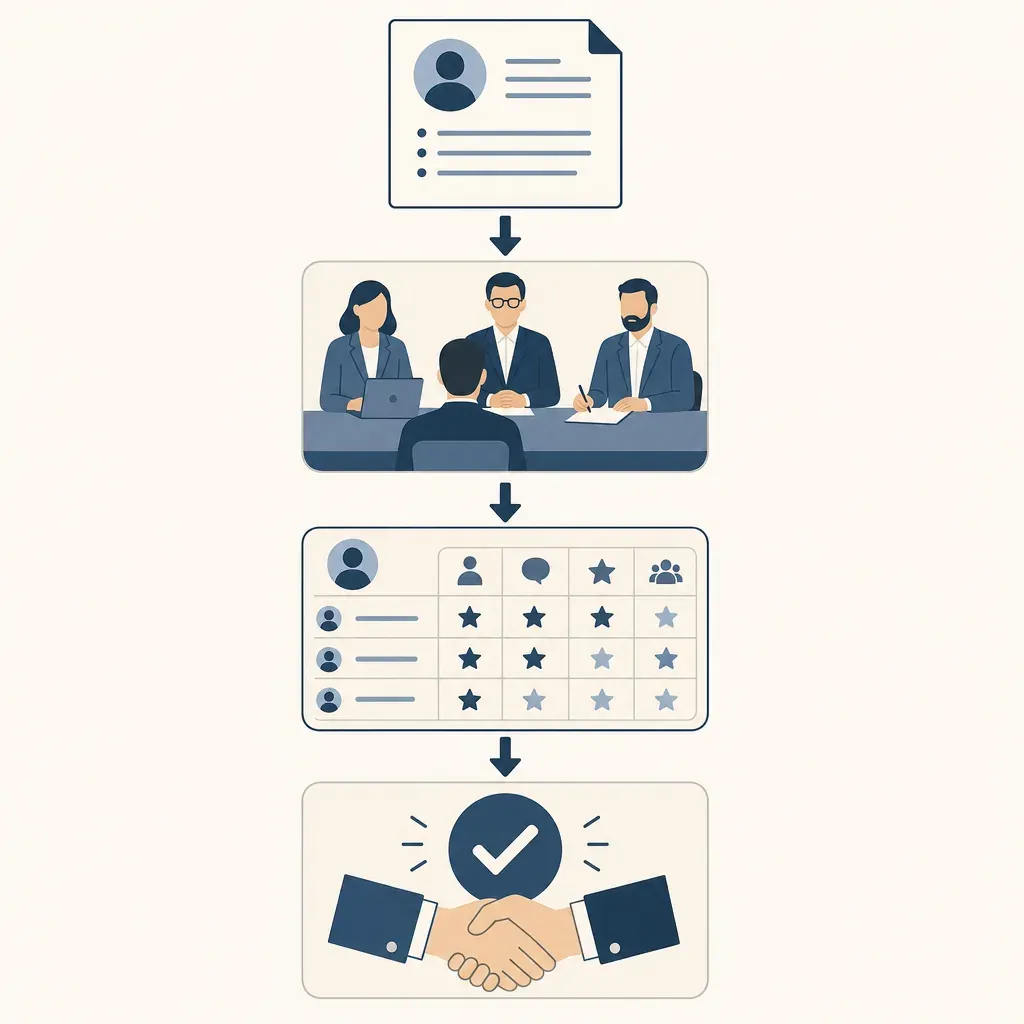
The answer starts with what the process actually requires, stripped of jargon. A brief that defines the competencies before the vacancy opens. A set of behavioural interview questions, the same for every candidate, derived from those competencies. A scorecard that each interviewer completes independently - before any group discussion, not after - so that the debrief compares documented assessments rather than competing impressions. A calibrated decision that follows the evidence, not the energy in the room. That is the skeleton. It is not complicated; it is just consistently not done.
The business case is clearer than most small business owners realise. Scur, Cornwell and Schmutte (2019) analysed Brazilian employer-employee data across structured and unstructured management firms. Firms with structured management practices hired managers from the 58th percentile of the worker quality distribution; firms running without structure hired from the 46th percentile. The structured firms also fired less often, and when they did fire, they were more selective - because they had made better matches in the first place. Over ten years, they consistently retained a larger share of their top-quartile workers. That is not the result of an HR transformation programme; it is the result of a repeatable process, applied consistently.
Levashina, Hartwell, Morgeson and Campion (2013) confirmed in their comprehensive update of the structured-interview literature that the validity advantage of structured approaches holds across contexts, roles, and industries. The pattern is not sensitive to role type or company size. What it is sensitive to is whether the process is actually followed.
This is where HireSchool sits. HireSchool is a self-guided digital programme called the Structured Hiring Method. Businesses buy access and roll it out themselves, supported by video content and a learning management system that lets them onboard their hiring team and track progress through the curriculum. There are no embedded consultants and no bespoke advisory engagement - the buyer implements the method; HireSchool supplies it.
The programme addresses the specific problems this article has named. The Role Hiring Process Flow and the Hiring Manager Blueprint make the process explicit before a vacancy appears, so that hiring in a panic becomes a choice rather than a default. Behavioural interviewing training replaces the gut-feel interview with trained interviewers asking standard questions and scoring responses against anchored criteria - the approach the research consistently shows to be twice as valid as the unstructured alternative. The scorecard and Decision Management module give the panel a consistent basis for comparison that does not depend on who happened to feel most comfortable in the room.
HireSchool is not a recruiting agency. It is not an applicant tracking system. It is not a consultancy. The Structured Hiring Method is an installable process: the business builds the capability itself, supported by the programme materials, and runs it independently from that point forward.
If you want to understand what that looks like in practice, explore the Structured Hiring Method programme at hire.school.
Reference checks and onboarding: the finish line most businesses cross wrong
A structured interview process and a well-run scorecard get you most of the way. Reference checks and onboarding are the last two links in the chain, and they are the ones most likely to be rushed or dropped entirely.
The reference check tends to survive on paper and collapse in practice. The call happens, a former manager says something broadly positive, and the box gets ticked. What this usually misses is that references are not character witnesses; they are a second source of behavioural evidence. The interview showed you one performance. A well-run reference conversation reveals patterns you can't always see in interviews - how the candidate performed over time, under pressure, in situations that map to the demands of the new role.
The version that actually produces useful information asks open, behavioural questions rather than closed ones: not "was she reliable?" but "tell me about a time when she had to manage a tight deadline with limited resource." A yes-or-no question invites a positive response; a behavioural question requires a specific answer. The candidate's own choice of referees is worth noting too - if the references offered are all from early in a career and avoid the most recent role, that is information.
Onboarding is the other half. The businesses most likely to skip it are the ones that hired under pressure in the first place: they needed the person yesterday, so they have no time today to settle them in properly. The new hire is handed a laptop, pointed at a desk, and wished well. This is onboarding as a transaction rather than a process - and it is a reliable way to damage a hire that started well.
Structured onboarding does not need to be elaborate. It needs to set expectations clearly, connect the new person to the team and their role's context, and mark milestones in the first 30, 60, and 90 days. A hire who is well-settled is more productive sooner and more likely to stay. Breaking the chain here, after investing in a proper hiring process, wastes the work that came before it.
What to do from Monday
The common hiring mistakes are not exotic. They are mundane defaults - urgency over process, instinct over evidence, rapport over competence. Each one feels reasonable in the moment, which is part of what makes them persistent. Hiring in a panic feels like responsiveness. Trusting a strong first impression feels like good judgement. Asking whoever seems most enthusiastic for a reference feels like due diligence. The cost of each shortcut is real, and it tends to arrive late, when the evidence is harder to connect back to the original decision.
What the research recommends is not complicated. A brief before the vacancy opens. A standard set of behavioural questions, the same for every candidate. A scorecard completed independently by each interviewer. A calibrated decision that follows the documented evidence. A reference conversation that asks for specifics, not summaries. A structured first 90 days for whoever joins.
Small businesses often assume that this kind of process belongs to companies with a head of people and a dedicated HR function. The evidence suggests the opposite: the smaller the team, the more each hire matters, and the more a consistent process is worth. A company of eight cannot absorb the cost of a bad hire the way a company of 800 can. The asymmetry runs in favour of getting the process right, not against it.
None of this requires a large upfront investment or a consultancy engagement. It requires a method and the discipline to follow it. Small business hiring mistakes are not inevitable. They are, in most cases, a process gap - and process gaps can be closed.