.webp)
How to build a hiring process for a small business
What a hiring process for a small business actually looks like, why structure beats instinct, and how to install it yourself this quarter.
Why small-business hiring quietly breaks at scale
At five people, hiring runs on instinct, a coffee, and whoever the founder rang on Sunday. It works, more or less, because everyone in the room shares the same head. At fifty, the same approach produces a quiet mess: uneven panels, decisions no one can reconstruct a quarter later, and a growing folder of hires that looked obvious in the room and underwhelming by month four. Nothing dramatic breaks. The hiring process simply stops being a process and starts being a habit with a calendar invite.
The honest version of "we just know a good one when we see them" is that the founder knew the first ten. From the eleventh onward, the same confidence becomes a liability. It is easy to coast on the assumption that interviews work without any structure at all, because every individual hire feels defensible at the time. The cost shows up later, at the firm level. Cornwell, Schmutte and Scur (2019) traced ten years of linked employer-employee data and found that firms running structured management practices ended up drawing their hires from measurably higher in the talent distribution, not by recruiting harder but by deciding more consistently.
The question most owners frame as "what should our hiring process look like" almost always reduces to "how structured is it". The rest of this piece walks the canonical steps, the meta-analytic evidence, scorecard mechanics, fairness and the four-fifths rule, and a realistic install plan you can run yourself this quarter.
The recruitment and hiring process, step by step
Articles on this topic argue endlessly about whether the hiring process has five steps or seven. The substance is the same; the count moves because writers split or merge the bookends. Treat the recruitment and hiring process as one continuous chain with seven recognisable links, and the rest of this guide has somewhere to attach.
- Workforce planning and job analysis. Decide what the role actually does, which capabilities matter, and what good looks like a year in. Skip this and every later step inherits the fog.
- Sourcing and advertising. Write a job description that describes the job, post it where the right people read, and resist the temptation to demand a decade of experience for a junior role.
- CV and application screening. Apply consistent criteria from the job analysis. The shortlist is a filter, not a beauty contest.
- Structured interview rounds. Same questions, same scoring, same panel where possible. This is where most of the article's evidence will land.
- Assessments and reference checks. Work samples, short tests, or a structured reference call - whatever tests the capability you actually need.
- Offer and onboarding. Compensation conversations, paperwork, payroll set-up, and the first weeks that decide whether the hire stays.
- Post-hire review. Six months in, ask whether the scorecard predicted the performance. If it didn't, fix the scorecard, not the candidate.
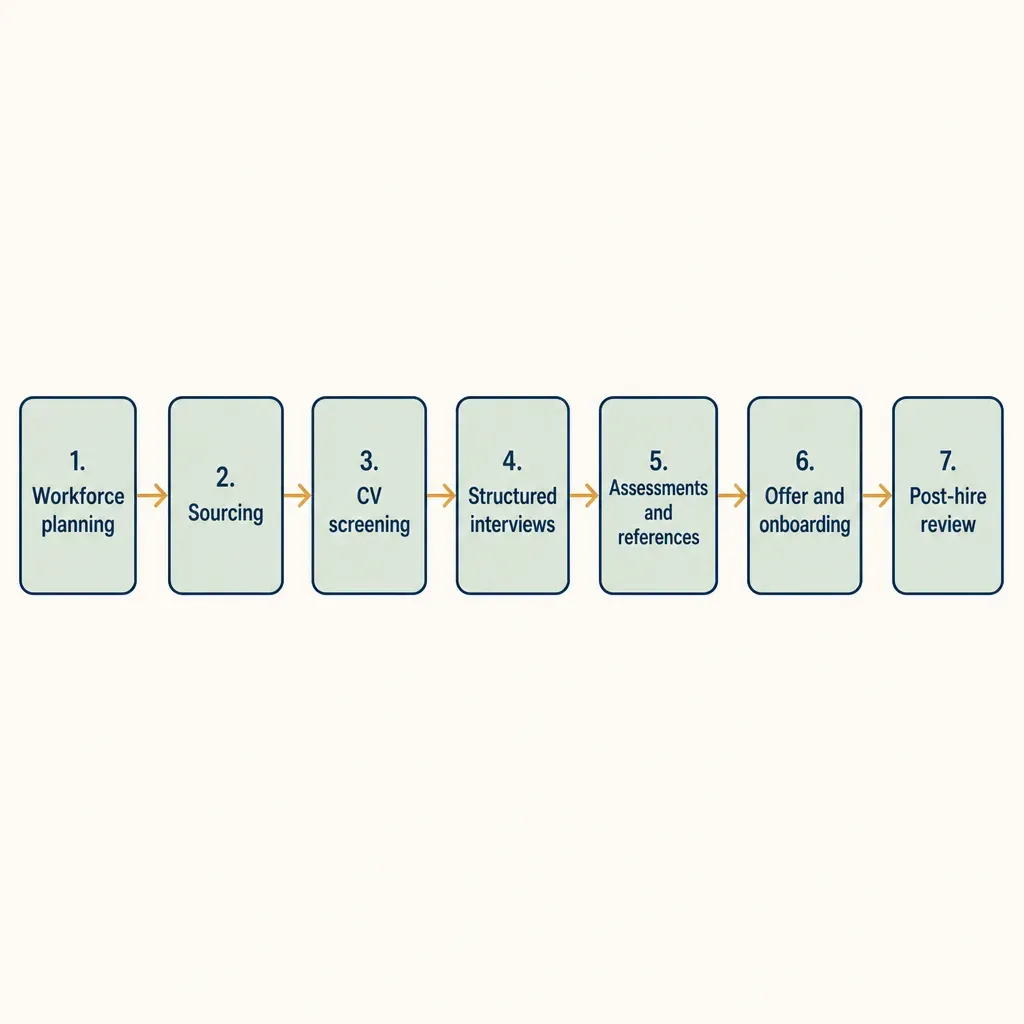
This is roughly the spine of the best practices for small-business hiring a busy founder is likely to recognise, where assessment methods are treated as a sequence rather than a pile. Most of the federal payroll, tax, and labour scaffolding around hiring sits alongside the process itself: W-4 forms, federal and state labour basics, and the onboarding admin that tends to surface the morning after the offer is signed. The local detail varies by jurisdiction; the obligation to handle it does not.
The "five steps" answer, by the way, usually compresses planning into sourcing and folds onboarding into the offer. The "seven steps" version splits them out. Same skeleton, different rib count.
The validity gap: what the research actually says
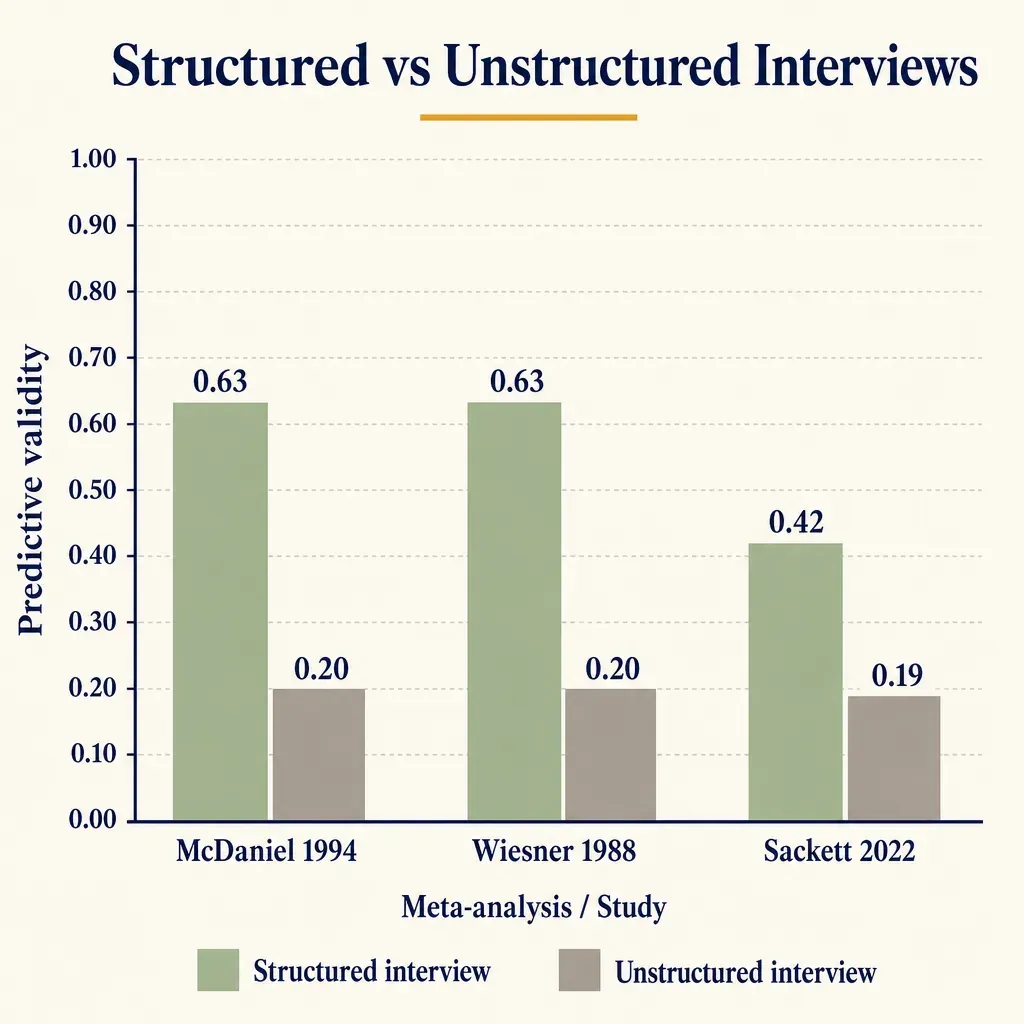
The argument for structure is not a matter of taste. Across three decades of meta-analyses, a structured interview roughly doubles the predictive validity of an unstructured one, and the ratio has barely shifted. If your hiring process rests on free-form conversation, the research has been quietly disagreeing with you since the early 1990s.
The numbers are unusually stable for social science. McDaniel et al. (1994) pooled 245 coefficients from 86,311 individuals and reported a clear gap between structured and unstructured formats throughout, with situational interviews at the top of the validity ranking. Wiesner and Cronshaw (1988) sharpened the same picture, reporting corrected validity of 0.63 for structured interviews against 0.20 for unstructured. More recently, Sackett and colleagues (2022) put the modern comparison at 0.42 against 0.19. Different decades, different samples, the same shape of result.
The more uncomfortable finding sits a little to the side. Dana, Dawes and Peterson (2012) ran an experiment in which interviewers given an unstructured interview plus a candidate's prior GPA predicted future GPA at r = 0.31. With prior GPA alone, no interview, they reached 0.61. The chat actively diluted the prediction, and the interviewers did not notice. In a follow-up condition, candidates answered questions on a pseudo-random basis and interviewers still felt confident in their reads. Any conversation, even one composed of noise, feels informative at the time.
One caveat is worth flagging in passing. These are validities corrected for range restriction and criterion unreliability, so the absolute coefficients move depending on which corrections you accept. The ratio between structured and unstructured is what matters, and that part is remarkably steady. The implication for a small business is unflashy: a predictable interview produces useful evidence for decisions, and an unpredictable one produces a feeling, often a wrong one, that no one can audit a year later.
Scorecards and the mechanics of a structured interview
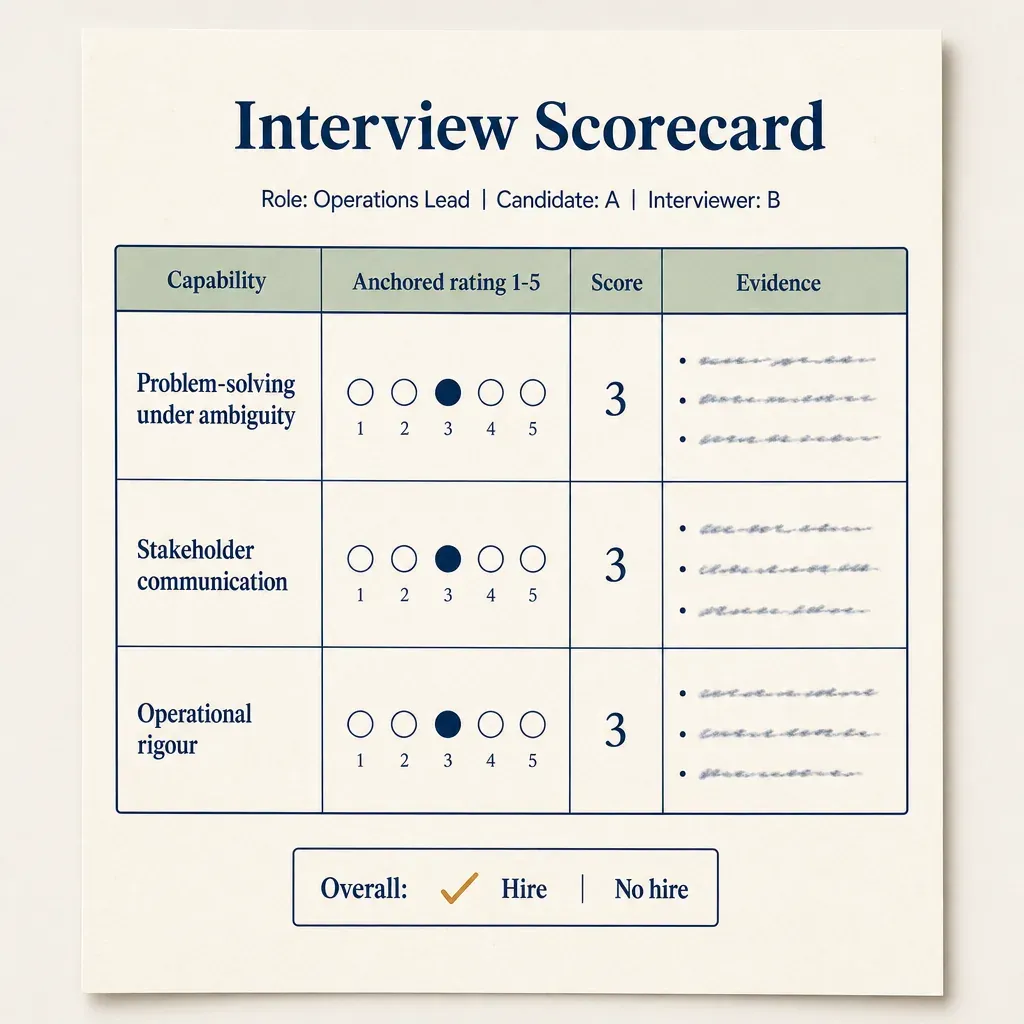
A scorecard, in plainer terms, is a one-page list of the capabilities the role actually needs, each one paired with an anchored rating scale and a column for evidence drawn from the interview itself. Nothing exotic. The discipline is in keeping it short, keeping it the same across candidates, and writing down what was said before opinions calcify over coffee.
Campion, Palmer and Campion (1997) reviewed roughly two hundred articles on interview structure and found that a handful of components do most of the work. For a small business with limited time, six are worth installing first: base every question on a job analysis, ask the same questions of every candidate, prefer situational and behavioural question types over open chat, rate each answer rather than scoring at the end, anchor those scales with concrete descriptions of what a 1, 3 and 5 actually look like, and give interviewers a brief training session before they ever sit in the room. That is the spine; the remaining components are refinements.
Huffcutt and Woehr (1999), in a regression meta-analysis of 120 studies covering 18,158 candidates, added two practical points the small-business reader should take seriously. First, brief interviewer training raises validity regardless of how structured the interview itself is, so do not skip it on the grounds that the questions are already written down. Second, using the same interviewer or panel across every candidate matters more than how many people are in the room. Their data suggest panels do not add validity over a single trained interviewer, and may even shave a little off.
Which is awkward news for the "let everyone meet them" reflex. A bigger panel feels thorough; in the numbers, it mostly produces more opinions to reconcile. The same two trained interviewers, scoring against the same scorecard, every time, is the cheaper and more accurate option.
Fairness, the four-fifths rule, and red flags
Fairness in hiring is usually argued in the abstract. The regulators prefer arithmetic. The four-fifths rule treats a selection rate for any group below 80 % of the highest-rate group as a sign of substantially different selection. It is a rule of thumb rather than a legal verdict, but it is the rule of thumb anyone reviewing your hiring will reach for first.
For a small business, the practical translation is plain. If your shortlist rate, interview pass rate, or offer rate for one group sits materially below another's, the structure of your interview is the first place to look, not the candidates. Unstructured interviews give bias more surface area; standardised questions and anchored scorecards give it less. That is not a moral claim, it is a measurement one.
The accuracy and fairness arguments turn out to be the same argument. Bragger, Kutcher, Morgan and Firth (2002) ran an experiment in which participants watched videotaped interviews varying pregnancy status, job type, and structure. Structured interviews materially reduced the hiring and salary penalty against pregnant candidates and produced higher inter-rater consistency. Structure is a fairness mechanism, not only an accuracy one.
Which leaves the inevitable question of red flags. The most useful one is procedural, not personal: a candidate who only shines when the interviewer wanders off script. If the scorecard says average and the chat says brilliant, trust the scorecard.
How to install a structured hiring process in your business
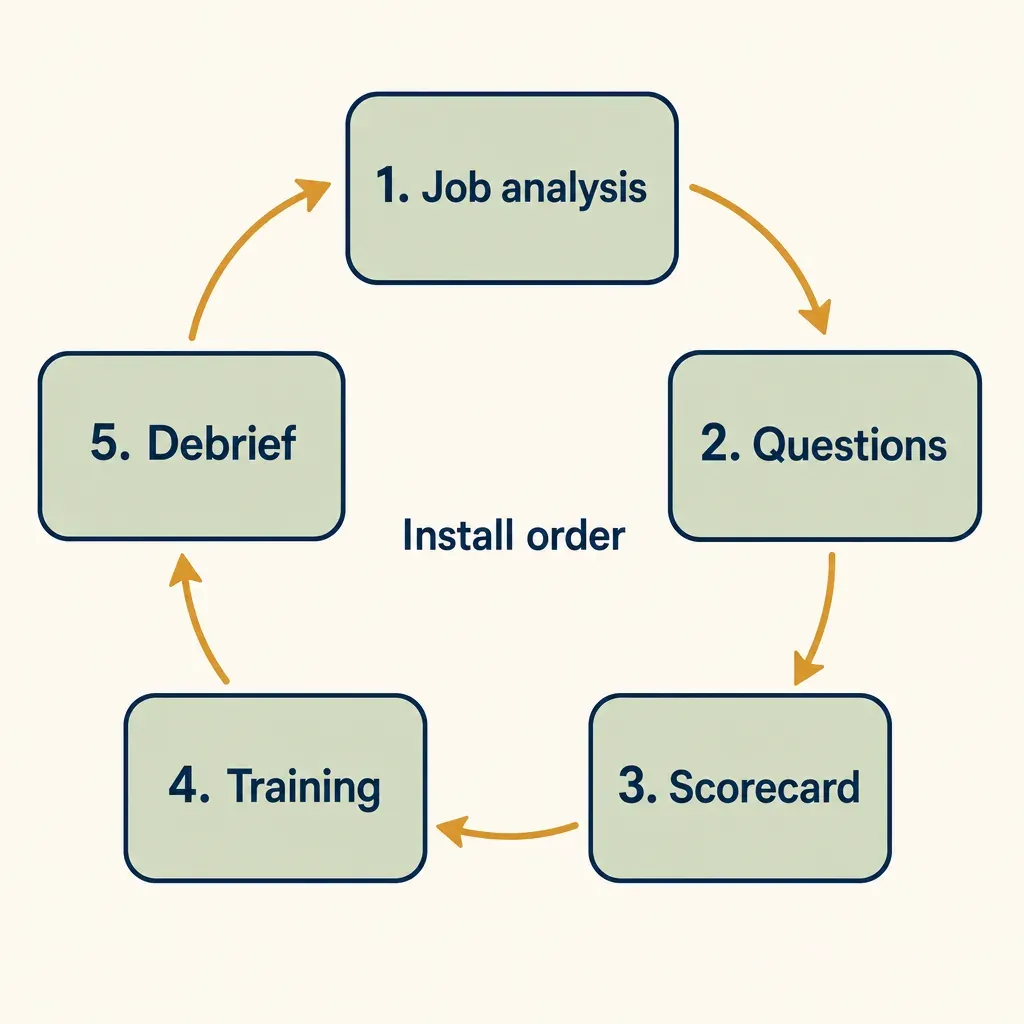
The install pattern is unglamorous and reasonably short. Start with a one-page job analysis for the role family, distil it into three or four capabilities the role actually needs, and write six to eight situational and behavioural questions that probe each one. Build a one-page scorecard with anchored 1-to-5 scales and an evidence column. Run a brief interviewer training session so everyone uses the same scales the same way, and end every loop with a short debrief script that forces evidence before opinion. None of this is exotic, and a 30-to-100-person company can absolutely run it in-house. It is also, for a busy founder, a real piece of work rather than a weekend project, and most of the friction lives in the writing, the training, and the discipline of using the kit once it exists. That is the gap a programme is supposed to close, and it is what brings us to the pitch. If you would rather assemble it yourself from primary sources, there is also a workable install pattern for a smaller team in the trade press.
HireSchool is a self-guided digital programme called the Structured Hiring Method, delivered through video content and a learning management system that lets a business onboard its team and track progress through the curriculum. Inside the programme are Leadership Values the customer chooses from rather than invents from scratch, codified scorecards with anchored rating scales, behavioural interviewing training built on the principle that past behaviour predicts future behaviour, decision management for getting the panel to a defensible answer, and the First Past the Post standard that fixes the bar before anyone meets a candidate. There is also an optional Quality Assurance module for businesses that can support an independent interviewer function, similar in spirit to the ones Google and Amazon run.
Three of those components do the heavy lifting for a small business installing a process for the first time. Leadership Values give every interviewer the same vocabulary, so the panel stops arguing about whether someone is "a good fit" and starts disagreeing about whether the evidence cleared the bar. Codified scorecards remove the inconsistency that builds up across interviewers and across months, which is the mechanism by which hiring debt accumulates as a company grows. Behavioural interviewing training equips hiring managers to gather evidence that is actually defensible the next morning, and the morning after that. Campion, Palmer and Campion (1997) put job analysis at the spine of a structured interview, and the programme is built around the same principle: every question, scale, and decision traces back to what the role actually needs.
HireSchool is not consultancy and not bespoke advisory. It is not an applicant tracking system, and it is not a recruiting agency that sources candidates on your behalf. The customer builds the muscle. HireSchool provides the kit, the training videos, and the platform that lets every interviewer hire to the same standard.
If that is the shape of help you want, you can explore the Structured Hiring Method programme and see what the curriculum covers before deciding whether to roll it out to your team.
The honest objections, and what to do about them
It is worth taking the resistance seriously, because most of it is reasonable. Three threads run through the most common reasons companies hesitate: interviewers resent the loss of autonomy, the format can feel culturally off in informal companies, and writing the questions takes time the founder does not have. Each deserves a calm answer rather than a counter-pitch.
The autonomy objection fades faster than people expect. Interviewers do not actually enjoy improvising; they tolerate it. Once the scorecard is in front of them and the panel debrief stops being a popularity contest, autonomy returns in the form they cared about all along, which is judgement on the answers rather than the questions.
Cultural fit is the trickier one, because the worry is real and the usual defence is bad. Free-form chat does not test cultural fit; it tests rapport. Behavioural questions, asked of every candidate, give you actual evidence of how someone has worked in the past. That is closer to fit than a relaxed coffee ever gets.
The time objection is the most honest of the three. The question-writing cost is real, but it is paid once per role family and amortised across every hire that follows. Huffcutt and Woehr (1999) are a useful reassurance here: brief interviewer training is enough. You are not building a research programme; you are installing a habit. Decades of evidence say it holds, and a small business can start this quarter.