.webp)
Work ethic interview questions that surface character, not slogans
Behavioural prompts, anchored ratings, and a scorecard that turns work ethic from a slogan into a useful signal at the next interview.

Why "describe your work ethic" rarely tells you much
Open any candidate-side interview guide and you will find the same prompt sitting near the top: "describe your work ethic". By the time someone walks into your office, they have read four versions of the model answer, picked the adjectives they like (dependable, motivated, self-starter), and rehearsed a tidy story to attach to them. Asking the question without changing anything else is roughly the same as asking what colour they would like to paint themselves.
This is the awkward truth about most work ethic interview questions. They do not fail because the topic is wrong. Work ethic is one of the things hiring managers most reasonably want to know. They fail because the format invites a slogan, and the interviewer hears the slogan as evidence. Dana, Dawes and Peterson (2012) called this sensemaking, though their original paper made the sharper point: in their studies, interviewers formed confident impressions of candidates even when the interviewees were answering at random. The interview was not gathering information; it was gathering certainty.
So this article does two things. It walks through the questions worth asking - behavioural prompts that probe past situations rather than self-rating - and then spends just as long on the structure that turns those questions into something useful. The questions are the smaller half of the problem. The scorecard, the anchored ratings, the agreed definitions of what a good answer looks like - that is where the signal sits. "I'm a hard worker" is not a data point. It is a slogan with a smile attached, and it is what you get when the question is good and the process is not.
What good work ethic and professionalism interview questions look like
Useful questions on this topic come in two shapes. The first is a past-behaviour prompt: "tell me about a time when you had to deliver against a hard deadline and something went wrong." The second is a situational prompt: "what would you do if a colleague's missed handover was about to cost you a promised release date?" Levashina, Hartwell, Morgeson and Campion (2013), reviewing twenty years of research on the structured employment interview, treat both as legitimate. They simply probe different things, and they have different failure modes.
Past-behaviour questions ask the candidate to recall a specific event and walk you through what they actually did. They are the workhorse of any behavioural interview because they require concrete recall. A candidate who claims a strong work ethic but cannot describe a recent example of it - who delivered, when, what the obstacle was, what they changed - is telling you something useful, even if it is not the thing they meant to tell you. Salgado and Moscoso (2002), in their construct-validity meta-analysis, found that behaviour interviews assess job knowledge, job experience, and situational judgement directly. Conventional self-rating interviews, by contrast, leak into measurements of general mental ability and verbal fluency. The candidate who sounds polished is not always the candidate who has done the work.
Situational questions earn their place when no candidate is likely to have direct prior experience with the situation, or when the role's hard moments do not yet exist in the candidate's history. They also resist a particular failure mode of past-behaviour prompts: the candidate who recycles the same well-rehearsed story for every behavioural question regardless of what was asked. A situational question knocks them off-script.
Both forms beat the self-rating prompt. The reason is mechanical, not philosophical. "Describe your work ethic" produces a paragraph of adjectives. "Tell me about the last time you missed a commitment and how you handled it" produces concrete examples instead of self-assessment, and concrete examples are what hiring decisions are supposed to be made of. The interviewer's job is to ask for the example, then resist filling in the parts the candidate skips.

Twelve work ethic and professionalism interview questions worth using
A good question bank is grouped by what it is actually probing, not by topic. Work ethic is a wide construct, and "tell me about a time you worked hard" is too broad to score reliably. The list below splits into five buckets: reliability and follow-through, ownership of mistakes, professionalism under pressure, persistence on difficult work, and ethical judgement. Two or three questions per bucket is plenty. Use them inside a scorecard, not as a free-form chat.
Reliability and follow-through.
- Tell me about a recent commitment you made at work that you knew would be difficult to keep. What did you do, and how did it land?
- Describe a time you noticed a deadline was at risk before anyone else did. What did you do next?
- Walk me through a week where you had more on your plate than was reasonable. How did you decide what to drop?
Ownership of mistakes.
- Tell me about the last time you missed a commitment at work. What happened, what did you do about it, and what did the conversation with the affected person look like?
- Describe a piece of feedback you received recently that landed harder than you expected. What did you change?
Professionalism under pressure.
- Tell me about a time a colleague behaved unprofessionally in a meeting you were in. What did you do?
- Describe a moment when you had to deliver bad news to someone above you in the organisation. How did you prepare for it?
- Walk me through a situation where keeping calm cost you something - a result, a chance to push back, anything. Was it the right call?
The Yardstick interview-question library has more in this category, but the shape is consistent: questions designed to probe maintained professionalism under pressure rather than asking the candidate to claim it.
Persistence on difficult work.
- Tell me about a piece of work you stayed with longer than was comfortable. What kept you on it?
- Describe the most tedious stretch of work you have done in the last year. How did you stay reliable through it?
Ethical judgement.
- Tell me about a time you saw something at work that did not feel right. What did you do?
- Describe a moment when doing the right thing was going to slow you down. Walk me through the call you made.
Two notes on use. First, each prompt is past-behaviour and asks for a specific event - that is deliberate, because situational prompts only earn their place when no candidate would have had the experience. For most roles, plenty of candidates have. Second, the same set of questions in front of every interviewer, scored against the same anchored scale, is the difference between a question bank and a process. Without the scoring, you have written a list. With it, you have a structured interview.
What to listen for and how to score it
The part most teams skip is also the part that does the heavy lifting. A structured interview is not just a list of agreed questions; it is a list of agreed questions paired with anchored rating scales and a scorecard. Campion, Palmer and Campion (1997), in their review of the fifteen components of interview structure, place anchored scales near the top. They are unglamorous and they require an hour of upfront work that nobody wants to do, and they are most of the difference between a panel that agrees on the candidate and a panel that quietly disagrees and votes for the loudest interviewer.
An anchored scale describes what each rating actually means, in behavioural terms, on this question. A bad scale runs from "1 = poor" to "5 = excellent", which leaves every interviewer to fill in the words. A good scale describes what an answer at each level looks like.
Take "tell me about the last time you missed a commitment at work." A workable anchor set might read: 1 - candidate cannot recall a missed commitment, or describes one and assigns the cause to other people; 3 - candidate describes a missed commitment, what happened, and one corrective action; 5 - candidate describes the miss, the conversation with the affected party, the corrective action, and a process change they introduced afterwards. Every interviewer rates against the same anchors. Any candidate who scores a 5 is being read the same way by the panel.
McClelland (1998) showed why this matters in his Behavioral-Event Interviewing work. When interviewers and coders were blind to outcome and rated against agreed competency definitions, reliability climbed sharply and validity followed. The reverse is also true: take away the agreed definitions and ratings drift, because every rater carries their own implicit scale.

The scorecard is what holds this together. Each capability tested - reliability, ownership, professionalism under pressure, and so on - has its own row, with the question that probes it, the anchored scale, and a small space for evidence the rater heard during the answer. Each capability is rated against the same anchored scale by every interviewer on the panel, and the scorecard is filled in during the interview, not from memory afterwards. None of this is exotic. It is the difference between a structured interview that earns its name and one that just has a script.
How to install this in your own hiring process
By this point the recipe is reasonably clear. Pick the capabilities you want the role to demonstrate, write past-behaviour questions that probe them, attach an anchored scale to each one, and put the scorecard in front of every interviewer. The hard part is the next step: making this the way every interviewer in the company hires, every time, without it becoming a side-project that depends on one person remembering to send the template around. The questions are easy to copy. The discipline of using them the same way at the next opening, and the one after that, is what teams quietly lose first.
HireSchool exists to fix that gap. It is a self-guided digital programme called the Structured Hiring Method, and it is built for small businesses and scale-ups that want their hiring process to behave like a process rather than a habit. The format is video content plus a learning management system, so the team works through the modules at their own pace and you can see who has and has not been onboarded. There is no consultant on a retainer and no bespoke advisory. The kit is the kit, and you install it yourself.
For the topic of this article in particular, three components do most of the work. The first is the translation of Leadership Values into capabilities your interviewers can actually rate - so "we hire for work ethic" stops being an aspiration and becomes a row on a scorecard with anchors against it. The second is codified scorecards with behavioural anchors, so the panel does not have to invent the rating scale on the morning of the interview. The third is behavioural interviewing training, which gets the questions and the rating scales out of one head and into a reusable kit the whole team can use without your supervision. Decision mechanics sit alongside these, so a hiring decision is a meeting that ends, not a debate that runs for a week.
It is worth being clear about what HireSchool is not, because the question comes up. It is not consultancy. It is not an applicant tracking system. It is not a recruiting agency. It is a programme that teaches the team how to install a structured hiring process and gives you the kit to do it - the modules, the templates, the scorecards, the panel onboarding flow - so the same standard holds whether you are running the interview yourself or one of your managers is running their first.
The natural next step, if any of this has landed, is to explore the Structured Hiring Method programme. The home page lays out what is in the kit and how the LMS works, which is enough to decide whether it fits the way your team hires. The shorter version: if you want the work-ethic questions in this article to land the same way every time, the questions are the small part and the structure is the rest.
Common pitfalls (and the fixes that work)
Even teams that get the questions and scorecards right tend to lose value at three predictable points. None of them are catastrophic, and all of them are fixable in an afternoon.
The first is question-bank decay. The same five behavioural prompts have been in use for two years, the same hiring manager has run forty interviews with them, and candidate-side guides have started quoting them by name. ERE made the point that interviews can quietly lose accuracy when questions that have been recycled until candidates rehearse them stop probing anything. The fix is rotation. Keep a question bank that is twice the size of any one interview, swap in a fresh quarter of it every six months, and vary the follow-up probes even when the headline question is the same.
The second is the warm-up chat. The interviewer arrives in the room, asks the candidate about their commute, and spends ten minutes building rapport before the structured part begins. This feels harmless and it is not. Dana, Dawes and Peterson (2012) demonstrated that interviewers form impressions from non-diagnostic information just as confidently as from diagnostic information, and those impressions then dilute the ratings that follow. The fix is also small: greet the candidate, explain the format, and start the questions. The rapport will come; the warm-up only delays it and contaminates what comes next.
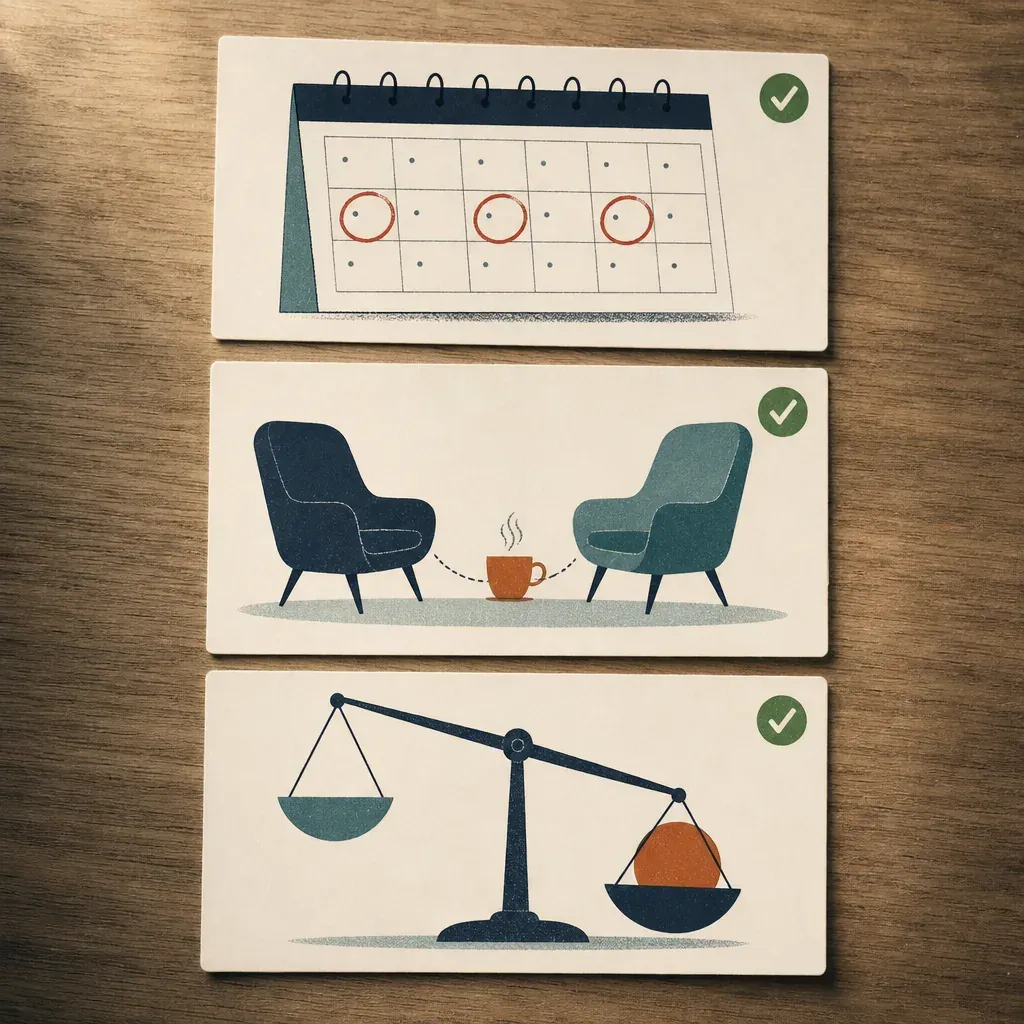
The third is over-weighting. Work ethic is a useful signal and it is also one of the easiest signals to over-weight, because hiring managers tend to like candidates who sound diligent. Recent meta-analytic work (Salgado et al., 2015) suggests even conscientiousness validity is overstated by around 30 per cent once publication bias is corrected for. Work ethic earns its row on the scorecard. It does not earn three rows under different names. Rate it once, weight it sensibly against the other capabilities the role needs, and resist the temptation to treat a polished answer as a tiebreaker.
What this changes about your next interview
The argument across this piece compresses to one line. The questions you ask about work ethic and professionalism matter less than the structure they sit inside. A great list of work ethic interview questions used inside an unstructured chat will under-perform a mediocre list used inside a structured interview with anchored ratings.
Three concrete moves are worth making this week. First, pick four behavioural prompts from the buckets in the question bank above - one each for reliability, ownership, professionalism under pressure, and persistence. Second, write anchored rating scales for each one, so a 1, a 3, and a 5 mean the same thing on every panel. Third, agree the scorecard with the interviewers before the next interview, not during it. None of those three takes more than a couple of hours, and together they convert a question list into a process the team can use the same way at the next opening, and the one after that.
Hiring for work ethic is one of the easiest places in the interview to mistake confidence for evidence. The candidate sounds diligent, the interviewer feels persuaded, and the scorecard, if there is one, gets filled in to match the impression. The fix is not better hunches. It is process - the same questions, the same scales, the same scorecard - run the same way every time.